




AI Search Ranking Factors: What Actually Influences ChatGPT, Perplexity, and AI Overviews

Last Updated on

Build Your 1st AI Agent

At least 10X Lower Cost

Fastest way to automate Growth

Build Your 1st AI Agent

At least 10X Lower Cost

Fastest way to automate Growth

TL;DR

  • AI-powered search systems parse content into knowledge components and reassemble answers from multiple sources—they don't rank pages in a list

  • Only 12% overlap exists between ChatGPT citations and Google search rankings because the selection criteria are fundamentally different

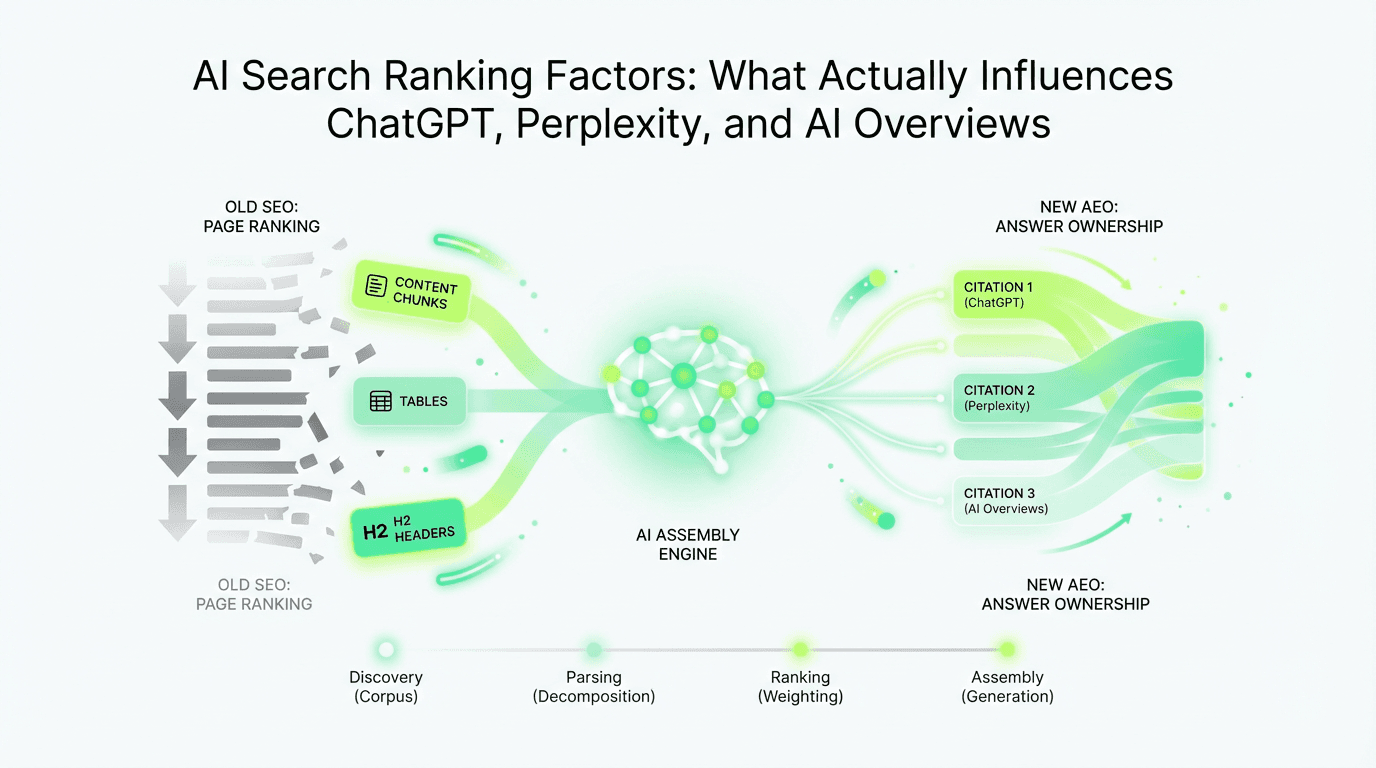
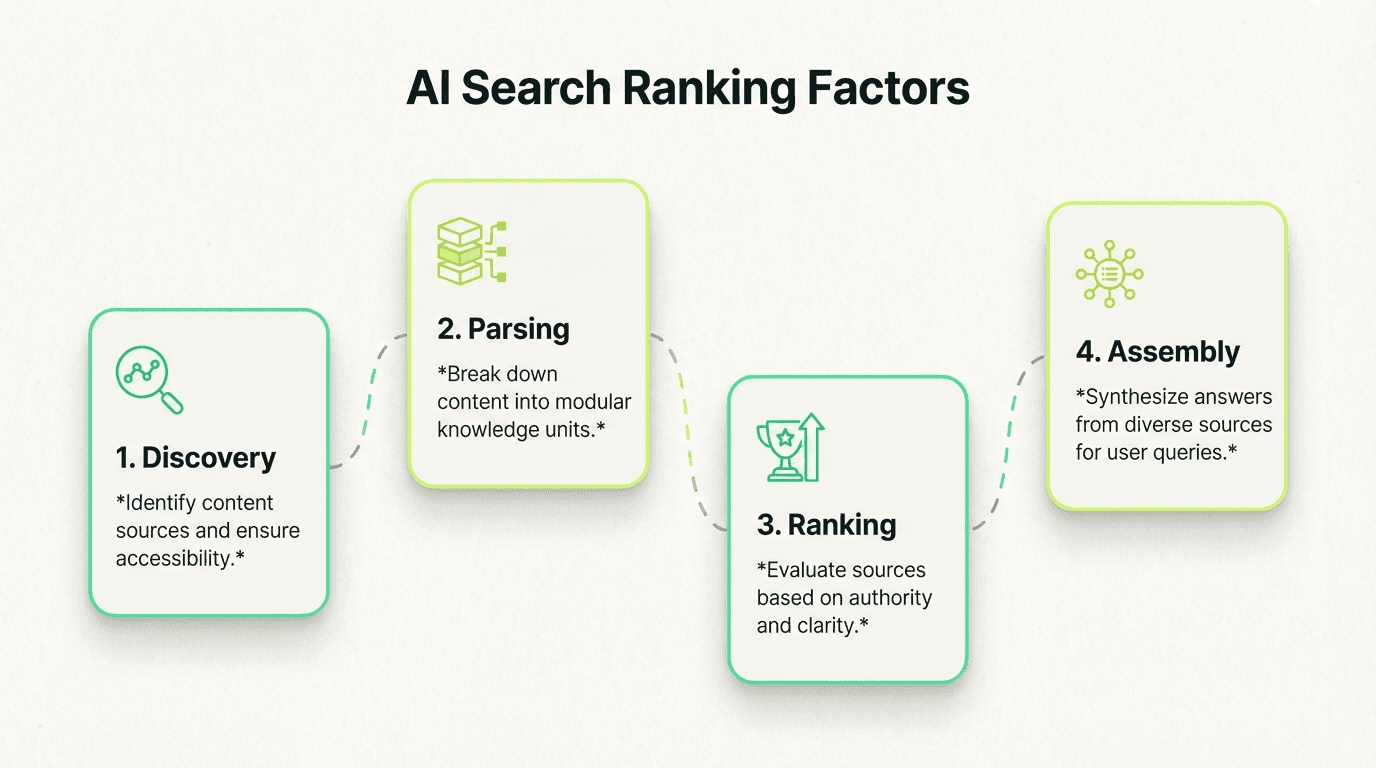
  • Four-layer model: Discovery (corpus building) → Parsing (content decomposition) → Ranking (source weighting) → Assembly (answer generation)

  • Brand mentions now outweigh backlinks as authority signals—LLMs learn from textual context and co-occurrence patterns, not link graphs

  • Semantic clarity beats keyword density—web pages must be structured for machine parsing with clear headings, Q&A formats, tables, and self-contained sections

  • Success = answer ownership—the goal is becoming the definitive source AI systems cite across thousands of query variations, not ranking for individual keywords
AI referrals to top websites spiked 357% year-over-year, reaching 1.13 billion visits by mid-2025, according to Microsoft Advertising research. Yet only 12% of quality content cited by ChatGPT overlaps with traditional Google search results, per a Profound study analyzing over 10 million AI search responses. This is a complete rewrite of the rules governing content discovery, evaluation, and citation for AI search and SEO: the rise of answer engine optimization (AEO).

Key Data Points:

  • AI referrals grew 357% year-over-year, reaching 1.13B visits (Microsoft, 2025)

  • Only 12% overlap between ChatGPT citations and Google rankings (Profound study)

  • Unlinked brand mentions show highest correlation with AI Overview inclusion (Ahrefs)

  • Reddit visibility in ChatGPT fluctuates 40-60% monthly despite direct partnership (Profound)


The gap between these data points reveals what most search engine optimization practitioners are still missing: AI-powered search engines parse content into knowledge components and reassemble them into novel answers. Your website is competing to become the definitive source that search engines cite with confidence across thousands of query variations.

We've moved from a link economy to a citation economy. The question is no longer "who links to you?" but "where does your brand appear in meaningful context, and can search algorithms parse your content cleanly enough to cite it?"

This shift—sometimes called generative engine optimization (GEO) or answer engine optimization (AEO)—requires a fundamentally different approach. When Ahrefs found that unlinked brand mentions showed the highest correlation with Google AI Overview inclusion, it confirmed what the underlying AI technology has been signaling all along: LLMs don't evaluate content the way PageRank does. They're trained on textual context, co-occurrence patterns, and semantic relationships through natural language processing, not link graphs.

The Fundamental Shift: From Ranking Pages to Citing Sources

Traditional SEO operates on a simple premise: rank entire pages in a linear list based on relevance and authority signals. AI-powered search operates on completely different mechanics. This is, practically, how search engines work in the LLM era.

Modern search engines:

  1. Parse content into modular knowledge units

  2. Rank individual chunks based on authority, clarity, and consensus

  3. Assemble multi-source answers by synthesizing the highest-confidence pieces

The 12% overlap between ChatGPT citations and Google rankings proves these are different games with different rules. Citation selection happens at the sentence and paragraph level, not the page level. A page ranking #1 for "dishwasher reviews" might contribute zero citations to ChatGPT's answer if its structure is too dense, too vague, or too difficult to parse cleanly.

The move from ranking pages to citing knowledge components represents a shift from Page Rank to Parse Rank. Your value isn't determined by where you sit in search results, but by how cleanly AI systems can decompose it into reusable knowledge and how confidently they can cite it.

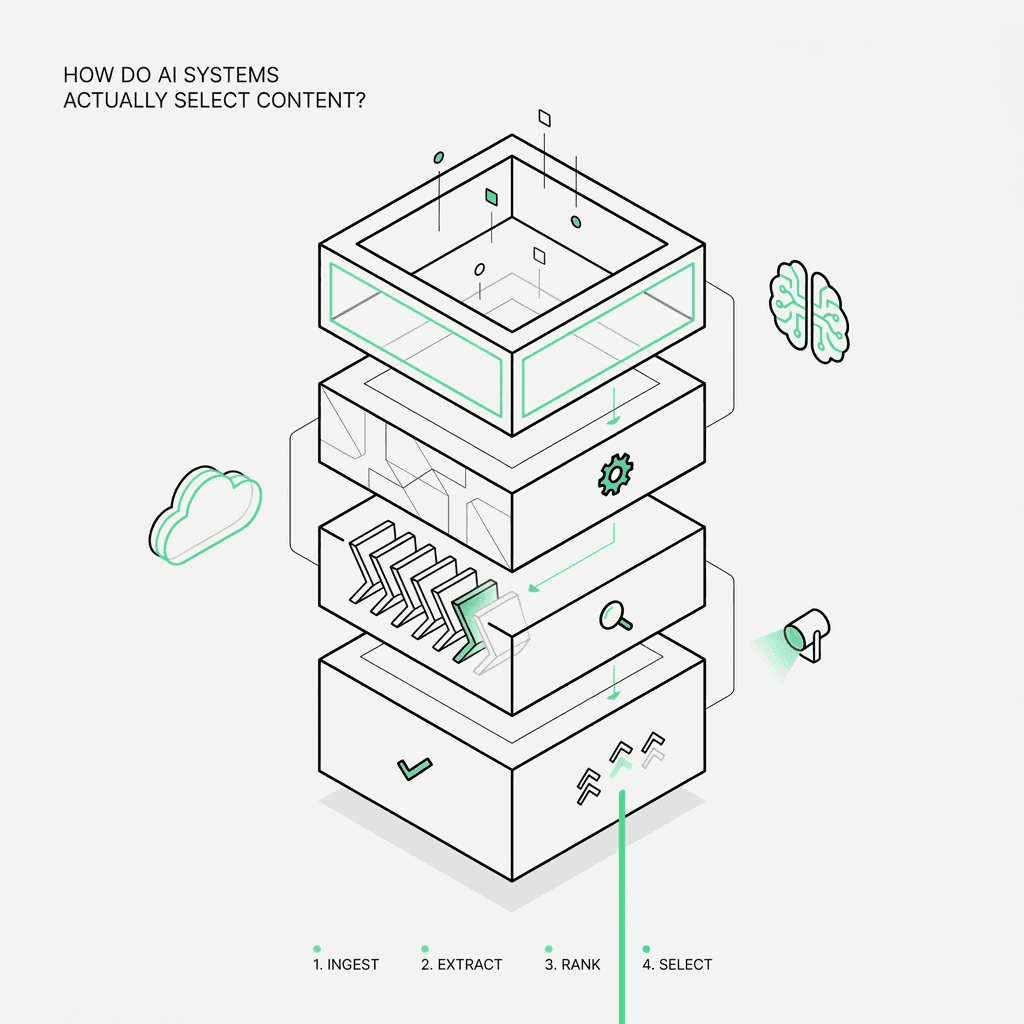
How Do AI Systems Actually Select Content? The Four-Layer Model

Understanding AI-powered search requires mapping the full pipeline from discovery to final citation—consider this a beginner's guide: how AEO works.
Layer 1: Discovery (Corpus Building)

AI models build their knowledge base from:

  • Wikipedia and high-authority reference sources

  • Bing index and CommonCrawl data

  • Direct partnerships (Reddit with OpenAI, for example)

  • Real-time indexing via protocols like IndexNow

Traditional crawling still matters as a baseline, alongside Google Search Console indexing. If your content isn't discoverable, nothing else matters. But discovery alone doesn't guarantee citation.

Layer 2: Parsing (Content Decomposition)

This is where most content fails. Machine learning systems break pages into modular knowledge units using structural signals:

  • H2/H3 headings act as parsing boundaries

  • Q&A formats provide clean question-answer pairs

  • Tables and lists enable structured data extraction

  • Hidden content (tabs, PDFs, image-only text) often gets skipped entirely

A 5,000-word comprehensive guide with no clear structure loses to a 1,500-word piece with crisp headings, tables, and self-contained sections. Parse-ability—how easily search algorithms can decompose your content into discrete, reusable knowledge units—beats comprehensiveness when the system can't extract usable knowledge—and be mindful of JavaScript SEO issues that can obscure content from parsers.

Parse-ability = how easily search engines can decompose your content into discrete, reusable knowledge units. High parse-ability means clear H2/H3 boundaries, self-contained sections, no hidden content, and explicit semantic structure.

Layer 3: Ranking (Source Weighting)

Once content is parsed, AI algorithms weight sources based on:

  • Brand mentions over backlinks — Ahrefs' research on AI Overviews found unlinked brand mentions correlated more strongly with inclusion than traditional link building metrics. LLMs learn from textual context—co-occurrence patterns matter more than PageRank. This is core to entity based SEO.

  • Consensus signals — Content that aligns with what multiple authoritative sources say gets weighted higher. Contrarian takes need stronger authority signals to overcome the consensus penalty.

  • Recency and update frequency — Fresh content with clear timestamps signals active maintenance and current accuracy.

  • Semantic clarity — Can the model understand your intent without ambiguity? Vague language ("eco-friendly dishwasher") loses to specific, measurable claims ("42 dB noise level, Energy Star certified").

Layer 4: Assembly (Answer Generation)

AI systems synthesize answers from multiple sources, reweighting based on:

  • Query-specific context (what type of answer does this search query need?)

  • User feedback loops (which citations led to satisfied users?)

  • Source diversity preferences (avoid over-relying on single sources)

The assembly layer's continuous reweighting explains why Reddit's visibility in ChatGPT fluctuates 40-60% month-over-month despite direct data partnerships, according to Profound's tracking data. Even guaranteed corpus inclusion doesn't guarantee stable citation rates. The assembly layer continuously reweights based on quality signals and user behavior. It also must handle query fan out in SEO across countless phrasings.

Do Traditional SEO Signals Still Matter for AI Search?

Title tags, meta descriptions, backlinks, internal linking—these still matter for technical SEO. They're table stakes for discovery and baseline domain authority, and core web vitals for SEO optimization fundamentals. But ranking #1 in Google search doesn't translate to citation in ChatGPT.
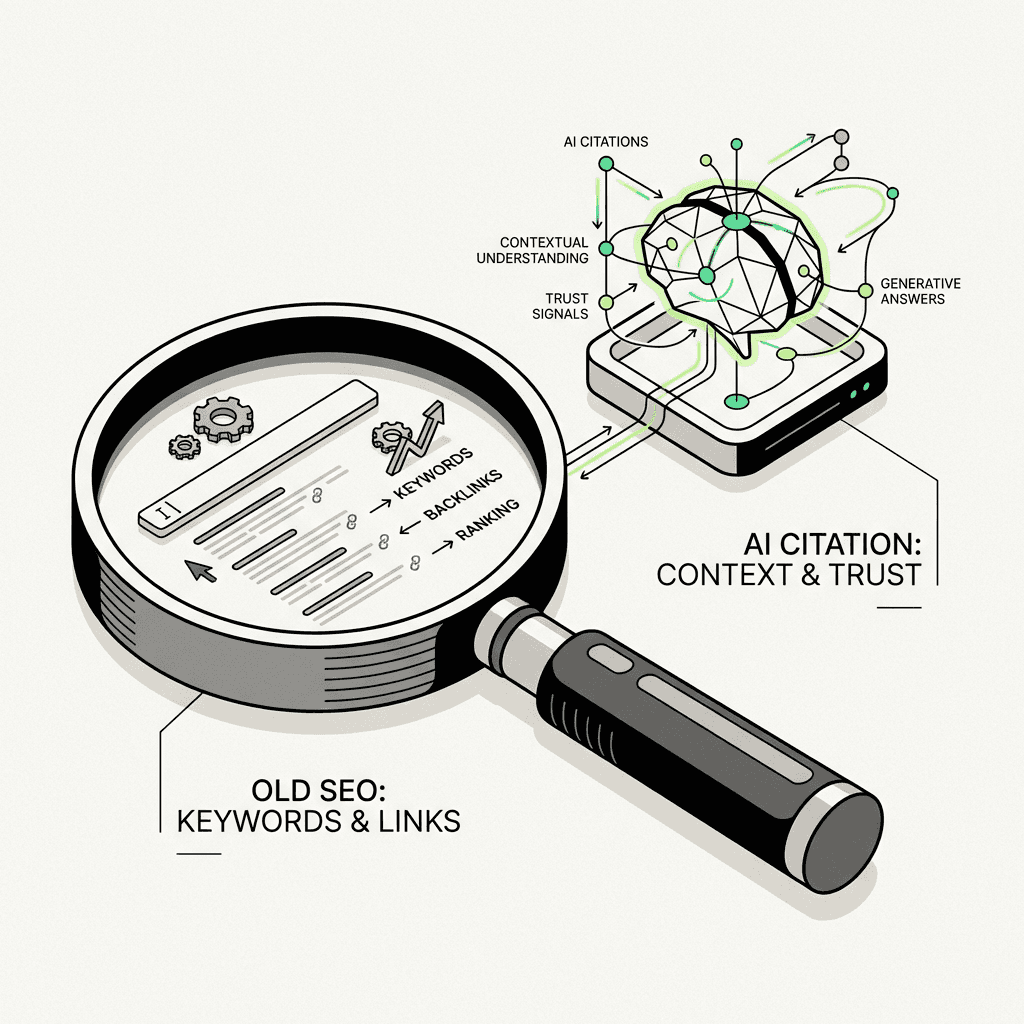
A B2B marketing automation platform with DA 65 and 2,000+ backlinks gets zero ChatGPT citations for "marketing automation" because their content is structured as dense 3,000-word guides with no H2 breaks, no tables, and no FAQ blocks. High-quality pages with perfect domain authority scores get zero AI citations when their structure is impenetrable—dense paragraphs, vague language, no clear hierarchy. The content was authoritative for humans who could parse context. But AI systems need machine readability, not just human readability.

The priority shift:

Old Model

New Model

Optimize for human readers, trust Google to figure it out

Optimize for semantic clarity and structural decomposition, which also improves user experience and scannability

Rank for keywords → drive traffic

Own answer space → become the cited source

If your search engine optimization checklist ends at "optimize title tags and build backlinks," you're optimizing for 2015. Modern search engines need content that's structured, semantically explicit, modular enough to be decomposed and reassembled, and cited across the web.

AI Search Ranking Factors: What Actually Drives Citation

Brand Authority & Entity Recognition

Unlinked mentions across high-authority sites build entity salience—how strongly your brand associates with specific topics in the corpus. A SaaS company mentioned in 50 industry roundups (even without links) signals more credibility to LLMs than 10 backlinks from low-context sources.

This shifts the game from link building to brand visibility campaigns:

  • Guest posts and bylined articles

  • Podcast appearances

  • Industry awards and recognition

  • Reddit AMAs in relevant communities

  • Expert roundups and listicles

Anywhere your brand appears in meaningful context strengthens your entity graph and improves trustworthiness signals. Make sure you're tracking brand visibility in AI search signals across these placements.

Consensus & Multi-Source Validation

Content that reflects general consensus gets weighted higher. Search algorithms look for validation across sources. Being included in listicles, rankings, and comprehensive industry guides isn't just good for backlinks—it's a consensus signal that your brand belongs in the answer. Use AI search competitor analysis tools to find the sources shaping consensus in your space.

Semantic Structure & Parse-Ability

Clear H2/H3 hierarchy defines knowledge boundaries. Q&A formats provide direct question-answer pairs. Tables enable clean data extraction. Schema markup explicitly labels content type and improves search visibility.

Example comparison:

Weak Structure

Strong Structure

"This dishwasher is very quiet and energy-efficient, making it a great choice for modern kitchens."

Q: How loud is this dishwasher?
A: 42 dB—quieter than 80% of comparable models.

Energy Efficiency: Energy Star certified, 3.5 gallons per cycle

The second version is scannable for humans and trivial for AI systems to parse and cite.

Weak (vague, pronoun-heavy): "This approach helps improve visibility. It works because the systems can understand it better. That's why it matters for rankings."

Strong (specific, self-contained): "Modular content architecture improves search visibility because LLMs can extract discrete knowledge units without surrounding context. Each H2 section functions as a standalone answer—no pronoun chains, no vague references." That level of specificity is the foundation of AI content for SEO.

Recency & Update Signals

Fresh, high-quality content with visible "last updated" timestamps signals active maintenance. Frequency of updates matters for performance metrics. Real-time indexing via IndexNow can accelerate discovery for time-sensitive content and improve organic search visibility. SEO automation tools can help maintain this cadence at scale without sacrificing quality.

Comprehensiveness & Depth

AI tools prefer comprehensive single sources over aggregating many partial sources. But comprehensiveness only works if it's structured for decomposition:

  • Tables of data

  • Multi-angle coverage (what, why, how)

  • Modular sections that work as standalone units

At scale, programmatic SEO can help generate consistent, modular pages from structured data.

Content Architecture for AI Search: Practical Implementation

Translation from theory to structure: build an AI content pipeline to consistently produce modular, parse-able assets.

Modular content design. Each H2 section should function as a standalone knowledge unit. Self-contained paragraphs that make sense when excerpted. Avoid pronoun chains ("this," "it," "that") without clear antecedents—a best practice for both user intent clarity and machine parsing.

Semantic clarity over keyword density. Write for search intent, not keyword matching. Use synonyms and related terms to reinforce meaning. Anchor vague claims in specifics: "user-friendly interface" becomes "drag-and-drop workflow builder with pre-built templates."

Schema implementation and structured data strategy:

  • Product schema for SEO for e-commerce

  • FAQ schema for Q&A content

  • Article schema with author and date metadata

  • HowTo schema for instructional guides

Formatting best practices:

  • Simple punctuation

  • Bulleted lists for key points (not every paragraph)

  • Tables for comparisons

  • Avoid hiding valuable content in tabs or PDFs

The best AI-optimized content doesn't feel robotic. It feels scannable, authoritative, and immediately useful—because that's what both user experience and machine learning systems prefer.

The Citation Economy: Why Brand Mentions Now Outweigh Backlinks

Ryan Law from Ahrefs captured this shift: "LLMs derive authority from words on the page, from the prevalence of particular words, the co-occurrence of different terms and topics." This is the move from link graphs to entity graphs.

Google taught us to chase backlinks. AI-powered search rewards contextual relevance and personalization. Strategic implications:

  • Shift budget from pure link building to brand visibility campaigns

  • Guest posts, podcast appearances, industry roundups

  • Reddit, Quora, niche forums (if relevant and informative)

  • Digital PR for unlinked mentions and digital marketing exposure

Where does your brand appear in meaningful conversations about your topic? That's what drives user engagement and citation authority in the age of generative AI. Augment outreach with AI visibility tools to prioritize high-context placements.

ChatGPT SEO vs. Perplexity Optimization: Key Differences

You can't "optimize for AI search" generically, but you can build content that meets shared criteria across platforms and improves overall search experience.

Platform

Primary Data Source

Citation Style

Recency Emphasis

Authority Signals

ChatGPT

CommonCrawl, Wikipedia, Reddit

Inline (sometimes)

Moderate

Consensus + comprehensiveness

Perplexity

Real-time web search

Always visible

High

Source diversity + freshness

AI Overviews

Google index

Embedded in answer

Moderate

E-E-A-T + existing rankings

ChatGPT favors consensus and comprehensive single sources. Trained on CommonCrawl, Wikipedia, books, and Reddit partnership data. Citation volatility shows active reweighting based on quality signals and user behavior patterns.

Perplexity emphasizes recency through real-time web search integration. Shows live citations for transparency. Prefers source diversity and answers user queries with multiple perspectives.

Google AI Overviews draws from Google's existing search engine results with strong E-E-A-T weighting. Author authority matters. Often (but not exclusively) cites content already ranking well in organic search and featured snippets.

The shared criteria: structured, authoritative, semantically clear, relevant to search intent, and cited across the web.

The Strategic Shift: From Traffic Acquisition to Answer Ownership

Strategic implications for digital marketing:

  • Invest in comprehensive, definitive content (not thin keyword targets)

  • Build brand presence across high-authority platforms

  • Update and maintain content (recency signals compound)

  • Think in topic clusters, not individual keywords

Metrics that matter (build a SEO KPIs framework):

  • Citation frequency across AI platforms

  • Source diversity (mentioned in how many contexts)

  • Topic authority (entity salience in your niche)

  • User engagement rates and click-through rate from AI citations

  • Conversions from AI referral traffic

The companies winning in AI-powered search aren't chasing rankings. They're building content so authoritative that search engines can't answer questions in their space without citing them.

How to Audit Your Content for AI Search

Search engine optimization taught us to optimize for algorithms. AI-powered search rewards optimization for understanding—which is what quality content has always required.
Here's how to audit your content against the four-layer model:

Discovery Audit

Is your content in the Bing index? Check via site:yourdomain.com search in Bing. Implement IndexNow for real-time inclusion. Verify your sitemap is submitted to Bing Webmaster Tools and that Google Search Console indexing is healthy.

Parsing Audit

Can you extract clear answers from each H2 section without reading surrounding context? Open your top 10 web pages. Read each H2 section in isolation. If you can't understand the point without scrolling up or down, restructure for self-contained knowledge units. Use AI content evaluation to catch ambiguous or underspecified sections before publishing.

Checklist:

  • Does each H2 section work as a standalone answer?

  • Are there pronoun chains ("this," "it," "that") without clear antecedents?

  • Is key information hidden in tabs, accordions, or PDFs?

  • Do you use tables and lists for structured data?

  • Is your content formatted with clear visual hierarchy and mobile-friendly design?

  • Have you optimized page speed and core web vitals SEO for better user experience?

Ranking Audit

How strong is your entity salience? Search "your brand + your topic" in Google. How many unlinked mentions appear in the top 50 search engine results? Track this as your baseline. Track progress with AI visibility tools.

Checklist:

  • Where does your brand appear in industry roundups, listicles, and comparison guides?

  • Do you have clear "last updated" timestamps on content?

  • Is your language semantically specific or vague?

  • Do multiple authoritative sources validate your claims with accuracy?

  • Are you monitoring SERP features like featured snippets and AI Overviews?

Assembly Audit

Are you actually being cited? Ask ChatGPT and Perplexity questions your content should answer based on user intent and search queries. Are you cited? If not, your content lacks sufficient authority signals, parse-ability, or both.
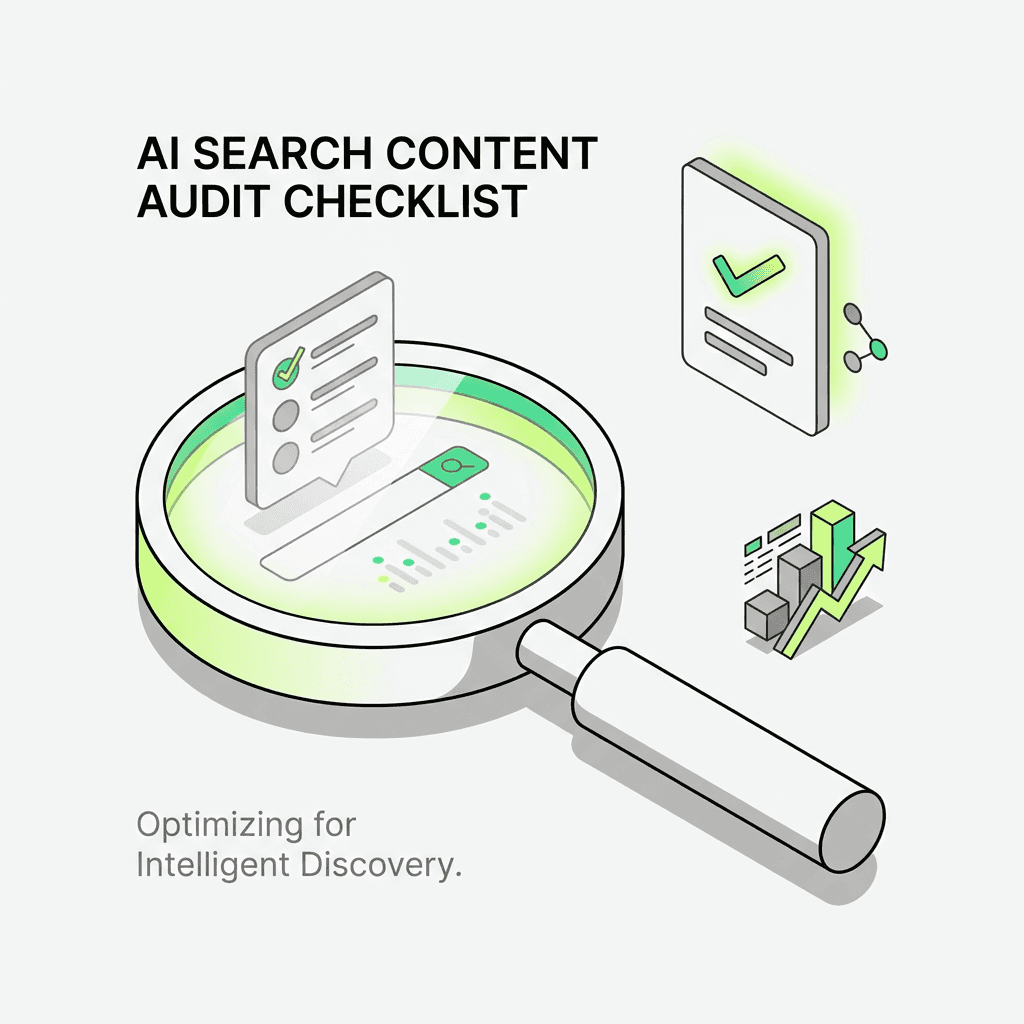
Checklist:

  • Test 10 core queries your content targets

  • Document which platforms cite you and which don't

  • Analyze cited competitors with AI search competitor analysis tools: what structural patterns do they use?

  • Check if you're appearing in voice search results and conversational AI responses

Prioritization Framework

If you have 2 hours: Audit your top 5 pages for parse-ability. Add clear H2s, convert dense paragraphs to bulleted lists, eliminate pronoun chains, add "last updated" timestamps, and verify mobile-friendly formatting.

If you have 2 weeks: Implement FAQ and Article schema on cornerstone content. Restructure your highest-traffic pages with modular H2 sections, tables for comparisons, and self-contained paragraphs. Optimize for core web vitals SEO and page speed to improve overall user experience, and stand up an AI SEO publishing pipeline.

If you have 2 months: Launch a brand visibility campaign. Identify 20 industry roundups, listicles, and comparison guides where your brand should appear. Pitch guest posts, podcast appearances, and expert quotes to build unlinked mentions. Focus on strategies that improve both online visibility and domain authority through contextual relevance rather than traditional link building. Consider off page SEO automation to scale outreach thoughtfully.

The shift to AI-powered search accelerates the trend toward quality over quantity, depth over volume, and structural clarity over keyword density. The citation economy rewards content that search engines trust enough to cite with confidence.

The content that wins isn't the content that ranks highest in search results. It's the content that AI systems can parse cleanly, validate through consensus, and cite across thousands of search queries—delivering valuable insights that match user intent while maintaining accuracy, relevance, and trustworthiness in an era dominated by machine learning and natural language processing.

FAQs

What are AI search ranking factors in 2026?

AI search ranking factors are the signals AI systems use to decide which sources (and which passages) to cite when generating answers in ChatGPT, Perplexity, or Google AI Overviews. They tend to prioritize parse-able structure, semantic clarity, consensus, recency signals, and brand/entity authority—not just classic "rank a page" SEO factors. In practice, they often evaluate content at the chunk (sentence/paragraph) level rather than the page level.

Why is there only limited overlap between Google rankings and ChatGPT citations?

ChatGPT citation selection is typically chunk-based (which passage is easiest to extract and trust), while Google's classic results rank whole pages using different weighting systems. A page can rank well but still be difficult to parse into clean, self-contained knowledge units, causing it to contribute zero usable citations. This difference in selection mechanics explains why "ranking well" doesn't reliably translate into "getting cited."

How do AI systems choose what to cite: discovery, parsing, ranking, and assembly?

Most AI answer systems follow a pipeline: (1) Discovery builds a corpus via indexes and large web crawls, (2) Parsing decomposes pages into knowledge units using headings/lists/tables, (3) Ranking weights sources using trust, entity signals, consensus, and clarity, and (4) Assembly synthesizes an answer and selects citations that best support the final response. If you fail at parsing (structure) or ranking (trust/authority), you can be discoverable but still not cited.

Do backlinks still matter for AI visibility, or do brand mentions matter more?

Backlinks still help with baseline discovery and authority in traditional search systems, but AI-driven citation often leans heavily on entity/brand mentions in meaningful context. Unlinked mentions can strengthen entity recognition because LLMs learn from text co-occurrence patterns and topic associations, not just link graphs. The practical takeaway is to pair technical SEO with brand visibility across relevant, high-context publications and communities.

What is "parse-ability," and how do I improve it for AI citations?

Parse-ability is how easily an AI system can split your page into reusable, self-contained knowledge units. Improve it by using clear H2/H3 boundaries, writing short sections that stand alone, converting dense paragraphs into lists/tables, and adding Q&A blocks where the question is explicit and the answer is direct. Avoid hiding key text in tabs/accordions or PDFs if you want it reliably extracted.

What content structure gets cited more often by ChatGPT and Perplexity?

Structures that produce "answer capsules" tend to win: question-style headings, 2-4 sentence direct answers, definitional statements, step lists, and comparison tables. Keep pronouns unambiguous (avoid "this/it/that" without clear nouns) so excerpts make sense out of context. Add visible timestamps ("last updated") when recency matters, since many systems reward freshness signals.

How is optimizing for Perplexity different from optimizing for ChatGPT?

Perplexity leans more on real-time web retrieval and typically displays citations prominently, so recency, source diversity, and up-to-date pages matter more. ChatGPT-style systems often reward consensus and comprehensive coverage that's easy to excerpt, with citation behavior that can be more volatile across time and queries. The overlap strategy is the same: publish cleanly structured, semantically explicit content that can be validated across multiple authoritative sources.

How do I audit a page to improve AI citation rates?

Test each H2 section in isolation: if the section can't be understood without scrolling for context, rewrite it into a standalone mini-answer. Then check discovery basics (indexing, crawlability), add structure (lists/tables/FAQ blocks), and strengthen authority signals (credible references, consistent author/date metadata, brand mentions in relevant contexts). Finally, run "citation checks" by asking AI systems the exact questions your page answers and comparing what they cite.

What does "answer ownership" mean in AEO/GEO?

Answer ownership means becoming the source AI systems repeatedly cite across many query variations—not just ranking for one keyword. It requires (1) coverage that matches intent, (2) modular sections that can be extracted cleanly, and (3) authority signals that make the content easy to trust and validate. Tools like Metaflow can help operationalize this by turning AEO structure (modular sections, FAQs, updates, schema) into a repeatable publishing workflow rather than one-off optimization.

TL;DR

  • AI-powered search systems parse content into knowledge components and reassemble answers from multiple sources—they don't rank pages in a list

  • Only 12% overlap exists between ChatGPT citations and Google search rankings because the selection criteria are fundamentally different

  • Four-layer model: Discovery (corpus building) → Parsing (content decomposition) → Ranking (source weighting) → Assembly (answer generation)

  • Brand mentions now outweigh backlinks as authority signals—LLMs learn from textual context and co-occurrence patterns, not link graphs

  • Semantic clarity beats keyword density—web pages must be structured for machine parsing with clear headings, Q&A formats, tables, and self-contained sections

  • Success = answer ownership—the goal is becoming the definitive source AI systems cite across thousands of query variations, not ranking for individual keywords

AI referrals to top websites spiked 357% year-over-year, reaching 1.13 billion visits by mid-2025, according to Microsoft Advertising research. Yet only 12% of quality content cited by ChatGPT overlaps with traditional Google search results, per a Profound study analyzing over 10 million AI search responses. This is a complete rewrite of the rules governing content discovery, evaluation, and citation for AI search and SEO: the rise of answer engine optimization (AEO).

Key Data Points:

  • AI referrals grew 357% year-over-year, reaching 1.13B visits (Microsoft, 2025)

  • Only 12% overlap between ChatGPT citations and Google rankings (Profound study)

  • Unlinked brand mentions show highest correlation with AI Overview inclusion (Ahrefs)

  • Reddit visibility in ChatGPT fluctuates 40-60% monthly despite direct partnership (Profound)


The gap between these data points reveals what most search engine optimization practitioners are still missing: AI-powered search engines parse content into knowledge components and reassemble them into novel answers. Your website is competing to become the definitive source that search engines cite with confidence across thousands of query variations.

We've moved from a link economy to a citation economy. The question is no longer "who links to you?" but "where does your brand appear in meaningful context, and can search algorithms parse your content cleanly enough to cite it?"

This shift—sometimes called generative engine optimization (GEO) or answer engine optimization (AEO)—requires a fundamentally different approach. When Ahrefs found that unlinked brand mentions showed the highest correlation with Google AI Overview inclusion, it confirmed what the underlying AI technology has been signaling all along: LLMs don't evaluate content the way PageRank does. They're trained on textual context, co-occurrence patterns, and semantic relationships through natural language processing, not link graphs.

The Fundamental Shift: From Ranking Pages to Citing Sources

Traditional SEO operates on a simple premise: rank entire pages in a linear list based on relevance and authority signals. AI-powered search operates on completely different mechanics. This is, practically, how search engines work in the LLM era.

Modern search engines:

  1. Parse content into modular knowledge units

  2. Rank individual chunks based on authority, clarity, and consensus

  3. Assemble multi-source answers by synthesizing the highest-confidence pieces

The 12% overlap between ChatGPT citations and Google rankings proves these are different games with different rules. Citation selection happens at the sentence and paragraph level, not the page level. A page ranking #1 for "dishwasher reviews" might contribute zero citations to ChatGPT's answer if its structure is too dense, too vague, or too difficult to parse cleanly.

The move from ranking pages to citing knowledge components represents a shift from Page Rank to Parse Rank. Your value isn't determined by where you sit in search results, but by how cleanly AI systems can decompose it into reusable knowledge and how confidently they can cite it.

How Do AI Systems Actually Select Content? The Four-Layer Model

Understanding AI-powered search requires mapping the full pipeline from discovery to final citation—consider this a beginner's guide: how AEO works.

Layer 1: Discovery (Corpus Building)

AI models build their knowledge base from:

  • Wikipedia and high-authority reference sources

  • Bing index and CommonCrawl data

  • Direct partnerships (Reddit with OpenAI, for example)

  • Real-time indexing via protocols like IndexNow

Traditional crawling still matters as a baseline, alongside Google Search Console indexing. If your content isn't discoverable, nothing else matters. But discovery alone doesn't guarantee citation.

Layer 2: Parsing (Content Decomposition)

This is where most content fails. Machine learning systems break pages into modular knowledge units using structural signals:

  • H2/H3 headings act as parsing boundaries

  • Q&A formats provide clean question-answer pairs

  • Tables and lists enable structured data extraction

  • Hidden content (tabs, PDFs, image-only text) often gets skipped entirely

A 5,000-word comprehensive guide with no clear structure loses to a 1,500-word piece with crisp headings, tables, and self-contained sections. Parse-ability—how easily search algorithms can decompose your content into discrete, reusable knowledge units—beats comprehensiveness when the system can't extract usable knowledge—and be mindful of JavaScript SEO issues that can obscure content from parsers.

Parse-ability = how easily search engines can decompose your content into discrete, reusable knowledge units. High parse-ability means clear H2/H3 boundaries, self-contained sections, no hidden content, and explicit semantic structure.

Layer 3: Ranking (Source Weighting)

Once content is parsed, AI algorithms weight sources based on:

  • Brand mentions over backlinks — Ahrefs' research on AI Overviews found unlinked brand mentions correlated more strongly with inclusion than traditional link building metrics. LLMs learn from textual context—co-occurrence patterns matter more than PageRank. This is core to entity based SEO.

  • Consensus signals — Content that aligns with what multiple authoritative sources say gets weighted higher. Contrarian takes need stronger authority signals to overcome the consensus penalty.

  • Recency and update frequency — Fresh content with clear timestamps signals active maintenance and current accuracy.

  • Semantic clarity — Can the model understand your intent without ambiguity? Vague language ("eco-friendly dishwasher") loses to specific, measurable claims ("42 dB noise level, Energy Star certified").

Layer 4: Assembly (Answer Generation)

AI systems synthesize answers from multiple sources, reweighting based on:

  • Query-specific context (what type of answer does this search query need?)

  • User feedback loops (which citations led to satisfied users?)

  • Source diversity preferences (avoid over-relying on single sources)

The assembly layer's continuous reweighting explains why Reddit's visibility in ChatGPT fluctuates 40-60% month-over-month despite direct data partnerships, according to Profound's tracking data. Even guaranteed corpus inclusion doesn't guarantee stable citation rates. The assembly layer continuously reweights based on quality signals and user behavior. It also must handle query fan out in SEO across countless phrasings.

Do Traditional SEO Signals Still Matter for AI Search?

Title tags, meta descriptions, backlinks, internal linking—these still matter for technical SEO. They're table stakes for discovery and baseline domain authority, and core web vitals for SEO optimization fundamentals. But ranking #1 in Google search doesn't translate to citation in ChatGPT.

A B2B marketing automation platform with DA 65 and 2,000+ backlinks gets zero ChatGPT citations for "marketing automation" because their content is structured as dense 3,000-word guides with no H2 breaks, no tables, and no FAQ blocks. High-quality pages with perfect domain authority scores get zero AI citations when their structure is impenetrable—dense paragraphs, vague language, no clear hierarchy. The content was authoritative for humans who could parse context. But AI systems need machine readability, not just human readability.

The priority shift:

Old Model

New Model

Optimize for human readers, trust Google to figure it out

Optimize for semantic clarity and structural decomposition, which also improves user experience and scannability

Rank for keywords → drive traffic

Own answer space → become the cited source

If your search engine optimization checklist ends at "optimize title tags and build backlinks," you're optimizing for 2015. Modern search engines need content that's structured, semantically explicit, modular enough to be decomposed and reassembled, and cited across the web.

AI Search Ranking Factors: What Actually Drives Citation

Brand Authority & Entity Recognition

Unlinked mentions across high-authority sites build entity salience—how strongly your brand associates with specific topics in the corpus. A SaaS company mentioned in 50 industry roundups (even without links) signals more credibility to LLMs than 10 backlinks from low-context sources.

This shifts the game from link building to brand visibility campaigns:

  • Guest posts and bylined articles

  • Podcast appearances

  • Industry awards and recognition

  • Reddit AMAs in relevant communities

  • Expert roundups and listicles

Anywhere your brand appears in meaningful context strengthens your entity graph and improves trustworthiness signals. Make sure you're tracking brand visibility in AI search signals across these placements.

Consensus & Multi-Source Validation

Content that reflects general consensus gets weighted higher. Search algorithms look for validation across sources. Being included in listicles, rankings, and comprehensive industry guides isn't just good for backlinks—it's a consensus signal that your brand belongs in the answer. Use AI search competitor analysis tools to find the sources shaping consensus in your space.

Semantic Structure & Parse-Ability

Clear H2/H3 hierarchy defines knowledge boundaries. Q&A formats provide direct question-answer pairs. Tables enable clean data extraction. Schema markup explicitly labels content type and improves search visibility.

Example comparison:

Weak Structure

Strong Structure

"This dishwasher is very quiet and energy-efficient, making it a great choice for modern kitchens."

Q: How loud is this dishwasher?
A: 42 dB—quieter than 80% of comparable models.

Energy Efficiency: Energy Star certified, 3.5 gallons per cycle

The second version is scannable for humans and trivial for AI systems to parse and cite.

Weak (vague, pronoun-heavy): "This approach helps improve visibility. It works because the systems can understand it better. That's why it matters for rankings."

Strong (specific, self-contained): "Modular content architecture improves search visibility because LLMs can extract discrete knowledge units without surrounding context. Each H2 section functions as a standalone answer—no pronoun chains, no vague references." That level of specificity is the foundation of AI content for SEO.

Recency & Update Signals

Fresh, high-quality content with visible "last updated" timestamps signals active maintenance. Frequency of updates matters for performance metrics. Real-time indexing via IndexNow can accelerate discovery for time-sensitive content and improve organic search visibility. SEO automation tools can help maintain this cadence at scale without sacrificing quality.

Comprehensiveness & Depth

AI tools prefer comprehensive single sources over aggregating many partial sources. But comprehensiveness only works if it's structured for decomposition:

  • Tables of data

  • Multi-angle coverage (what, why, how)

  • Modular sections that work as standalone units

At scale, programmatic SEO can help generate consistent, modular pages from structured data.

Content Architecture for AI Search: Practical Implementation

Translation from theory to structure: build an AI content pipeline to consistently produce modular, parse-able assets.

Modular content design. Each H2 section should function as a standalone knowledge unit. Self-contained paragraphs that make sense when excerpted. Avoid pronoun chains ("this," "it," "that") without clear antecedents—a best practice for both user intent clarity and machine parsing.

Semantic clarity over keyword density. Write for search intent, not keyword matching. Use synonyms and related terms to reinforce meaning. Anchor vague claims in specifics: "user-friendly interface" becomes "drag-and-drop workflow builder with pre-built templates."

Schema implementation and structured data strategy:

  • Product schema for SEO for e-commerce

  • FAQ schema for Q&A content

  • Article schema with author and date metadata

  • HowTo schema for instructional guides

Formatting best practices:

  • Simple punctuation

  • Bulleted lists for key points (not every paragraph)

  • Tables for comparisons

  • Avoid hiding valuable content in tabs or PDFs

The best AI-optimized content doesn't feel robotic. It feels scannable, authoritative, and immediately useful—because that's what both user experience and machine learning systems prefer.

The Citation Economy: Why Brand Mentions Now Outweigh Backlinks

Ryan Law from Ahrefs captured this shift: "LLMs derive authority from words on the page, from the prevalence of particular words, the co-occurrence of different terms and topics." This is the move from link graphs to entity graphs.

Google taught us to chase backlinks. AI-powered search rewards contextual relevance and personalization. Strategic implications:

  • Shift budget from pure link building to brand visibility campaigns

  • Guest posts, podcast appearances, industry roundups

  • Reddit, Quora, niche forums (if relevant and informative)

  • Digital PR for unlinked mentions and digital marketing exposure

Where does your brand appear in meaningful conversations about your topic? That's what drives user engagement and citation authority in the age of generative AI. Augment outreach with AI visibility tools to prioritize high-context placements.

ChatGPT SEO vs. Perplexity Optimization: Key Differences

You can't "optimize for AI search" generically, but you can build content that meets shared criteria across platforms and improves overall search experience.

Platform

Primary Data Source

Citation Style

Recency Emphasis

Authority Signals

ChatGPT

CommonCrawl, Wikipedia, Reddit

Inline (sometimes)

Moderate

Consensus + comprehensiveness

Perplexity

Real-time web search

Always visible

High

Source diversity + freshness

AI Overviews

Google index

Embedded in answer

Moderate

E-E-A-T + existing rankings

ChatGPT favors consensus and comprehensive single sources. Trained on CommonCrawl, Wikipedia, books, and Reddit partnership data. Citation volatility shows active reweighting based on quality signals and user behavior patterns.

Perplexity emphasizes recency through real-time web search integration. Shows live citations for transparency. Prefers source diversity and answers user queries with multiple perspectives.

Google AI Overviews draws from Google's existing search engine results with strong E-E-A-T weighting. Author authority matters. Often (but not exclusively) cites content already ranking well in organic search and featured snippets.

The shared criteria: structured, authoritative, semantically clear, relevant to search intent, and cited across the web.

The Strategic Shift: From Traffic Acquisition to Answer Ownership

Strategic implications for digital marketing:

  • Invest in comprehensive, definitive content (not thin keyword targets)

  • Build brand presence across high-authority platforms

  • Update and maintain content (recency signals compound)

  • Think in topic clusters, not individual keywords

Metrics that matter (build a SEO KPIs framework):

  • Citation frequency across AI platforms

  • Source diversity (mentioned in how many contexts)

  • Topic authority (entity salience in your niche)

  • User engagement rates and click-through rate from AI citations

  • Conversions from AI referral traffic

The companies winning in AI-powered search aren't chasing rankings. They're building content so authoritative that search engines can't answer questions in their space without citing them.

How to Audit Your Content for AI Search

Search engine optimization taught us to optimize for algorithms. AI-powered search rewards optimization for understanding—which is what quality content has always required.

Here's how to audit your content against the four-layer model:

Discovery Audit

Is your content in the Bing index? Check via site:yourdomain.com search in Bing. Implement IndexNow for real-time inclusion. Verify your sitemap is submitted to Bing Webmaster Tools and that Google Search Console indexing is healthy.

Parsing Audit

Can you extract clear answers from each H2 section without reading surrounding context? Open your top 10 web pages. Read each H2 section in isolation. If you can't understand the point without scrolling up or down, restructure for self-contained knowledge units. Use AI content evaluation to catch ambiguous or underspecified sections before publishing.

Checklist:

  • Does each H2 section work as a standalone answer?

  • Are there pronoun chains ("this," "it," "that") without clear antecedents?

  • Is key information hidden in tabs, accordions, or PDFs?

  • Do you use tables and lists for structured data?

  • Is your content formatted with clear visual hierarchy and mobile-friendly design?

  • Have you optimized page speed and core web vitals SEO for better user experience?

Ranking Audit

How strong is your entity salience? Search "your brand + your topic" in Google. How many unlinked mentions appear in the top 50 search engine results? Track this as your baseline. Track progress with AI visibility tools.

Checklist:

  • Where does your brand appear in industry roundups, listicles, and comparison guides?

  • Do you have clear "last updated" timestamps on content?

  • Is your language semantically specific or vague?

  • Do multiple authoritative sources validate your claims with accuracy?

  • Are you monitoring SERP features like featured snippets and AI Overviews?

Assembly Audit

Are you actually being cited? Ask ChatGPT and Perplexity questions your content should answer based on user intent and search queries. Are you cited? If not, your content lacks sufficient authority signals, parse-ability, or both.

Checklist:

  • Test 10 core queries your content targets

  • Document which platforms cite you and which don't

  • Analyze cited competitors with AI search competitor analysis tools: what structural patterns do they use?

  • Check if you're appearing in voice search results and conversational AI responses

Prioritization Framework

If you have 2 hours: Audit your top 5 pages for parse-ability. Add clear H2s, convert dense paragraphs to bulleted lists, eliminate pronoun chains, add "last updated" timestamps, and verify mobile-friendly formatting.

If you have 2 weeks: Implement FAQ and Article schema on cornerstone content. Restructure your highest-traffic pages with modular H2 sections, tables for comparisons, and self-contained paragraphs. Optimize for core web vitals SEO and page speed to improve overall user experience, and stand up an AI SEO publishing pipeline.

If you have 2 months: Launch a brand visibility campaign. Identify 20 industry roundups, listicles, and comparison guides where your brand should appear. Pitch guest posts, podcast appearances, and expert quotes to build unlinked mentions. Focus on strategies that improve both online visibility and domain authority through contextual relevance rather than traditional link building. Consider off page SEO automation to scale outreach thoughtfully.

The shift to AI-powered search accelerates the trend toward quality over quantity, depth over volume, and structural clarity over keyword density. The citation economy rewards content that search engines trust enough to cite with confidence.

The content that wins isn't the content that ranks highest in search results. It's the content that AI systems can parse cleanly, validate through consensus, and cite across thousands of search queries—delivering valuable insights that match user intent while maintaining accuracy, relevance, and trustworthiness in an era dominated by machine learning and natural language processing.

FAQs

What are AI search ranking factors in 2026?

AI search ranking factors are the signals AI systems use to decide which sources (and which passages) to cite when generating answers in ChatGPT, Perplexity, or Google AI Overviews. They tend to prioritize parse-able structure, semantic clarity, consensus, recency signals, and brand/entity authority—not just classic "rank a page" SEO factors. In practice, they often evaluate content at the chunk (sentence/paragraph) level rather than the page level.

Why is there only limited overlap between Google rankings and ChatGPT citations?

ChatGPT citation selection is typically chunk-based (which passage is easiest to extract and trust), while Google's classic results rank whole pages using different weighting systems. A page can rank well but still be difficult to parse into clean, self-contained knowledge units, causing it to contribute zero usable citations. This difference in selection mechanics explains why "ranking well" doesn't reliably translate into "getting cited."

How do AI systems choose what to cite: discovery, parsing, ranking, and assembly?

Most AI answer systems follow a pipeline: (1) Discovery builds a corpus via indexes and large web crawls, (2) Parsing decomposes pages into knowledge units using headings/lists/tables, (3) Ranking weights sources using trust, entity signals, consensus, and clarity, and (4) Assembly synthesizes an answer and selects citations that best support the final response. If you fail at parsing (structure) or ranking (trust/authority), you can be discoverable but still not cited.

Do backlinks still matter for AI visibility, or do brand mentions matter more?

Backlinks still help with baseline discovery and authority in traditional search systems, but AI-driven citation often leans heavily on entity/brand mentions in meaningful context. Unlinked mentions can strengthen entity recognition because LLMs learn from text co-occurrence patterns and topic associations, not just link graphs. The practical takeaway is to pair technical SEO with brand visibility across relevant, high-context publications and communities.

What is "parse-ability," and how do I improve it for AI citations?

Parse-ability is how easily an AI system can split your page into reusable, self-contained knowledge units. Improve it by using clear H2/H3 boundaries, writing short sections that stand alone, converting dense paragraphs into lists/tables, and adding Q&A blocks where the question is explicit and the answer is direct. Avoid hiding key text in tabs/accordions or PDFs if you want it reliably extracted.

What content structure gets cited more often by ChatGPT and Perplexity?

Structures that produce "answer capsules" tend to win: question-style headings, 2-4 sentence direct answers, definitional statements, step lists, and comparison tables. Keep pronouns unambiguous (avoid "this/it/that" without clear nouns) so excerpts make sense out of context. Add visible timestamps ("last updated") when recency matters, since many systems reward freshness signals.

How is optimizing for Perplexity different from optimizing for ChatGPT?

Perplexity leans more on real-time web retrieval and typically displays citations prominently, so recency, source diversity, and up-to-date pages matter more. ChatGPT-style systems often reward consensus and comprehensive coverage that's easy to excerpt, with citation behavior that can be more volatile across time and queries. The overlap strategy is the same: publish cleanly structured, semantically explicit content that can be validated across multiple authoritative sources.

How do I audit a page to improve AI citation rates?

Test each H2 section in isolation: if the section can't be understood without scrolling for context, rewrite it into a standalone mini-answer. Then check discovery basics (indexing, crawlability), add structure (lists/tables/FAQ blocks), and strengthen authority signals (credible references, consistent author/date metadata, brand mentions in relevant contexts). Finally, run "citation checks" by asking AI systems the exact questions your page answers and comparing what they cite.

What does "answer ownership" mean in AEO/GEO?

Answer ownership means becoming the source AI systems repeatedly cite across many query variations—not just ranking for one keyword. It requires (1) coverage that matches intent, (2) modular sections that can be extracted cleanly, and (3) authority signals that make the content easy to trust and validate. Tools like Metaflow can help operationalize this by turning AEO structure (modular sections, FAQs, updates, schema) into a repeatable publishing workflow rather than one-off optimization.

Run an SEO Agent

Out-of-the box Growth Agents

Comes with search data

Fully Cutomizable

Run an SEO Agent

Out-of-the box Growth Agents

Comes with search data

Fully Cutomizable

Get Geared for Growth.

Get Geared for Growth.

Get Geared for Growth.