






TL;DR
Metaflow is a no-code agentic marketing platform that turns AI content experiments into versioned, reproducible publishing systems for growth teams
Build agents and skills visually — no engineers required — to orchestrate research, drafting, SEO validation, publishing, and measurement as one continuous flow
Each agent owns a stage; sub-agents handle specialized tasks like keyword extraction, competitor scraping, AEO scoring, and CMS deployment
Every run is versioned: prompts, briefs, drafts, lint reports, and published URLs stay traceable months or quarters later
Built-in QA gates pause runs for human review before publishing — keyword density, readability, word count, and brand voice surface as readable scorecards
Connects to your existing stack: Ahrefs, SEMrush, Google Search Console, WordPress, Webflow, GA4, Slack, and more
Real-world use cases: programmatic SEO at scale, content refresh loops, multi-channel repurposing, and regulated-industry approval workflows
The infrastructure layer that makes AI SEO agents and AI marketing agents production-ready — not fragile prototypes
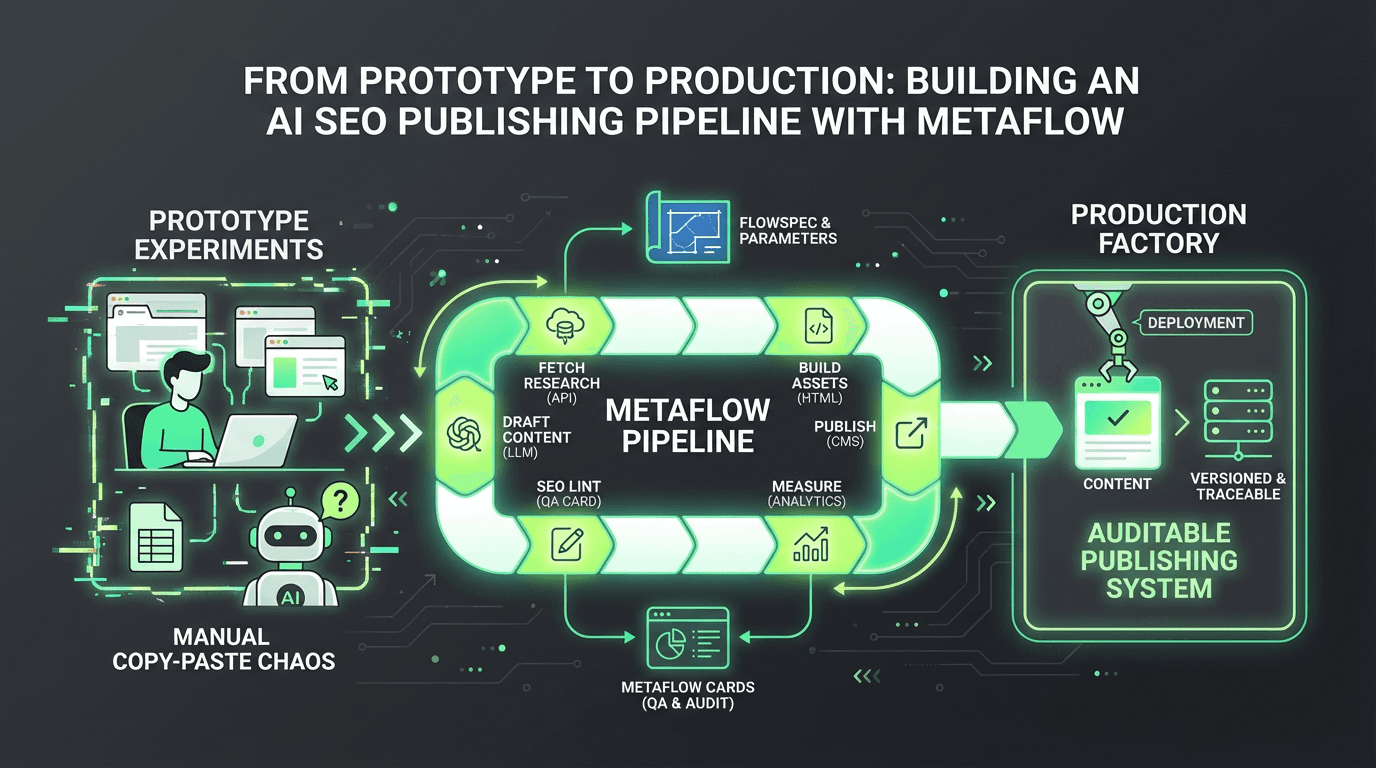
If you've copied prompts between ChatGPT tabs, juggled keyword spreadsheets, and wondered whether your last post used the good prompt or the old one, you're not alone. Most marketing teams live between "we use AI sometimes" and "we have a system." The gap isn't capability — it's infrastructure.
Metaflow is the agentic marketing platform built for that gap. It turns ad-hoc AI content workflows into reproducible, auditable publishing systems — without code. Growth teams use it to ship AI-powered content at scale with production-grade output, no dev team required.
This isn't about replacing creativity. It's about building a content automation system that handles the tedious work — research, SEO validation, formatting, publishing — so your team focuses on strategy and storytelling.
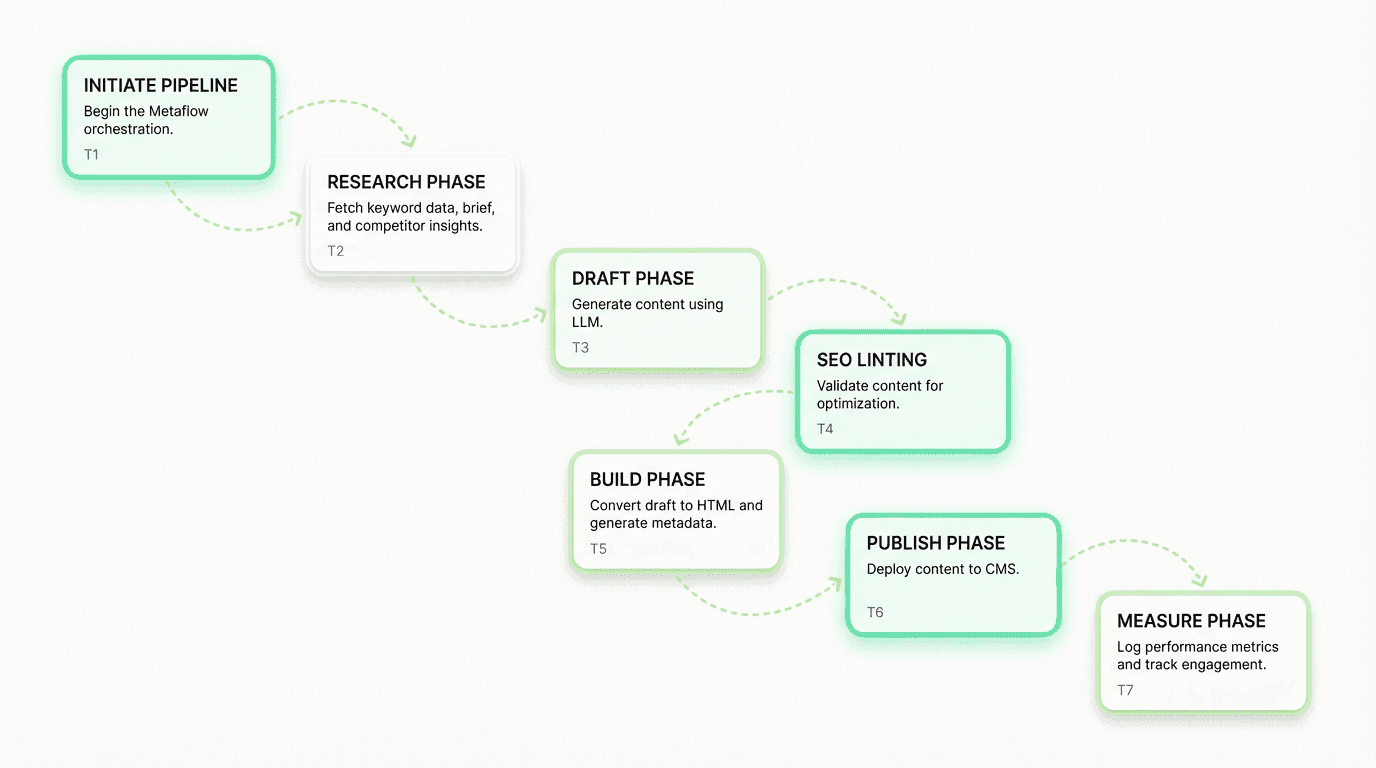
This guide shows how Metaflow turns every blog post into a versioned, traceable workflow using agents, skills, parameters, and scorecards. You'll see how to orchestrate research → draft → SEO lint → publish → measure with QA gates at every step, and why this is the foundation for every serious AI SEO agent deployment — including the next generation of AI marketing automation platforms.
The problem: AI content tools are powerful, but fragile
The promise of AI for SEO is intoxicating. Generate outlines in seconds. Draft long-form articles. Optimize meta descriptions at scale. The reality is messier.
Prompt drift: Your best-performing prompt is buried in a Slack thread from three weeks ago.
No version control: Last month's winner can't be reproduced because someone tweaked the model mid-campaign.
Manual handoffs: Drafts get copy-pasted from Claude to WordPress, and the sitemap update gets forgotten.
Zero auditability: When a post underperforms, there's no way to isolate which stage failed.
Traditional SEO automation tools handle parts of this — keyword research, rank tracking, backlink monitoring — but none orchestrate the end-to-end publishing process. You're left stitching Zapier chains, Sheets, and prayer.
Metaflow treats each published piece as a parameterized, versioned workflow. Every stage — keyword extraction to deployment — is a discrete, testable unit. Every artifact — research, draft, validation report — is stored and traceable. When something breaks, you see exactly where. When something works, you reproduce it next quarter.
What is a Metaflow pipeline?
A Metaflow pipeline is a visual workflow of agents and skills that transforms inputs into published output. Think of it as a recipe that remembers every ingredient, every adjustment, and every reviewer's feedback.
Agents: the blueprint
Every workflow is owned by an agent — a configurable AI worker with a role, instructions, and access to tools. A publishing pipeline typically uses one orchestrator agent and several sub-agents, each owning a stage:
Research agent
Drafting agent
SEO lint agent
Publishing agent
Measurement agent
Agents are built on a visual canvas. No Python, no decorators, no DAG syntax. Drag, connect, configure.
Skills: reusable building blocks
A skill is a packaged capability an agent can call — keyword extraction, competitor scraping, readability scoring, CMS deployment. Metaflow ships with marketing skills out of the box, and custom skills cover proprietary processes.
Skills are reusable across agents. A "fetch top SERP competitors" skill works in your blog pipeline, your landing-page pipeline, and your refresh pipeline.
Parameters: dynamic inputs
Parameters inject configuration per run — target keyword, brief URL, publish date, tone of voice — without rebuilding the workflow:
Primary keyword
Content brief
Brand voice (casual, professional, technical)
Target CMS
Publish schedule
One pipeline definition, infinite campaigns. This is what makes AI marketing agents reusable rather than disposable.
Scorecards: human-readable QA
Every stage emits a scorecard — a visual report showing keyword density, readability, validation status, and brand-voice alignment. Reviewers approve or reject without touching a terminal.
The gap between "the AI generated something" and "this is ready to ship" closes through structured, reviewable scorecards.
Building your content automation pipeline
A real publishing system for AI-powered blog articles runs through six stages:
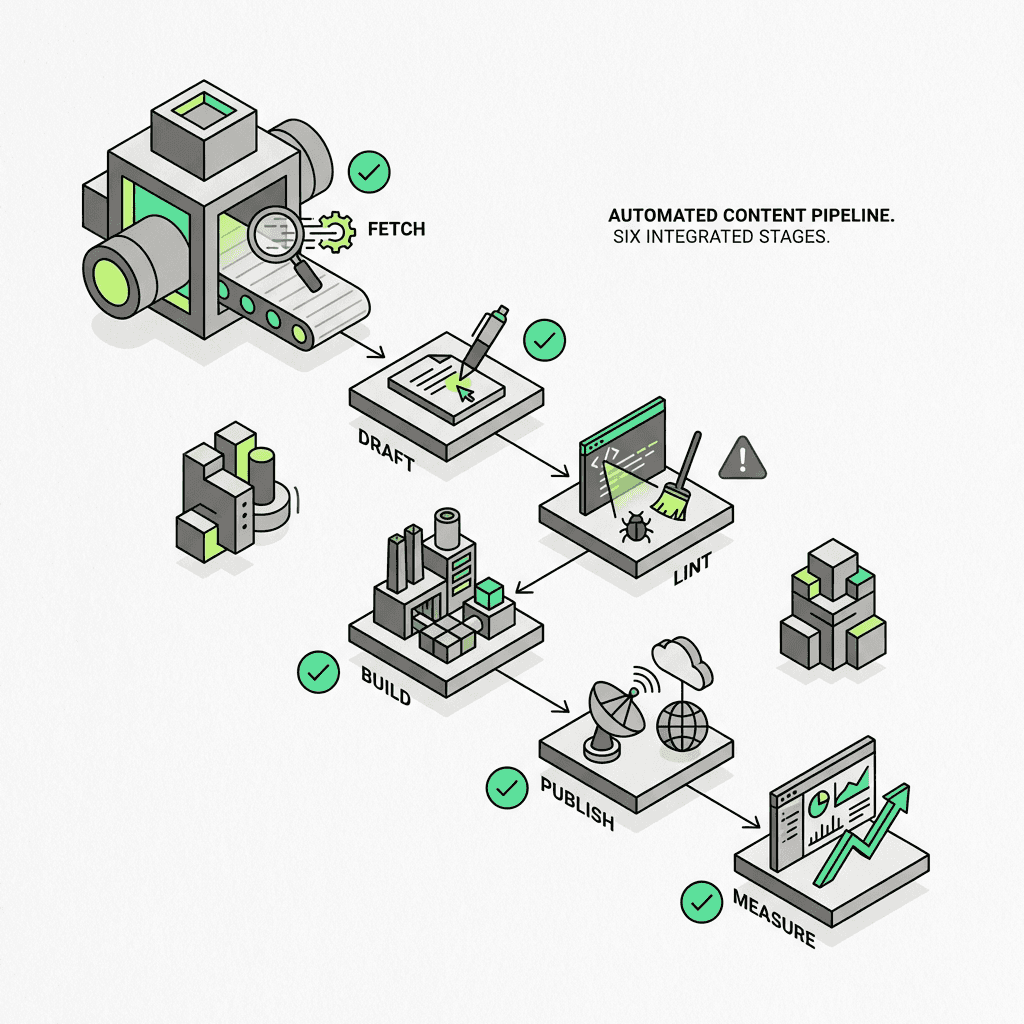
Fetch — pull keyword data, competitor analysis, internal brief.
Draft — generate the long-form article.
Lint — validate optimization: keyword density, readability, meta tags.
Build — render Markdown to HTML, generate social cards.
Publish — push to CMS (WordPress, Webflow, headless).
Measure — log to analytics, set up rank tracking.
Each stage is an agent. Each artifact is versioned. Each decision point has a scorecard.
Stage 1: Fetch research artifacts
The research agent pulls the brief from your content ops doc, fetches keyword metrics from your SEO tool of choice, and scrapes the top three SERP results. Every artifact is stored and inspectable — weeks later you can ask "what did the SERP look like when we wrote this?" That foundation enables effective AI workflows for growth.
Stage 2: Draft the article
The drafting agent assembles a prompt from the research artifacts and brief, calls the configured LLM (GPT-4, Claude, your choice), and writes the draft. Retries and timeouts are built in. The draft is stored as a versioned artifact tied to the run.
Stage 3: SEO lint and validation
The lint agent runs structured checks:
Keyword density vs. target
Flesch-Kincaid readability
Meta description length and presence
Heading hierarchy
Word count vs. brief
Internal link coverage
AEO scoring for answer-engine visibility
Each check is a scorecard line. If the article fails a threshold, the run halts at the QA gate. No bad work reaches production.
Stage 4: Build publication assets
The build agent renders Markdown to HTML, generates the OG image, builds the CMS payload (title, slug, meta, featured image, tags), and prepares the final artifact for deployment.
Stage 5: Publish
The publishing agent calls your CMS API (WordPress, Webflow, Contentful, headless) and ships the post. The published URL is logged and tied to the run.
Stage 6: Measure
The measurement agent logs the publish event to analytics, sets up rank tracking for the primary and secondary keywords, and registers the post for ongoing performance monitoring.
Thirty days later, when the post ranks, you trace it back to this exact run — which prompt, which brief, which model.
Scorecards: human-readable QA reports
Code is one thing. When your CMO asks "why did this post fail validation?" you don't want to grep logs. Metaflow scorecards generate visual reports embedded in the workspace.
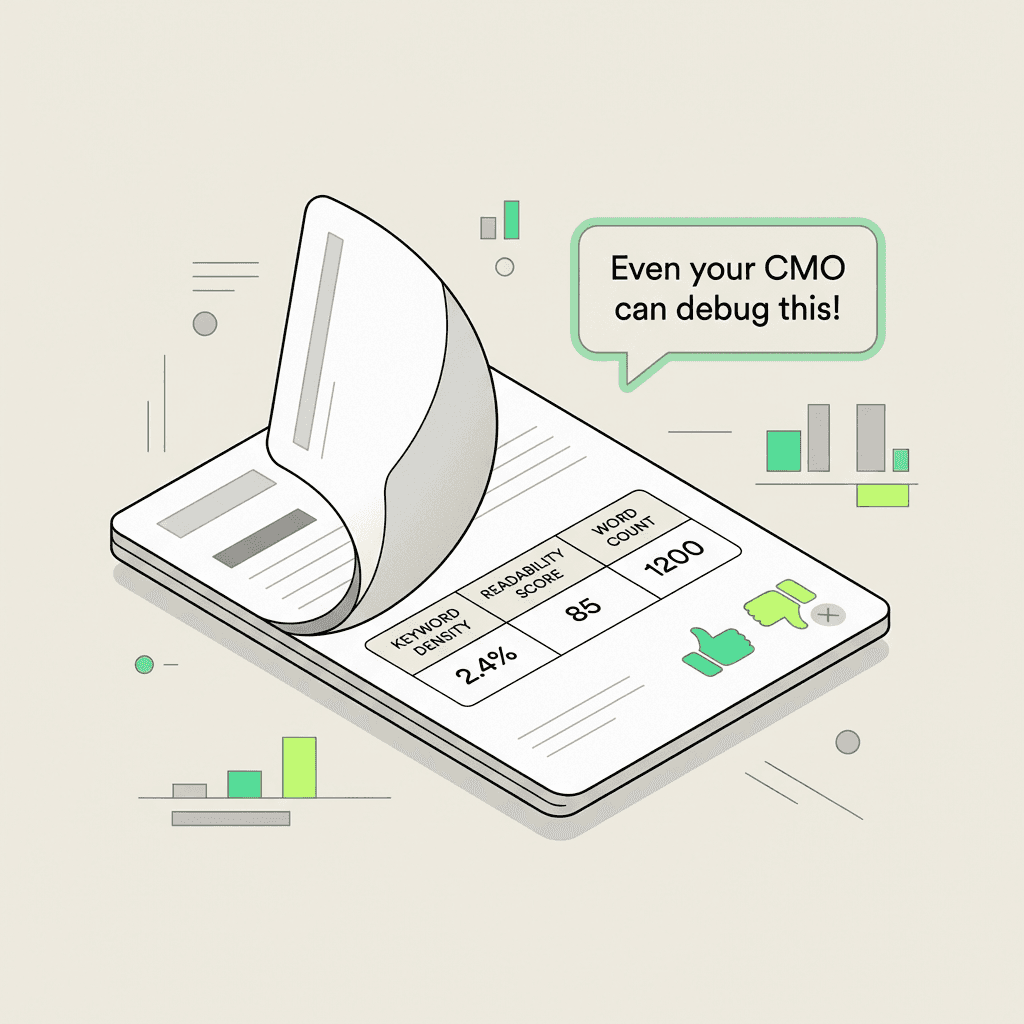
A typical lint scorecard:
Keyword density: ✅ 0.8%
Readability score: ✅ 65 (Flesch-Kincaid)
Word count: ❌ 1,200 (target: 1,500+)
AEO score: ✅ 82
Brand voice match: ✅ 91%
Non-technical stakeholders review and approve at the gate. Scorecards support tables, charts, and inline previews — exactly what AI agents for marketing need to earn human trust before deployment.
From experiments to production-grade AI SEO agents
Most teams treat AI as a tool — a better text editor. The Metaflow approach treats it as infrastructure. The difference:
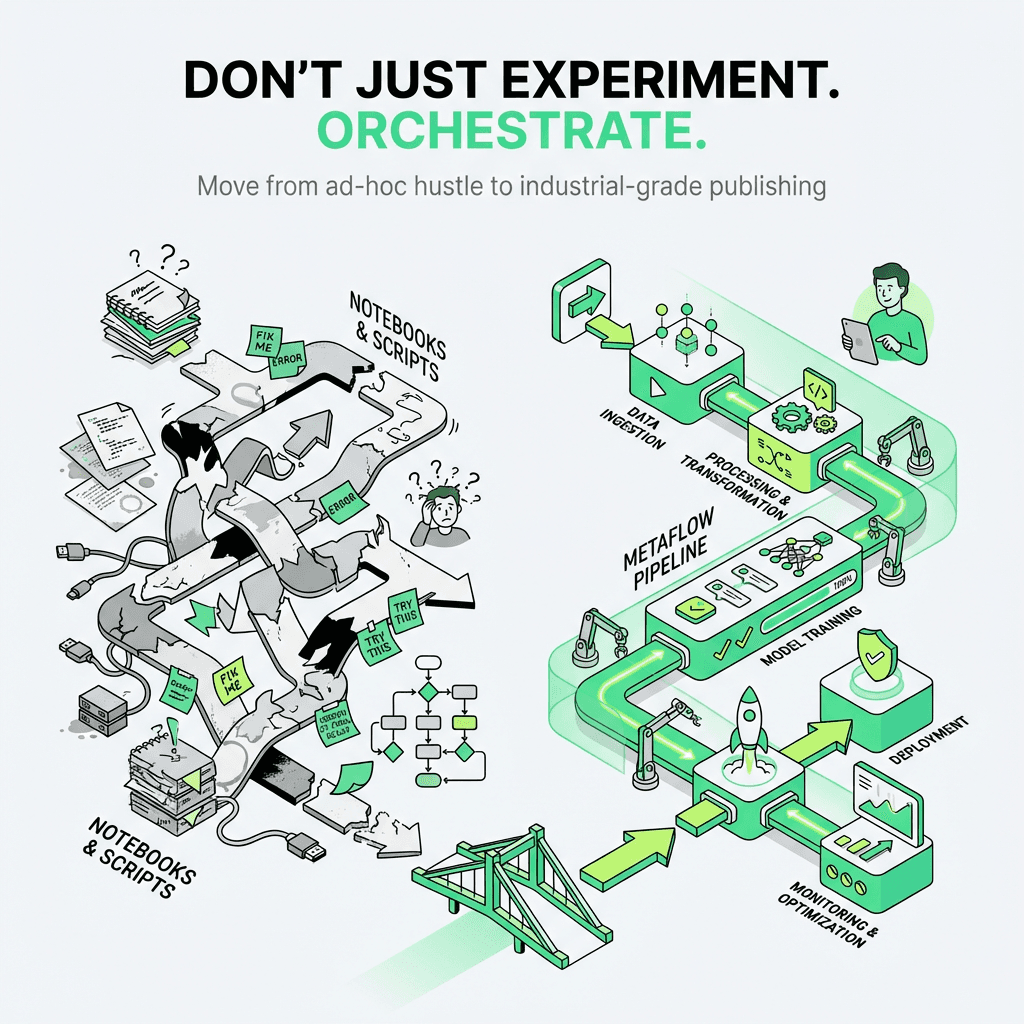
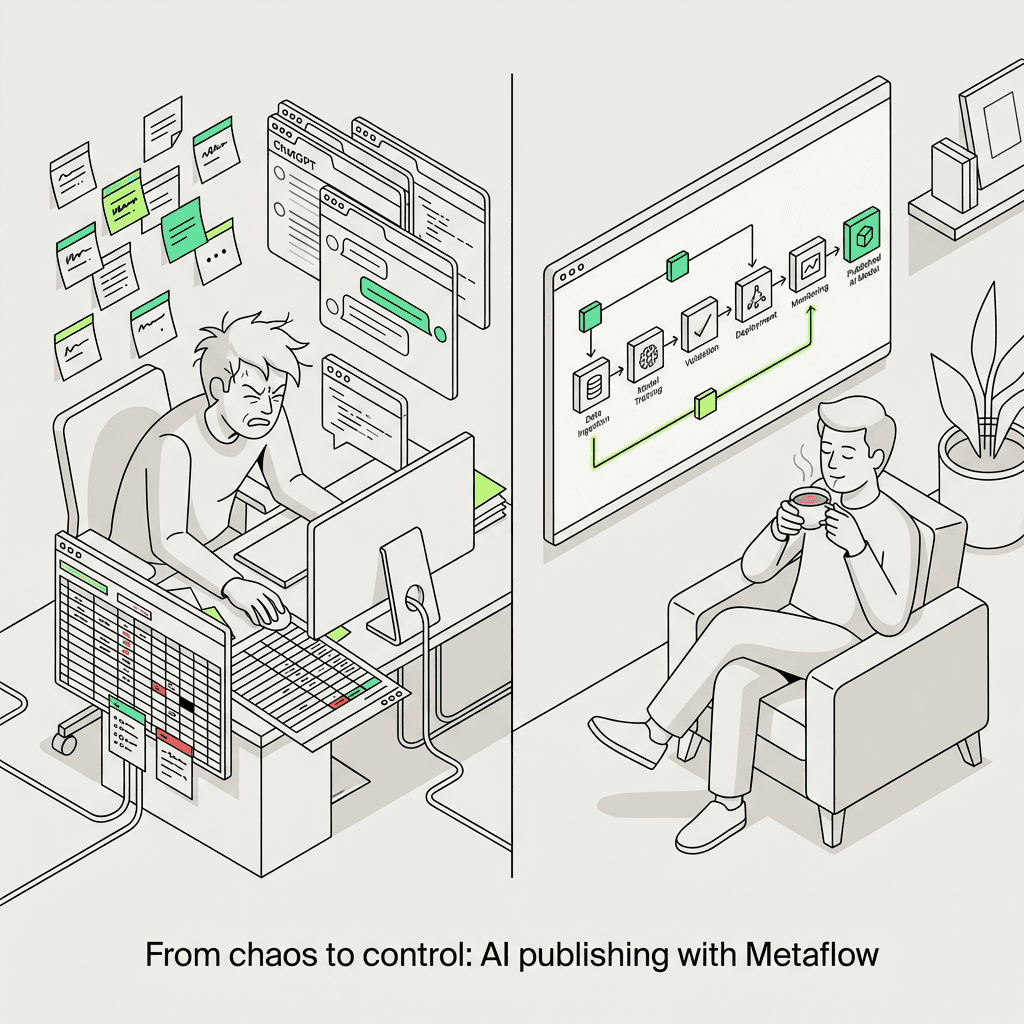
Without Metaflow
Prompts live in Google Docs.
Someone runs them manually in ChatGPT.
Drafts are copy-pasted into WordPress.
SEO checks happen sometimes.
No version control. No audit trail. No reproducibility.
When something breaks, you start over.
With Metaflow
Prompts are versioned inside the agent definition.
Parameters let you A/B test tone, model, and brief structure.
Built-in retries and timeouts handle flaky APIs and runaway generations.
Scorecards provide human-reviewable QA gates.
Every artifact — research, draft, lint, published URL — is stored and traceable.
When something breaks, you see exactly where.
When something works, you reproduce it at scale.
This is the difference between "we use ChatGPT sometimes" and "we run an auditable publishing factory" — the hallmark of a serious AI marketing workspace.
Real-world use cases
Programmatic SEO at scale
Generate 500 location-specific landing pages. Each page is a run with different keyword and location parameters. Metaflow handles parallel execution, retries, and logging. Reviewers spot-check scorecards, approve the batch, and ship. This is AI workflows for marketing at production scale.
Content refresh pipelines
Identify underperforming posts via Search Console. Feed URLs into a refresh pipeline that:
Scrapes the current article
Analyzes SERP changes since publish
Generates updated sections
Re-lints for optimization
Republishes with a changelog
Every refresh is versioned — roll back if rankings drop.
Multi-channel repurposing
One draft, multiple outputs. A single pipeline:
Drafts the long-form blog post
Generates the LinkedIn summary
Writes the Twitter thread
Produces the email newsletter version
Publishes all four with tracked links
Each output is a parallel stage. The orchestrator handles fan-out and fan-in.
Compliance and legal review
For regulated industries — finance, healthcare — add a manual approval gate. The pipeline drafts, lints, and halts. Legal reviews the draft in a scorecard, approves via the workspace, and execution resumes. Zero risk of accidental deployment.
Integrating Metaflow with your existing SEO stack
Metaflow isn't a replacement for your best SEO automation tools — it's the orchestration layer that ties them together.
Keyword research — Ahrefs, SEMrush, Search Console pulled into the research stage.
Content generation — OpenAI, Anthropic, or Cohere called in the drafting stage. Model version, temperature, and token count logged as metadata.
SEO validation — Surfer, Clearscope, or custom AEO models in the lint stage.
Publishing — WordPress, Webflow, Contentful, or static site generators in the publish stage.
Analytics — GA4, Mixpanel, or your warehouse in the measure stage. Run ID provides attribution.
Swap Ahrefs for SEMrush by changing one skill configuration. The pipeline stays the same. Your institutional knowledge — how you publish — is preserved. That's the advantage of an AI workflow builder built for marketers.
Getting started
Build your first pipeline in under an hour:
Create a publishing agent in the Metaflow workspace.
Add the research, drafting, lint, build, publish, and measure sub-agents.
Configure parameters: primary keyword, brief URL, brand voice.
Connect your SEO tools, LLM provider, and CMS.
Run it.
You'll see scorecards, stored artifacts, and the published URL within minutes. Replace defaults with your prompts and thresholds. Add custom skills. Add additional QA gates.
Within a week, you have a production-grade automation system your entire team can run without touching code. Teams evaluating alternatives can also compare no-code AI agent builders.
Why this beats notebooks, scripts, and Zapier chains
You could stitch this together with Jupyter notebooks, cron jobs, and Zapier. You'd lose:
Versioning — Metaflow stores every artifact from every run. Notebooks overwrite. Zapier doesn't store at all.
Reproducibility — Metaflow captures dependencies, parameters, and configuration. Scripts assume "it works on my machine."
Observability — Metaflow scorecards provide rich dashboards. Notebooks print to stdout.
Collaboration — Metaflow pipelines live in a shared workspace. Notebooks are opaque blobs.
Resilience — Metaflow retries and recovers. Notebooks crash and ghost you.
For one-off experiments, notebooks are fine. For AI SEO agents running weekly, monthly, or on demand for years, Metaflow is the only sane choice.
The infrastructure layer for AI-powered growth
The future of content isn't humans vs. AI. It's humans with AI infrastructure. The teams that win won't have the best prompts — prompts are commoditized. They'll have the best publishing systems: reproducible, auditable, scalable workflows that turn articles into a competitive moat.
Metaflow is that platform. It's the orchestration layer that makes AI marketing agents production-ready. It's how you go from "we drafted a post with ChatGPT" to "we shipped 50 posts this quarter, tracked performance, identified winners, and scaled them — without hiring a dev team."
Every stage is versioned. Every artifact is traceable. Every decision point has a QA gate. When something works, you reproduce it forever.
Start with one post. Turn it into a pipeline. Add parameters. Add QA gates. Add scorecards. Run it again. And again. And again.
Welcome to AI-powered marketing automation. It's reproducible. It's auditable. And it's yours.
FAQs
What is a Metaflow pipeline?
A Metaflow pipeline is a visual workflow of agents and skills that runs a marketing task — like publishing a blog post — in a reproducible, observable way. Each stage produces versioned artifacts so debugging and collaboration are straightforward.
What problem does Metaflow solve for AI content and SEO workflows?
It turns fragile, manual "prompt + copy-paste" processes into a production-grade automation pipeline with version control, retries, scorecards, and a clear audit trail. You can reproduce the exact research inputs, prompts, drafts, validation reports, and publishing outputs for any run.
What are agents and skills in Metaflow?
Agents are configurable AI workers that own a stage of the pipeline. Skills are reusable capabilities — keyword extraction, competitor scraping, AEO scoring, CMS deployment — that agents call. Both are built on a visual canvas with no code.
How do parameters make a publishing system reusable?
Parameters let you change runtime inputs — keyword, tone, publish date, brief URL — without rebuilding the pipeline. This enables repeatable campaigns, A/B tests across prompts or models, and batch runs for programmatic SEO with the same workflow logic.
How does Metaflow handle flaky APIs and runaway LLM generations?
Built-in retries re-attempt failed stages with backoff. Built-in timeouts stop runaway generations to control cost and prevent stuck runs. Both are configured per agent — no custom code required.
What does a good end-to-end content automation pipeline look like?
Research → draft → SEO lint → build → publish → measure. Each stage is a testable agent with stored artifacts and explicit QA gates before anything goes live.
What are scorecards and how do they help non-technical reviews?
Scorecards are visual reports attached to a stage — tables, charts, and inline previews showing keyword density, readability, word count, AEO score, and brand-voice match. Stakeholders approve or reject without reading logs.
How is Metaflow different from notebooks, scripts, or Zapier?
Notebooks and scripts are easy to start but hard to reproduce. Zapier handles triggers but not artifact storage, retries on AI content, or reviewable QA gates. Metaflow adds structured execution, artifact versioning, and an auditable history of inputs, prompts, parameters, and outputs across runs.
Can Metaflow integrate with Ahrefs, SEMrush, WordPress, or analytics tools?
Yes. Metaflow connects to most SEO and publishing tools via API. The pipeline coordinates those API calls, logs results, and retries safely on rate limits or transient failures.
How do you add compliance or human approval gates?
Add a manual review step that blocks publishing until approval arrives from the workspace or a webhook. Common in regulated industries because it creates a documented, auditable checkpoint between generation and deployment.