







TL;DR:
Structured data is standardized markup (typically JSON-LD format) that makes your information machine-readable for search engines and generative systems — essential for rich snippets and generative engine optimization
Eligibility ≠ guaranteed display; follow policies strictly (mark up only visible information, ensure accuracy, avoid spam) to maximize your chances without risking penalties
Start with low-risk, high-utility schema: Organization and Breadcrumb markup first, then expand to Article, Product, FAQ, and other types based on your offerings and business goals
Implement at the template level (not per-page) for scalability, validate rigorously using the Rich Results Test and structured data testing tool, and monitor performance in Google Search Console continuously
For WordPress beginners: Use plugins like Yoast or a schema generator tool to simplify adding markup without manual code editing
Alternative formats exist: While JSON-LD is recommended, you may encounter Microdata or RDFa in legacy implementations — all use the schema.org vocabulary
LLMs are changing the game: Generative systems parse schema to understand entities and relationships, making markup the bridge from traditional optimization to generative search — web pages with comprehensive schema become citeable knowledge sources
Metaflow agents can automate the entire workflow: audit schema coverage, analyze information with LLMs, auto-generate policy-compliant JSON-LD, validate, and monitor — scaling implementation without manual per-page effort
Testing is critical: Use the structured data testing tool, markup validator, and Search Console to test implementation, catch errors, and monitor performance
Measure beyond rich snippets: track citations, entity recognition, and machine-readability alongside traditional CTR and impression metrics

Schema implementation has become the silent architect of modern search visibility. While most SEO practitioners obsess over keywords and backlinks, the websites winning featured snippets, knowledge panels, and rich snippets are speaking a language search engines actually understand: schema markup.
But here's the catch — implementing markup isn't just about adding code to your web pages. It's about designing a strategic roadmap that improves your eligibility for enhanced search results without crossing Google's strict policy lines. Because in the world of schema.org vocabulary, eligibility never equals guaranteed display.
This guide will walk you through building an optimization strategy that bridges traditional SEO with the emerging world of generative engine optimization (GEO) and large language model (LLM) comprehension. Whether you're optimizing for Google's enhanced search listings or preparing your information for answer engines, schema implementation is your foundation.
What Is Structured Data and Why Does It Matter?
Structured data is a standardized format for providing information about a web page and classifying its content. Think of it as metadata that helps search engines not just crawl your information, but truly understand it.
When you visit a recipe site and see cooking time, ratings, and calorie counts directly in search results, that's schema at work. When you search for a local business and immediately see hours, phone numbers, and reviews in a knowledge panel — again, structured markup.

The difference between structured data vs unstructured data is fundamental:
Unstructured data is the raw HTML and text on your website — readable by humans but requiring interpretation by machines
Structured data uses standardized schemas (typically JSON-LD format) to explicitly label what each piece of information represents
Search engines like Google use this markup to create rich results — enhanced search listings that stand out visually and provide immediate value to users. But more importantly for the future, schema implementation is becoming the bridge between traditional SEO and generative search experiences, including the use of ai powered workflows to streamline implementation and maintenance.
The Evolution: From SEO to AEO and GEO
We're witnessing a fundamental shift in how people find information. Traditional search is being augmented — and in some cases replaced — by answer engines, ChatGPT searches, and generative assistants.

This is where optimization for search engines and generative engine optimization converge. LLMs and generative systems parse schema.org vocabulary to understand entities, relationships, and factual connections between concepts. Web pages with comprehensive markup aren't just optimized for Google — they're optimized for machine comprehension at scale.
Think of schema implementation as the Rosetta Stone that translates your human-readable information into machine-readable knowledge. And in an era where generative systems are answering questions directly, that translation layer is no longer optional.
Understanding Structured Data Policies: The Rules of the Game
Before you start implementing markup across your site, you need to understand a critical principle: rich result eligibility doesn't guarantee display.
Google maintains strict structured data policies designed to prevent manipulation and ensure quality. Violate these policies, and your markup won't just be ignored — it could trigger manual actions against your entire website.

Core Policy Principles
1. Content Visibility
All information marked up with schema must be visible on the web page. You can't markup information that only exists in your code — that's considered deceptive.
2. Relevance
Your markup must accurately represent the page information. Don't mark up a product listing as a recipe, or add fake review markup to web pages without actual reviews.
3. Completeness
If you're using schema for a specific feature (like recipes or products), include all required properties. Incomplete markup often fails validation.
4. No Spammy Markup
Avoid manipulative practices like:
Marking up invisible information
Creating misleading schema
Adding irrelevant schema types to game the system
Using markup for information not present on the website
5. Original Content
Don't markup syndicated or duplicate information as if it's original. Search engines can detect this and may ignore your markup entirely.
The Eligibility vs. Display Distinction
This is where many SEO practitioners get frustrated: you can implement perfect, policy-compliant schema and still not see enhanced results.
Why? Because eligibility is just the first gate. Google's algorithms then evaluate:
Quality and trustworthiness
User experience signals
Competitive landscape for that query
Whether enhanced results improve the search experience
Your job is to maximize eligibility while building the quality signals that increase display probability.
Choosing Your Structured Data Features: Strategic Prioritization
Not all schema types deliver equal value. A strategic approach begins with identifying which features actually move the needle for your business.
High-Impact, Low-Risk Schema Types
Start with these foundational markup types that offer broad utility and minimal policy risk:
Organization Schema Establishes your brand entity, connects your website to your knowledge graph presence, and provides basic business information. This is table stakes for any serious website.
Breadcrumb Schema Improves how your site hierarchy appears in Google search results, helps users understand context, and strengthens internal site structure signals.
Article Schema For publishers, this enables eligibility for Top Stories, article-rich snippets, and better attribution across the web.
FAQ Schema Expands your search result footprint by displaying frequently asked questions directly in SERPs — though Google has recently limited this to more authoritative websites.
Medium-Impact, Context-Dependent Schema
Product Schema Essential for e-commerce, enabling price, availability, and review display in search listings.
LocalBusiness Schema Critical for businesses with physical locations, powering local pack inclusion and knowledge panel information.
Review Schema Can display star ratings in search results, but must represent genuine, unbiased reviews and follow strict guidelines.
Event Schema For organizations hosting events, this creates rich result cards with dates, locations, and ticket information.
Advanced Schema for Specific Use Cases
Recipe Schema, Video Schema, Course Schema, Job Posting Schema — these are powerful for specific types but require careful implementation and ongoing maintenance.
The Strategic Question: What Matters for Your Goals?
Ask yourself:
What types of enhanced results would most improve click-through rates for your key pages?
Which schema types align with your actual offerings?
Where are competitors getting enhanced results that you're not?
What markup supports your broader business strategy?
Start narrow and deep rather than broad and shallow. It's better to implement three schema types perfectly across all relevant pages than to implement ten types inconsistently.
Tactical Implementation: Your Step-by-Step Roadmap
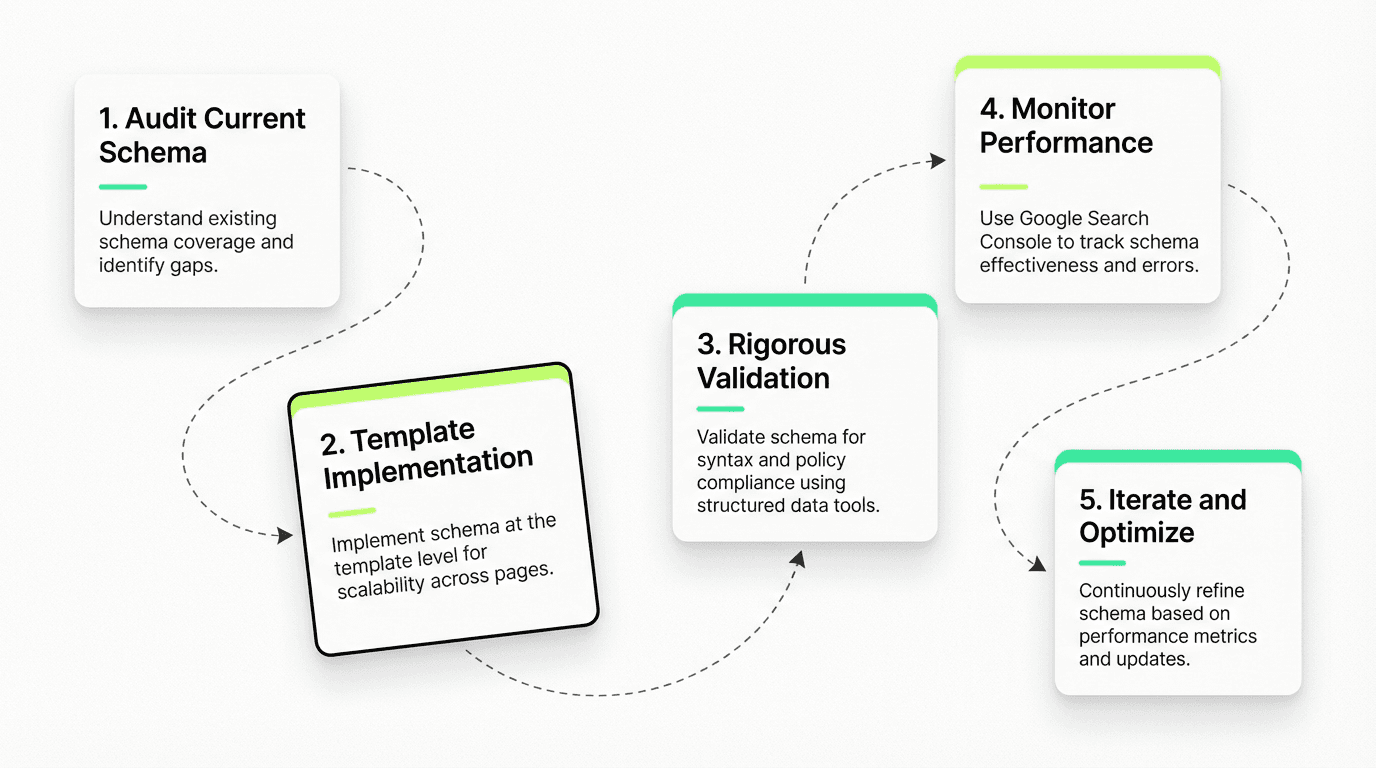
Now let's get practical. Here's how to implement schema at scale without creating maintenance nightmares or policy violations. This beginner-friendly tutorial will guide you through each step.

Step 1: Audit Current Schema Coverage
Before adding new markup, understand what you already have:
Use a structured data testing tool like Google's Rich Results Test or Schema Markup Validator to test your existing implementation
Crawl your site with Screaming Frog or similar tools to inventory existing schema
Identify pages with errors, warnings, or missing markup
Document which templates need schema implementation
Example: Run your homepage through the testing tool to see what schema types Google detects and whether any errors appear.
Step 2: Implement on Templates, Not Individual Pages
The key to scalable implementation is template-level deployment. Work with your development team to:
Identify templates (homepage, product listings, blog posts, category pages, etc.)
Map appropriate schema types to each template
Build dynamic schema generation that pulls from your CMS or database
Ensure markup updates automatically when information changes
This template approach means one implementation scales across hundreds or thousands of web pages and is a hallmark of an effective ai workflow builder.
For WordPress users: Consider using plugins like Yoast SEO or Rank Math, which include built-in schema generators that automatically add markup to your website. These WordPress plugins simplify implementation for beginners without requiring manual code editing.
Step 3: Validate Rigorously
Validation happens in layers:
Syntax Validation Use Google's Rich Results Test or Schema.org validator to ensure your JSON-LD is properly formatted and contains required properties. You can also test alternative formats like Microdata or RDFa, though JSON-LD is generally recommended.
Policy Compliance Manually review that your markup follows Google's policies — visible information only, accurate representation, no manipulation.
Rendering Verification Check that your schema is present in the rendered HTML (not just server-side) using "View Page Source" or Google's URL Inspection Tool in Search Console.
Cross-Browser Testing Verify markup appears correctly across different devices and browsers, especially if using JavaScript to inject schema.
Example validation workflow: After adding schema to your product template, test a sample product page using the Rich Results Test, then verify in Google Search Console that Google has detected the markup.
Step 4: Monitor in Search Console
Google Search Console is your feedback loop:
Navigate to the "Enhancements" section to see which enhanced results Google has detected
Monitor errors, warnings, and valid items over time
Track impressions and clicks for pages with schema
Set up alerts for sudden drops in valid items
Pay special attention to error spikes — they often indicate implementation issues that need immediate attention.
Step 5: Iterate Based on Performance
Schema implementation isn't set-and-forget. Continuously:
A/B test different implementations where possible
Add new schema types as your offerings evolve
Update markup when Google releases new features
Remove or fix markup that consistently generates errors
Code Examples: Starting with Breadcrumb + Organization Markup
Let's look at practical implementation for two foundational schema types: Breadcrumb and Organization markup. These code examples show the JSON-LD format, which is Google's recommended format.
Organization Schema (Add to Homepage)
This establishes your brand entity, connects social profiles, and provides basic contact information — all low-risk, high-value properties.
Key properties explained:
name: Your organization's official name
url: Your website's homepage
logo: URL to your logo image (helps with brand recognition)
sameAs: Social media profiles (establishes entity connections)
contactPoint: Customer service information with specific properties like telephone and contactType
Breadcrumb Schema (Add to All Interior Pages)
Breadcrumb markup improves how your site hierarchy displays in Google search and helps search engines understand your information architecture.
Pro tip: Implement these two schema types first. They're universally applicable, have minimal policy risk, and provide immediate value across your entire website.
Alternative Format Example: Microdata vs JSON-LD
While JSON-LD is recommended, you might encounter Microdata or RDFa in existing implementations. Here's the same breadcrumb example in Microdata format:
JSON-LD is preferred because it separates markup from HTML, making it easier to maintain and less prone to breaking when you update your website's design.
How AI Is Changing Structured Data: From SEO to Generative Engine Optimization
Here's where your strategy gets truly future-focused. The rise of large language models and generative search experiences is fundamentally changing why schema matters.
Structured Data as Machine-Readable Context
LLMs like GPT-4, Claude, and Google's Gemini don't just crawl text — they parse structure to understand relationships, entities, and factual assertions. When a generative system encounters JSON-LD markup, it gains:
Entity clarity: Understanding exactly what the web page is about (a person, product, organization, event, etc.)
Relationship mapping: Seeing how entities connect (this author wrote this article for this organization)
Factual extraction: Pulling specific properties (prices, dates, ratings) with confidence
Context enrichment: Understanding where this information fits in a broader knowledge graph
This is the foundation of generative engine optimization (GEO) — optimizing so generative systems can confidently cite, reference, and synthesize your information.
From Rich Results to AI Citations
Traditional optimization focused on click-throughs from search listings. GEO optimizes for citations in generated answers.
When ChatGPT, Perplexity, or Google's Overviews generate an answer, they're more likely to reference and cite sources that:
Have clear schema establishing topical authority
Use markup to make facts easily extractable
Provide machine-readable context about freshness, authorship, and relationships
Your strategy isn't just about getting a rich snippet anymore — it's about becoming a preferred source for generated knowledge.
The Metaflow Agent Opportunity: Structured Data at Scale
Implementing schema manually across hundreds or thousands of web pages is tedious, error-prone, and doesn't scale. This is where automation transforms the game.
Imagine an AI SEO agent that:
Audits schema coverage across your entire site, identifying pages missing markup or containing errors
Analyzes content using LLMs to understand what each web page is actually about
Auto-generates appropriate JSON-LD based on analysis and schema.org best practices
Validates against Google's policies automatically, flagging potential violations before implementation
Monitors performance in Search Console and suggests optimizations based on eligibility
This is exactly the kind of workflow Metaflow enables. Rather than manually creating schema for each page or building complex automation pipelines, growth teams can design natural language agents that understand intent: "Audit all blog posts for missing Article schema, generate appropriate markup, validate for errors, and flag for review."
Metaflow's agent builder approach means you're not locked into rigid connectors or pre-built workflows. You describe what you want to accomplish in natural language, and the platform orchestrates the necessary steps — from analysis to schema generation to validation.
For growth marketing teams managing large libraries, this represents a fundamental shift: from manual, per-page implementation to automated, intelligent schema deployment at scale. The cognitive load moves from "how do I write this JSON-LD?" to "what strategy drives the most value?" By leveraging a no-code ai agent builder, teams can orchestrate complex initiatives efficiently.
LLM Optimization Through Structured Data
Here's a practical framework for LLM optimization through schema:
Entity Establishment
Use Organization, Person, and Brand schema to clearly establish your entity presence. LLMs use these signals to understand who you are and what you're authoritative about.
Content Attribution
Implement Article schema with proper author and publisher markup. Generative systems are increasingly prioritizing information with clear attribution and provenance.
Factual Assertions
Use specific schema types (Product, Event, Recipe, etc.) to make factual claims machine-readable. When an LLM can extract a specific price, date, or rating from schema properties, it's more likely to reference that information.
Relationship Mapping
Connect entities through schema relationships — this article is about this topic, written by this author, published by this organization. These connections help generative systems understand context and relevance.
Freshness Signals
Include datePublished and dateModified properties in your schema. Systems prioritizing recent information will weight accordingly.
Measuring Success: Beyond Rich Results
Traditional success metrics focus on rich snippet impressions and click-through rates in Search Console. But in a generative-first world, you need broader measurement:
Direct Metrics
Rich snippet impressions and CTR (Google Search Console)
Valid items (Search Console Enhancements)
Error and warning rates
Coverage across templates
AI-Era Metrics
Citations in generated answers (manual monitoring of ChatGPT, Perplexity, etc.)
Appearance in Overviews (Google's generative search features)
Entity recognition in knowledge graphs
Extraction accuracy by generative systems
Business Impact Metrics
Organic traffic to pages with schema vs. without
Conversion rates from enhanced result traffic
Brand search volume (indicating entity establishment)
Overall organic visibility trends
The goal isn't just to get rich snippets — it's to become a machine-readable, citeable, authoritative source in your domain.
Common Pitfalls and How to Avoid Them
Even experienced practitioners make schema mistakes. Here are the most common:

Pitfall 1: Marking Up Invisible Content
Never add schema for information that doesn't appear on the web page. This is a policy violation and can result in manual actions.
Pitfall 2: Inconsistent Implementation
Implementing schema on some pages but not others creates an incomplete picture for search engines. Aim for comprehensive, template-level coverage.
Pitfall 3: Ignoring Validation Errors
Warnings and errors in Search Console aren't just suggestions — they indicate problems that may prevent eligibility.
Pitfall 4: Static Schema in Dynamic Environments
If your information changes but your schema doesn't update, you're creating a mismatch. Ensure schema generation is dynamic and pulls from your CMS.
Pitfall 5: Over-Optimization
Adding every possible schema type to every web page doesn't help. Focus on relevant, accurate markup that genuinely represents the information.
Pitfall 6: Neglecting Mobile Rendering
Ensure your schema renders properly on mobile devices, where most search traffic occurs.
Pitfall 7: Not Using a Schema Generator Tool
Beginners often hand-code schema and make syntax errors. Use a generator tool or WordPress plugin to reduce errors and speed up implementation.
The Future: Structured Data in an AI-Native Web
As we move toward an increasingly generative web, schema will only become more critical. The websites that thrive will be those that speak the language of machines while serving the needs of humans.
Voice search and virtual assistants rely heavily on schema to answer questions. Research tools like Perplexity and ChatGPT's web browsing prioritize sources with clear, machine-readable structure. Google's Search Generative Experience uses the schema.org vocabulary to understand and synthesize information.
Your strategy today is your visibility strategy tomorrow. The question isn't whether to implement markup — it's how quickly you can build a comprehensive, policy-compliant, strategically focused roadmap.
And in a world where growth teams are already stretched thin, the ability to automate schema generation, validation, and monitoring through ai marketing agents isn't just convenient — it's becoming essential. Tools like Metaflow represent the next evolution: moving from manual implementation to intelligent, scalable, agent-driven schema deployment.
The bridge between traditional optimization and generative search isn't built with more keywords. It's built with schema — the universal vocabulary that makes your information comprehensible to both search engines and the generative systems that are rapidly reshaping how information is discovered and consumed.
FAQs
What is structured data in SEO?
Structured data is standardized markup (usually in JSON-LD) that labels the meaning of your content using the Schema.org vocabulary, so search engines can understand it more reliably. It helps power rich results (like breadcrumbs, FAQs, ratings, and product details) and improves machine-readability for answer engines.
What is schema markup, and is it the same as structured data?
Schema markup is structured data that specifically uses the Schema.org vocabulary (e.g., Organization, Article, Product). In practice, most SEOs use “schema markup” and “structured data” interchangeably, but “structured data” can refer more broadly to any machine-readable labeling.
What format should I use for schema markup: JSON-LD, Microdata, or RDFa?
Google generally recommends JSON-LD because it’s easier to implement and maintain without touching your HTML structure. Microdata and RDFa are still valid (and common in legacy sites), but they’re more tightly coupled to page markup and can break during design or template changes.
Does adding structured data guarantee rich snippets in Google?
No—structured data can make a page eligible for certain rich results, but Google doesn’t guarantee display. Beyond validity, Google considers quality signals, query intent, and whether the enhancement improves the search experience.
What are Google’s structured data policy rules I should follow?
Mark up only information that’s visible to users on the page, keep the markup accurate and representative, and avoid spammy or irrelevant schema types. If you add a rich-result-eligible schema type (like Product or FAQPage), include required properties and don’t fabricate reviews, ratings, prices, or availability.
Which schema types should I implement first for the best ROI?
Start with low-risk, broadly applicable markup like Organization and BreadcrumbList, then expand based on your content: Article for editorial pages, Product for e-commerce, and LocalBusiness for physical locations. Prioritize schema that aligns with your templates and business goals rather than adding every type everywhere.
Should I implement schema per page or at the template level?
Implement schema at the template level whenever possible so it scales and stays consistent across the site. Template-driven JSON-LD that pulls from your CMS reduces errors, prevents mismatches as content changes, and is easier to validate and maintain.
What tools should I use to test structured data?
Use Google’s Rich Results Test for rich-result eligibility and the Schema.org Validator for broader Schema.org validation. Then monitor ongoing detection and errors in Google Search Console’s rich result / enhancement reports to catch issues as templates change.
How do I add schema markup on WordPress if I’m a beginner?
Use a reputable SEO plugin (like Yoast SEO or Rank Math) or a schema generator to output JSON-LD without manual coding. Still validate the output—plugins can misconfigure properties, and Google will ignore or flag markup that doesn’t match visible page content.
How does structured data help with AEO/GEO and LLM citations?
Schema clarifies entities (e.g., organization, author, product) and relationships (publisher → article → author), making facts easier for generative systems to extract with confidence. After you implement accurate markup, tools like Metaflow can help automate audits, generate policy-compliant JSON-LD at scale, and monitor coverage—supporting machine-readability without turning schema maintenance into a manual workflow.