






TL;DR
AI-driven discovery is reshaping B2B buying (ChatGPT: 2.5B queries/day, AI traffic up 1,200% YoY)
Most optimization advice (LLMs.txt, schema markup, keyword URLs) has negligible impact per 129K website study
What drives recommendations: backlinks (32K+ sources = 3.5x), community trust (millions of mentions = 4x), positive feedback (70%+ = 3x), content depth (2,900+ words = 5.1 vs. 3.2), fast load times (FCP < 0.4s = 3x)
Shift from measuring traffic to measuring influence (being mentioned in 10K conversations influences 10K buying decisions)
Leverage these best practices and effective strategies to improve your visibility, enhance your online presence, and ensure your business appears in AI-powered search results and recommendations across digital platforms, and validate progress with ai search competitor analysis tools
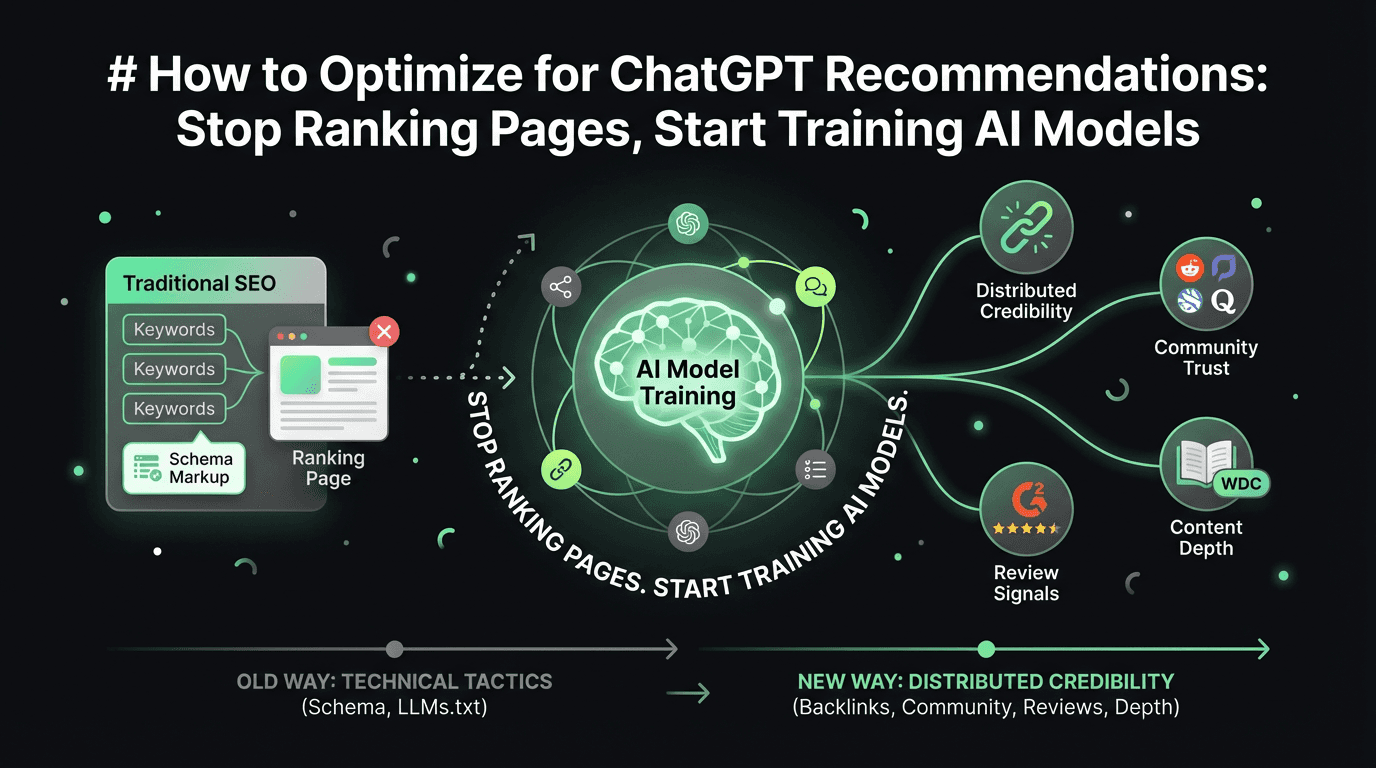
Most marketers trying to optimize for ChatGPT recommendations are using the wrong playbook. They're treating it like SEO 2.0 (add schema markup, implement LLMs.txt files, optimize for keywords). Research analyzing 129,000 websites from SE Ranking reveals these tactics have negligible impact on how often you get recommended. Some approaches, like schema markup, correlate with fewer recommendations.
The companies winning AI recommendations and improving their visibility aren't just optimizing pages. They're building distributed credibility across backlinks, community platforms, review sites, and comprehensive content. They're training AI to recognize them as credible information sources. This requires a fundamentally different approach: shifting from traffic acquisition to answer ownership through AI search SEO answer engine optimization (AEO).
According to recent Adobe Analytics research, AI-driven traffic to retail and B2B sites surged 1,200% year-over-year, while a Forbes study found that 39% of consumers already use generative AI for shopping decisions (with 53% planning to adopt it soon). ChatGPT now handles 2.5 billion queries daily across 1 billion users, approaching Google's 14 billion daily search queries. For B2B companies, this isn't a future trend. ChatGPT is reshaping how buyers find, evaluate, and select solutions right now.
I've spent three years building SEO and growth systems for B2B SaaS companies. Here's what surprised me about AI optimization: the tactics that worked for Google search engines are almost useless. The companies getting cited aren't doing technical SEO. They're crossing credibility thresholds that trigger exponential growth in recommendations.
Why Most Advice on How to Optimize for ChatGPT Recommendations Misses the Mark
The current wave of AEO advice suffers from three critical blind spots.
First, the LLMs.txt fallacy. Dozens of articles recommend implementing LLMs.txt files to help AI understand your content structure. SE Ranking's analysis of 129,000 websites found that removing LLMs.txt files actually improved model accuracy and recommendation rates. The format adds complexity without signal.
Second, the SEO translation trap. Most marketers are cargo-culting technical solutions that worked in traditional search: schema markup, keyword-optimized URLs, internal linking patterns, and a structured data strategy. But AI doesn't crawl and rank pages like search engines do. Large language models synthesize trust signals from across the web to determine credibility. SE Ranking found that pages with FAQ schema averaged 3.6 recommendations versus 4.2 for pages without it. Schema isn't driving visibility.
Third, the single-platform delusion. Profound Research analyzed 100,000 queries across ChatGPT and Perplexity and found only 11% overlap in what gets recommended. What appears in ChatGPT often disappears in Perplexity. There's no universal "AI optimization" to show up in AI answers. Each platform weighs credibility signals differently.
The deeper issue: most advice focuses on what you can control on your own website (technical SEO, content optimization) while ignoring the distributed credibility signals that actually drive recommendations. Your presence on Reddit. Your G2 reviews. Your Quora answers. Your backlink profile from high-trust websites.
How Do AI Models and Search Engines Decide What to Recommend?
ChatGPT and other generative AI platforms synthesize trust signals across the web to determine credibility. When a user asks for recommendations, the model doesn't crawl your site and rank it against competitors (i.e., how search engines work). It evaluates distributed credibility: the cumulative trust signals across backlinks, community mentions, review platforms, content depth, and technical performance.
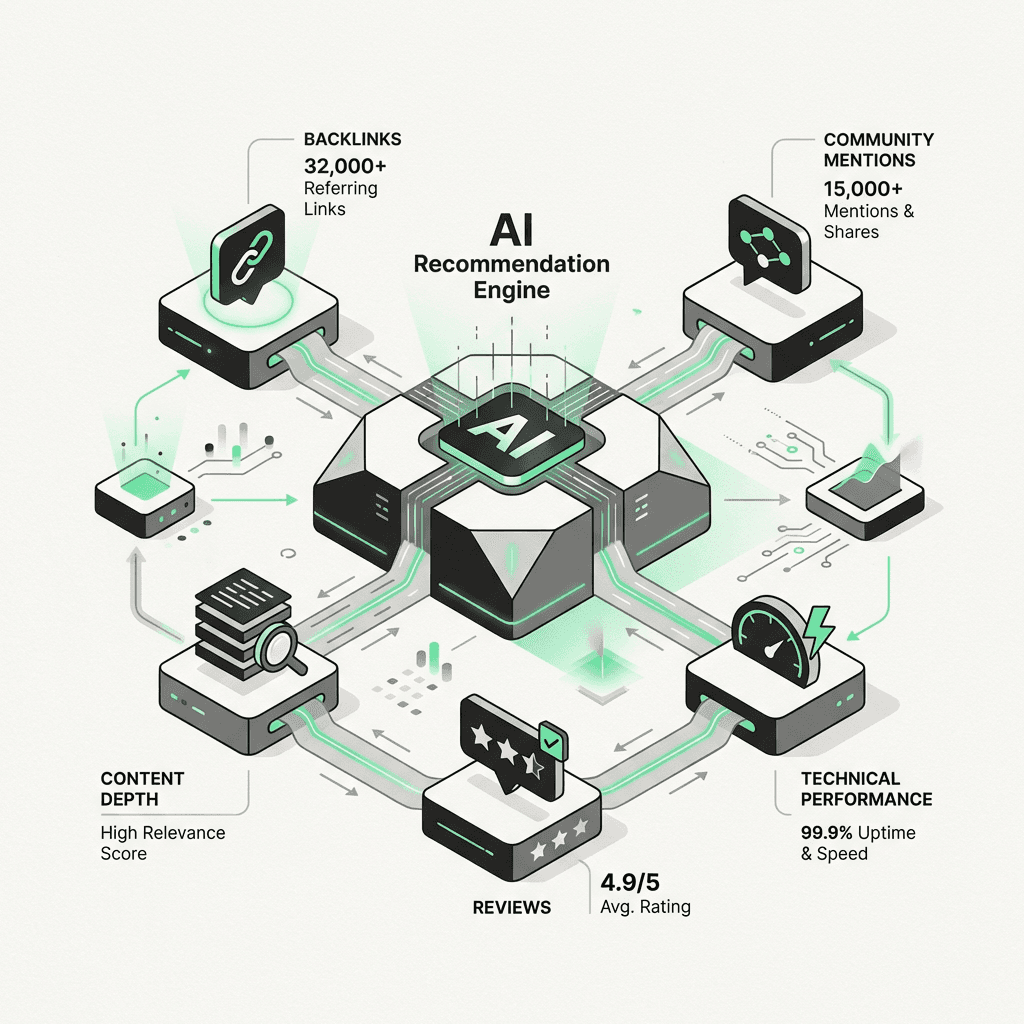
Your homepage traffic metrics, Reddit mentions, G2 reviews, and Quora answers all feed into the same trust evaluation. The AI is asking: "Across the entire web, is this source credible enough to cite?"
SE Ranking's research reveals the credibility thresholds that matter:
Credibility Signal | Threshold | Impact |
|---|---|---|
Referring Links | 32,000+ sources | 3.5x more recommendations |
Site Trust Score | 90+ | Exponential growth in visibility |
Content Length | 2,900+ words | 5.1 vs. 3.2 recommendations |
First Contentful Paint | < 0.4 seconds | 6.7 vs. 2.1 recommendations (3x) |
Review Score | 70%+ positive | 3x recommendation likelihood |
Community Mentions | Millions on Quora/Reddit | 4x higher rates |
Credibility doesn't scale linearly. Once you cross critical thresholds, recommendation rates don't improve gradually. They explode. You're training an AI to recognize you as the definitive source.
The Multi-Signal Framework: A Comprehensive Guide
AI evaluates five compounding credibility signals. These don't add up. They multiply to maximize your visibility.
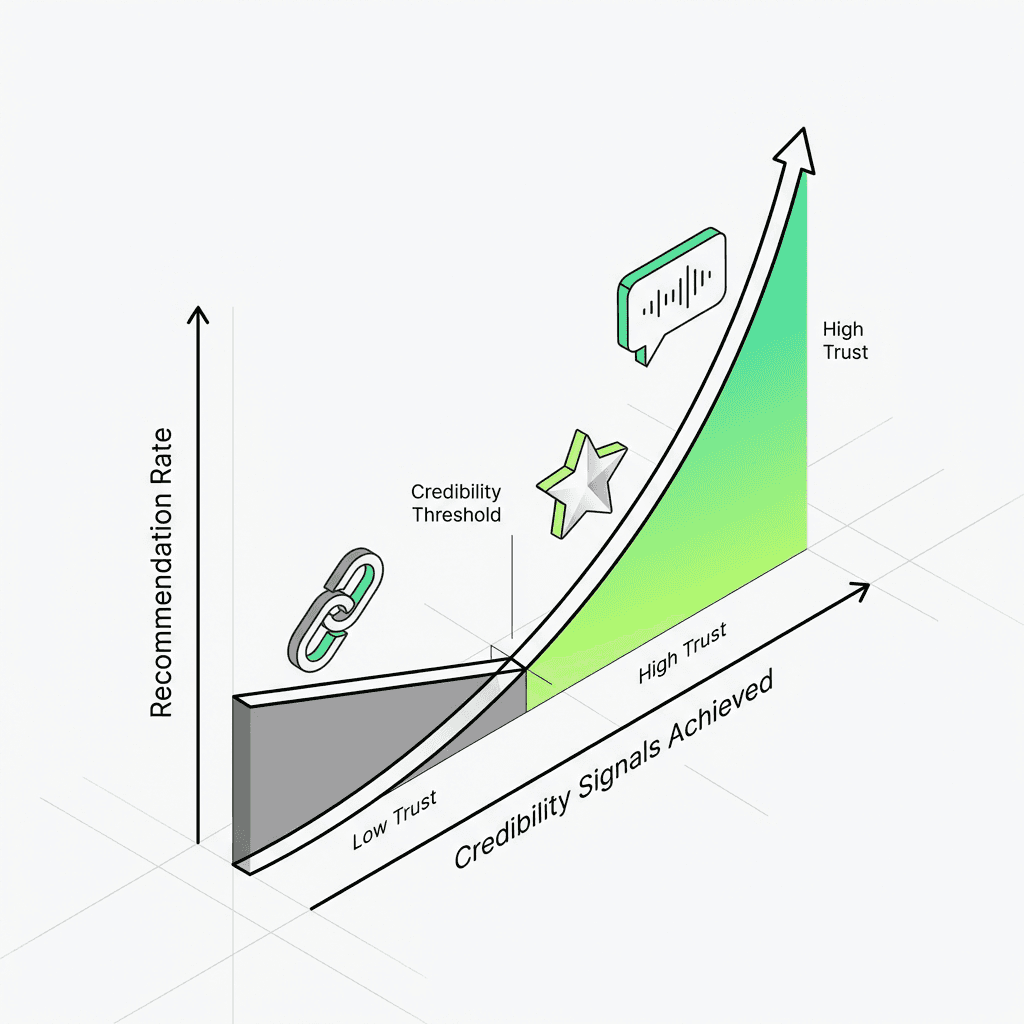
Signal 1: Link Credibility
> Websites with 32,000+ referring sources get 3.5x more recommendations than those below this threshold
Referring source diversity matters more than total backlinks. Trust scores above 90 create exponential advantages. The critical threshold sits at 32,000+ referring sources.
Why it matters: AI uses backlink profiles as a proxy for credibility. A website cited by thousands of other trusted sources signals expertise and quality information.
How to build it:
Publish original research or data studies that naturally earn backlinks, not off page seo automation
Focus on high-trust sources (Trust Score > 70) rather than volume
Create genuinely useful tools, calculators, or resources that solve real problems
Example: A B2B SaaS company published an annual industry benchmark with data from 2,000+ customers. The study earned 2,400 backlinks from 800 sources in six months, including from TechCrunch, Forbes, and industry-specific publications. Their ChatGPT recommendation rate jumped 340% within 90 days.
Signal 2: Community Trust and Online Presence
> Millions of Quora and Reddit mentions correlate with 4x recommendation rates
For smaller websites without massive backlink profiles, community trust has 65-70% more impact on recommendations than for established brands. Authentic participation matters, not promotional volume.
Why it matters: AI scans community platforms to understand real user sentiment and recommendations (a dynamic that directly affects tracking brand visibility ai search). When thousands of Reddit users mention your solution in authentic contexts, that signals trust and quality.
How to build it:
Answer 2-3 Quora questions per week in your category (focus on questions with 10K+ views)
Engage in 1-2 relevant subreddits consistently (comment on posts, don't post promotional content)
Build reputation over time through helpful, specific answers that provide valuable insights
Example: The founder of a developer tools company spent 12 months answering 150 Quora questions about API security and developer workflows. He never promoted his solution directly. ChatGPT now recommends his company in 40% of queries related to API authentication, despite the company having only 8,000 referring sources.
Signal 3: Review Presence and Quality
> Websites with review profiles are 3x more likely to be recommended
Profiles on G2, Clutch, Capterra, Trustpilot, or Yelp dramatically increase recommendation likelihood. Below 70% positive scores, likelihood drops significantly.
Why it matters: Review platforms aggregate verified customer sentiment. AI treats these as trust signals because they represent real user experiences and quality indicators.
How to build it:
Claim and optimize profiles on all relevant platforms for your category, and prioritize google reviews management seo if you operate in local markets
Actively collect feedback from satisfied customers (email campaigns, in-app requests)
Respond to feedback (both positive and negative) to signal active engagement
Example: A project management software company systematically requested G2 feedback after successful onboarding calls. They grew from 40 reviews (3.8 stars) to 300+ reviews (4.6 stars) in eight months. Their ChatGPT recommendation rate for "project management software" queries increased from 12% to 38%.
Signal 4: Content Depth, Freshness, and Quality
> Content exceeding 2,900 words averages 5.1 recommendations versus 3.2 for content under 800 words
Length alone doesn't drive this. Depth does. Structure matters: 120-180 words between headings improves readability and ensures better performance. Question-based titles and H1s nearly double recommendation likelihood for smaller websites.
Why it matters: AI extracts answers from comprehensive content that thoroughly addresses a topic (this is foundational to ai content seo). Shallow content gets skipped. High-quality, in-depth information becomes the foundation for AI recommendations.
How to build it:
Expand your top 5-10 pieces of content to 2,900+ words with depth and structure
Include FAQ sections within your main content (actual questions and answers written naturally, not just schema markup). This nearly doubles recommendation likelihood.
Update content within the past 3 months (fresh content averages 6 recommendations versus 3.6 for outdated material)
Add "Last updated: date" timestamps at the top of articles
Example: A cybersecurity company expanded a 1,200-word article on "zero trust architecture" to 3,400 words by adding: detailed implementation steps, 5 real-world case studies, a comparison table of approaches, common pitfalls section, and an embedded FAQ. Recommendations increased from 2 per month to 11 per month.
Signal 5: Technical Performance and User Experience
> Websites with First Contentful Paint (FCP) under 0.4 seconds average 6.7 recommendations versus 2.1 for those above 1.13 seconds
Core Web Vitals SEO directly impacts recommendation rates. Fast-loading pages signal quality and user respect, which AI rewards.
Why it matters: AI correlates site speed with overall quality and user experience. A slow website suggests poor experience, which reduces trust and visibility.
How to build it:
Run PageSpeed Insights on your top 10 pages and fix any FCP > 0.4s issues
Optimize images (compress, use modern formats like WebP)
Minimize JavaScript and CSS blocking render
Use a CDN for faster global delivery
A website with strong backlink credibility, active community presence, positive feedback, deep content, and fast load times doesn't get incrementally more recommendations. It dominates the conversational landscape.
Platform-Specific Strategies for AI Optimization
With only 11% overlap between platforms, you need differentiated strategies to maximize visibility across generative AI tools.
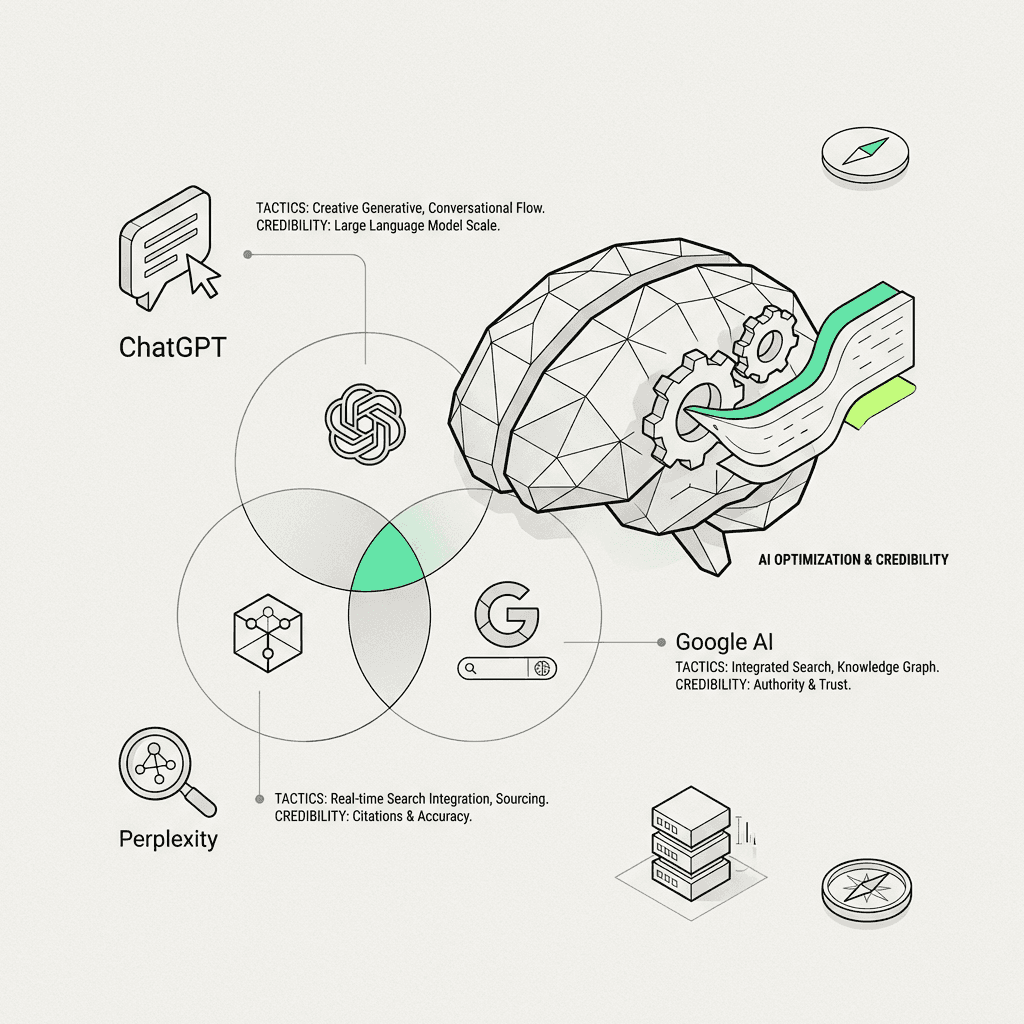
ChatGPT
To optimize for ChatGPT, prioritize getting featured in credible "best of" lists, showcase customer usage metrics prominently, and build positive social proof across platforms as part of your [ai marketing strategy](https://metaflow.life/blog/ai-marketing-strategy).
ChatGPT's algorithm heavily weights "best of" lists from trusted publications, verified customer counts, and positive sentiment across social platforms.
Tactical execution:
Pitch your solution to G2's "Best Of" lists, Capterra's category leaders, and industry-specific roundups (e.g., "Best DevOps Tools" by TechCrunch). In your pitch, include customer count, usage statistics, and any awards or recognitions.
Add customer metrics to your homepage hero section and about page (e.g., "Trusted by 10,000+ companies" or "Processing 50M API calls daily")
Build positive mentions across Twitter, LinkedIn, and Reddit through authentic engagement
Perplexity
To optimize for Perplexity, update content quarterly with fresh data, diversify your backlink profile across different source types, and structure content for direct answers to specific questions.
Perplexity favors recently published or updated content and pulls from a wider range of sources than ChatGPT.
Tactical execution:
Add a "Last updated: date" timestamp at the top of your key articles
Refresh content quarterly with new statistics, recent case studies, and current examples
Earn backlinks from diverse source types: industry blogs, news outlets, educational institutions, forums
Structure content with clear H2s that match common questions (e.g., "How does solution work?" or "What are the benefits of approach?") informed by ai keyword research
Google AI Overviews and Search Engine Optimization
To optimize for Google AI Overviews, focus on traditional SEO fundamentals first, build topical credibility through comprehensive content clusters, and ensure technical hygiene.
If you rank in the top 5 organically, you're far more likely to appear in AI Overviews and improve your overall search visibility.
Tactical execution:
Prioritize ranking for your target keywords through traditional SEO (keyword research, on-page optimization, quality backlinks)
Create content clusters: a pillar page covering a broad topic with 8-10 supporting articles covering subtopics in depth, all internally linked
Ensure clean technical SEO: proper heading hierarchy, descriptive URLs, fast load times, mobile optimization, and mobile first indexing best practices
Start with the platform most important to your audience. For B2B discovery, that's likely ChatGPT. For search-driven buying journeys, prioritize Google AI Overviews.
What ChatGPT Optimization Tactics Don't Work? Best Practices to Avoid
The digital marketing industry loves technical solutions because they feel like "doing something." But AI doesn't care about your schema markup. It cares about distributed credibility.
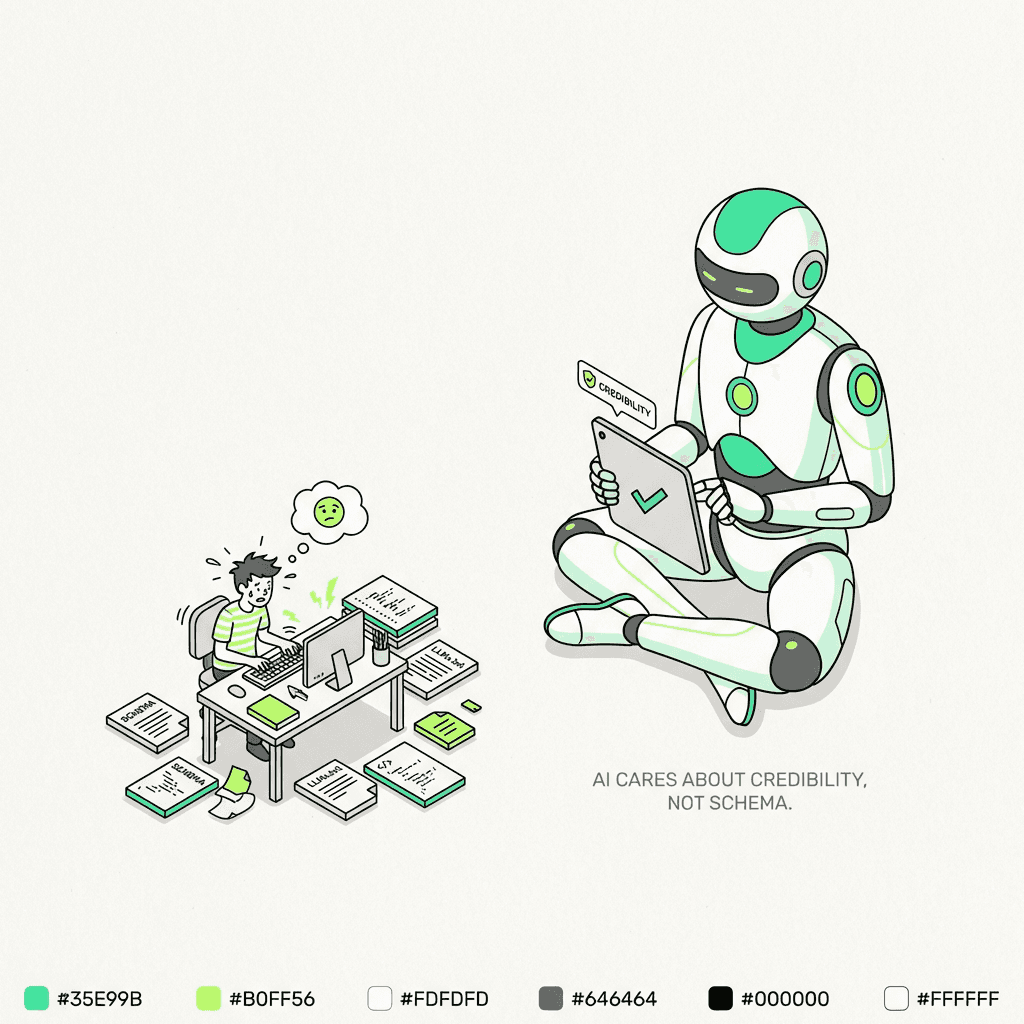
LLMs.txt files: SE Ranking's research showed negligible impact. In some cases, removing them improved accuracy.
FAQ schema markup: Pages with FAQ schema averaged 3.6 recommendations versus 4.2 without it. To be clear: FAQ content (actual questions and answers written naturally within your article) nearly doubles recommendations. FAQ schema markup (structured data code) does not. Write FAQ content naturally. Don't just add schema.
Keyword-optimized URLs: Broad, topic-aligned URLs get 2x more recommendations than keyword-stuffed URLs. AI prioritizes semantic relevance and an entity based seo view over exact-match keywords.
Linking out to high-credibility sources: Minimal effect on your own recommendation likelihood. Outbound links help users, but they don't signal credibility to AI.
Instead of chasing technical quick fixes, focus on the five credibility signals that compound: backlinks, community trust, feedback presence, content depth, and performance. These aren't page-level optimizations. They're systems you build across your entire web presence to enhance visibility.
How Do You Measure ChatGPT Optimization Success?
Stop measuring clicks, impressions, and traffic. Start measuring how often you're recommended, mention context, and positioning in AI answers.
Tools like SE Ranking's ChatGPT Visibility Tracker and Profound's Conversational Explorer are ai visibility tools that let you track where and how often you're recommended across AI platforms. But here's the critical reframe: being mentioned without attribution is still influence.
If ChatGPT recommends your solution in 10,000 conversations but never links to you, you've still influenced 10,000 buying decisions. That's the shift from traffic to influence.
Track these key metrics instead:
Recommendation frequency: How often you're mentioned across target queries (use Profound's Conversational Explorer to test 10-20 queries in your category monthly)
Share of voice: Your rate versus competitors for key discovery queries
Positioning: Are you recommended first, second, or mentioned alongside alternatives?
Sentiment and context: Are you cited as "best for X use case" or just "another option"?
The goal is no longer getting clicks. It's owning the answer and maximizing your presence in conversational AI.
The Strategic Implications: From Traffic Acquisition to Answer Ownership
In 18 months, a B2B buyer will ask ChatGPT for recommendations before they ever visit your website. If you're not recommended in that conversation, you don't exist. The companies building distributed credibility now (32,000+ referring sources, millions of community mentions, 90+ trust scores) will own those recommendations. Everyone else will be fighting for scraps in traditional search.
For growth operators, this represents the most significant shift since Google introduced PageRank. SEO evolved into AEO (Answer Engine Optimization), which is now evolving into GEO (Generative Engine Optimization). Each phase represents a fundamental change in how discovery works in the digital landscape.
Content is shifting from "ranking pages" to "training AI." Marketing must shift from "driving traffic" to "owning answers." The companies that recognize this early and build for answer ownership, not traffic, will dominate the next decade of AI-driven discovery.
This creates compounding advantages for early movers. Credibility thresholds create winner-take-most dynamics. Once a company crosses 32,000 referring sources, 90+ trust scores, and millions of community mentions, competitors can't easily replicate that position.
For teams building growth systems (whether through AI agents (ai agents growth marketing), repeatable workflows, or unified execution platforms like Metaflow) the strategic opportunity is clear: build distributed credibility systematically, not tactically. This isn't about adding "AI optimization" to your checklist. It's about recognizing that the entire discovery-to-evaluation funnel is collapsing into conversational interfaces, and your solution either exists in that conversation or it doesn't.
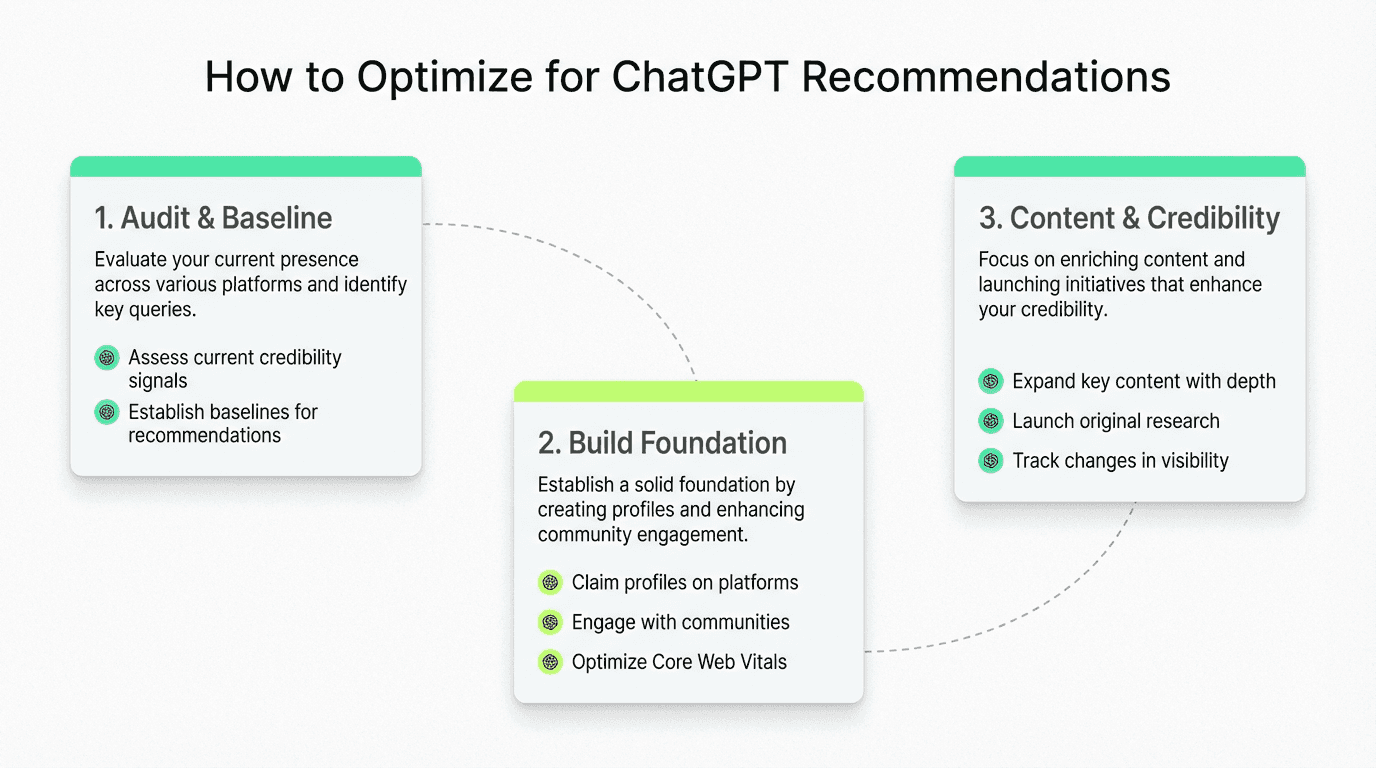
Getting Started: Your 90-Day ChatGPT Optimization Roadmap
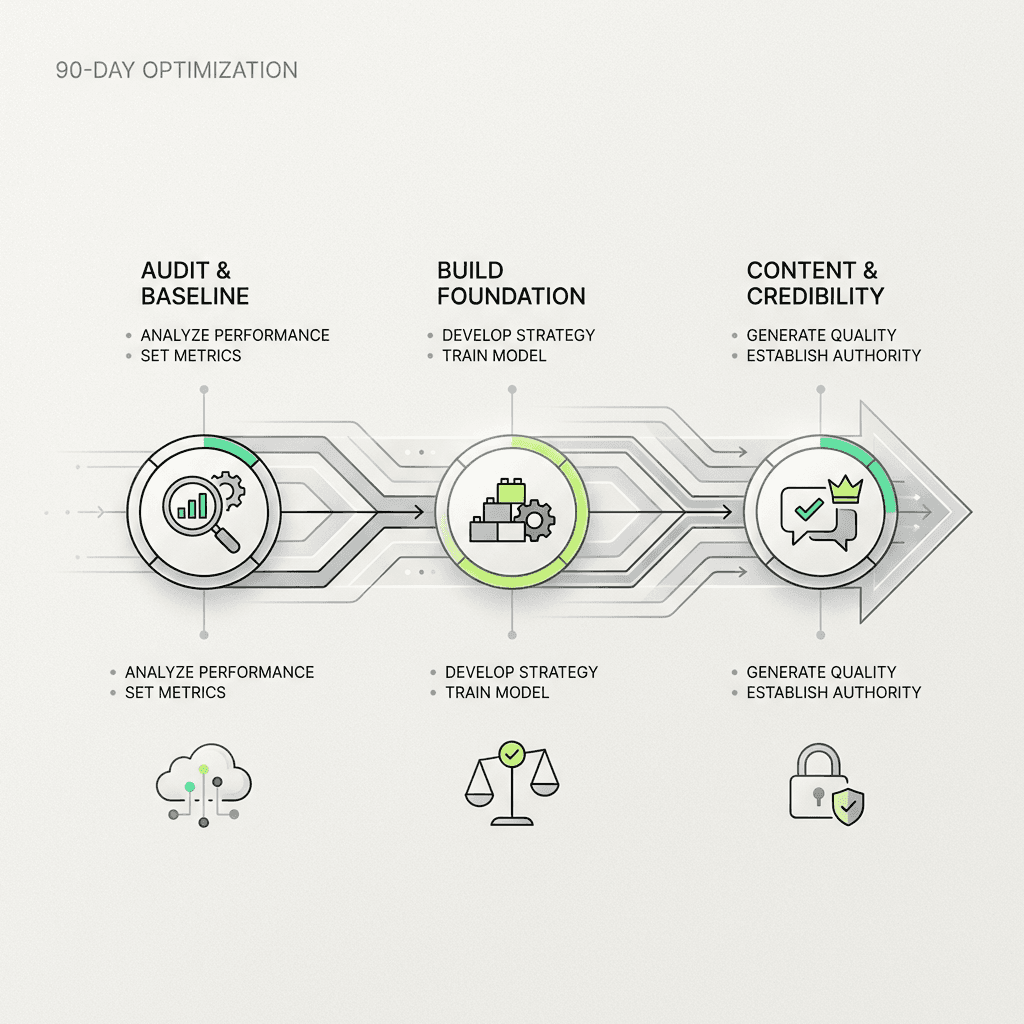
Month 1: Audit & Baseline
Audit current credibility signals:
Use Ahrefs or Moz to pull your referring source count and trust score
Search your brand name on Quora (site:quora.com "your brand") and Reddit (site:reddit.com "your brand") to count mentions
Check G2, Clutch, and Capterra for your presence and scores
Run PageSpeed Insights on your top 10 pages and note any FCP > 0.4s issues
Identify target queries:
Use Profound's Conversational Explorer to test 10 discovery queries in your category (e.g., "What's the best solution type for use case?")
Note which competitors are recommended and in what context
Establish baseline:
Track where you're currently recommended (or not) and at what frequency within a simple seo kpis framework
Month 2: Build Foundation
Claim profiles:
Set up or claim profiles on G2, Clutch, Capterra, and any industry-specific platforms
Create a system to request feedback from satisfied customers (post-onboarding email, in-app prompt)
Start community engagement:
Answer 2-3 Quora questions per week in your category (prioritize questions with 10K+ views)
Engage in 1-2 relevant subreddits (comment helpfully on posts, don't post promotional content)
Focus on providing valuable insights, not promoting your solution
Optimize Core Web Vitals:
Fix any pages with FCP > 0.4s (compress images, minimize JavaScript, implement CDN)
Target FCP under 0.4 seconds for your top 10 pages
Identify content to expand:
Select your top 5-10 pieces of content (by traffic or strategic importance) to feed your ai content pipeline
Month 3: Content & Credibility
Expand key content:
Add depth to your top 5-10 articles: more examples, case studies, implementation steps, comparison tables, common pitfalls
Include naturally written FAQ sections (not just schema)
Add "Last updated: date" timestamps
Aim for 2,900+ words with structure (120-180 words between headings)
Launch original research:
Plan and execute a data study, industry benchmark, or survey that will naturally earn backlinks and improve your credibility
Promote to relevant publications and online communities
Track changes:
Re-test your 10 target queries in Profound's Conversational Explorer
Measure frequency changes versus your Month 1 baseline
Identify what's working and iterate on your approach, and run ai content evaluation on the updated articles
This isn't a sprint. It's a systems build. But the companies that start now will have compounding credibility advantages in 12-18 months that competitors can't easily replicate. This comprehensive guide provides the effective techniques and strategies to maximize your visibility in the evolving landscape of generative search engines and conversational AI platforms.
FAQs
How do you optimize for ChatGPT recommendations?
Optimize for distributed credibility, not on-page SEO checklists. ChatGPT tends to recommend brands that show strong trust signals across the web (diverse referring sources, credible community mentions, positive reviews, deep content, and fast site performance) rather than brands that only "optimize pages."
How can a business be recommended by ChatGPT more often?
Increase the number and quality of independent signals that validate you: reputable backlinks from many referring domains, consistent positive sentiment on community platforms (e.g., Reddit/Quora), strong third-party reviews (e.g., G2/Clutch/Capterra), and comprehensive content that answers common questions clearly. The key is crossing credibility thresholds where visibility compounds, instead of expecting linear gains.
Do LLMs.txt files help you show up in ChatGPT recommendations?
In most cases, they don't appear to be a meaningful driver of recommendations. Research cited in the post (SE Ranking's large-scale analysis) suggests LLMs.txt can add complexity without adding useful signal (and in some cases, removing them correlated with improved outcomes).
Does schema markup (including FAQ schema) increase ChatGPT recommendations?
Not reliably. The post highlights that FAQ schema can correlate with fewer recommendations, while FAQ content (clear, naturally written questions and answers in the article) can improve extractability and "answer readiness" for AI systems.
What trust signals matter most for AI recommendations?
The post's framework emphasizes five compounding signals: link credibility (especially referring-source diversity and high trust), community trust (authentic mentions), review presence and positivity, content depth/freshness/structure, and technical performance (notably speed). These signals reinforce each other and can drive step-change visibility once you pass certain thresholds.
How many backlinks or referring domains do you need to be seen as credible by AI models?
There isn't a universal number, but the post cites a sharp threshold effect around 32,000+ referring sources correlating with materially higher recommendation rates. Practically, "more" only helps when it's diverse and earned from trusted sources (brand mentions in credible publications and research citations tend to matter more than low-quality volume).
Why do Reddit, Quora, and review sites affect ChatGPT recommendations?
They provide external, user-generated validation that's hard to fake at scale: discussions, comparisons, and sentiment about real usage. AI systems use these distributed references as credibility inputs (especially for smaller brands that don't yet have massive backlink profiles).
How fast should your website be to improve AI recommendation likelihood?
The post calls out First Contentful Paint (FCP) under ~0.4 seconds as a strong differentiator associated with higher recommendation rates. While speed alone won't earn trust, poor performance can undercut it (especially when combined with thin content or weak off-site validation).
What content format is most likely to get cited in AI answers?
Content that is comprehensive and structured for extraction: 2,900+ words with clear headings, 120-180 words between headings, naturally written FAQ sections, recent updates (within 3 months), and question-based titles that match user queries.