






TL;DR:
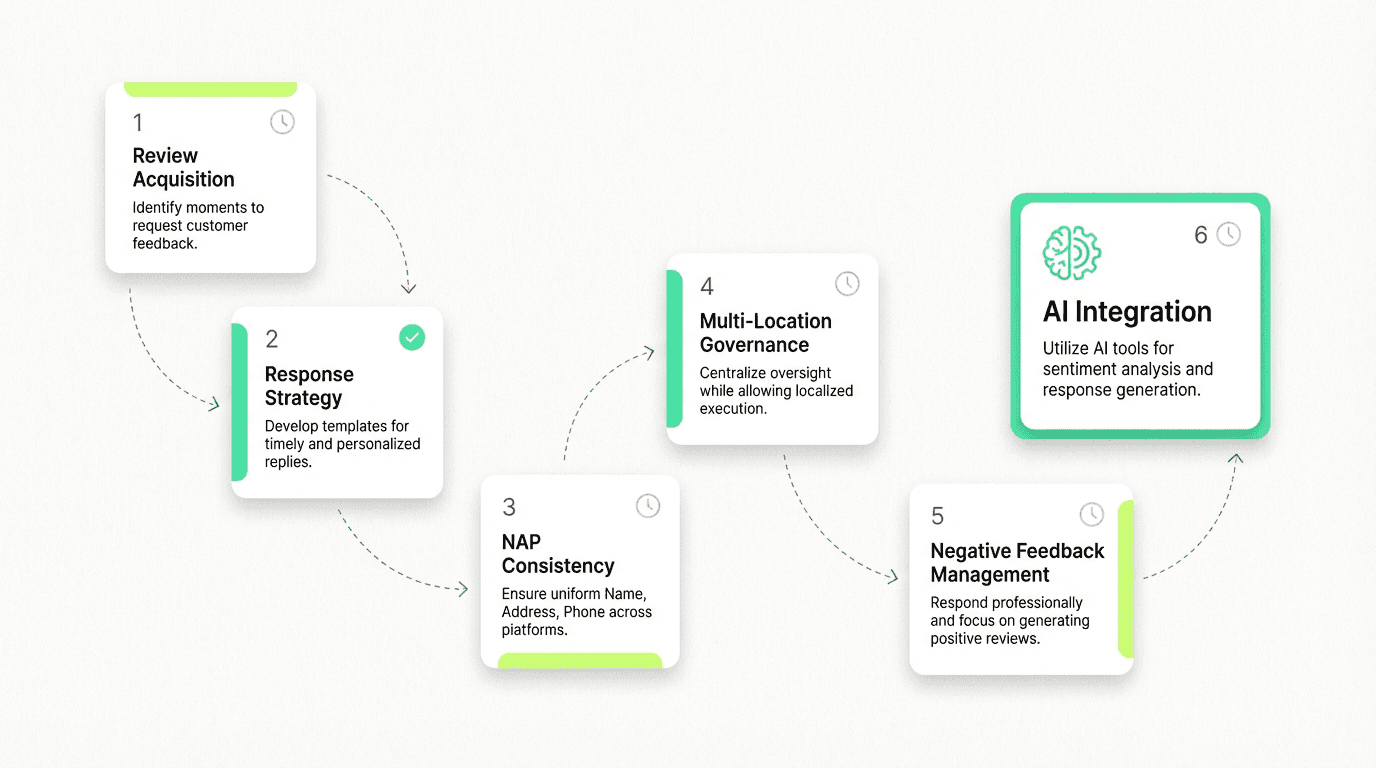
Online reputation management is now mission-critical infrastructure—customer reviews influence both traditional rankings and AI-powered recommendation systems that parse content for semantic signals
Build a review acquisition SOP with trigger moments, frictionless request mechanisms, and team training; respond to customer feedback within 24-48 hours using personalized templates that acknowledge specific details
NAP consistency (Name, Address, Phone) across all citations is foundational—inconsistencies erode trust signals; prioritize fixing data aggregators (Neustar, Acxiom, Factual) to auto-correct hundreds of downstream listings
Multi-location operations require centralized governance with localized execution: master location database, proper GBP access controls, and scalable response systems
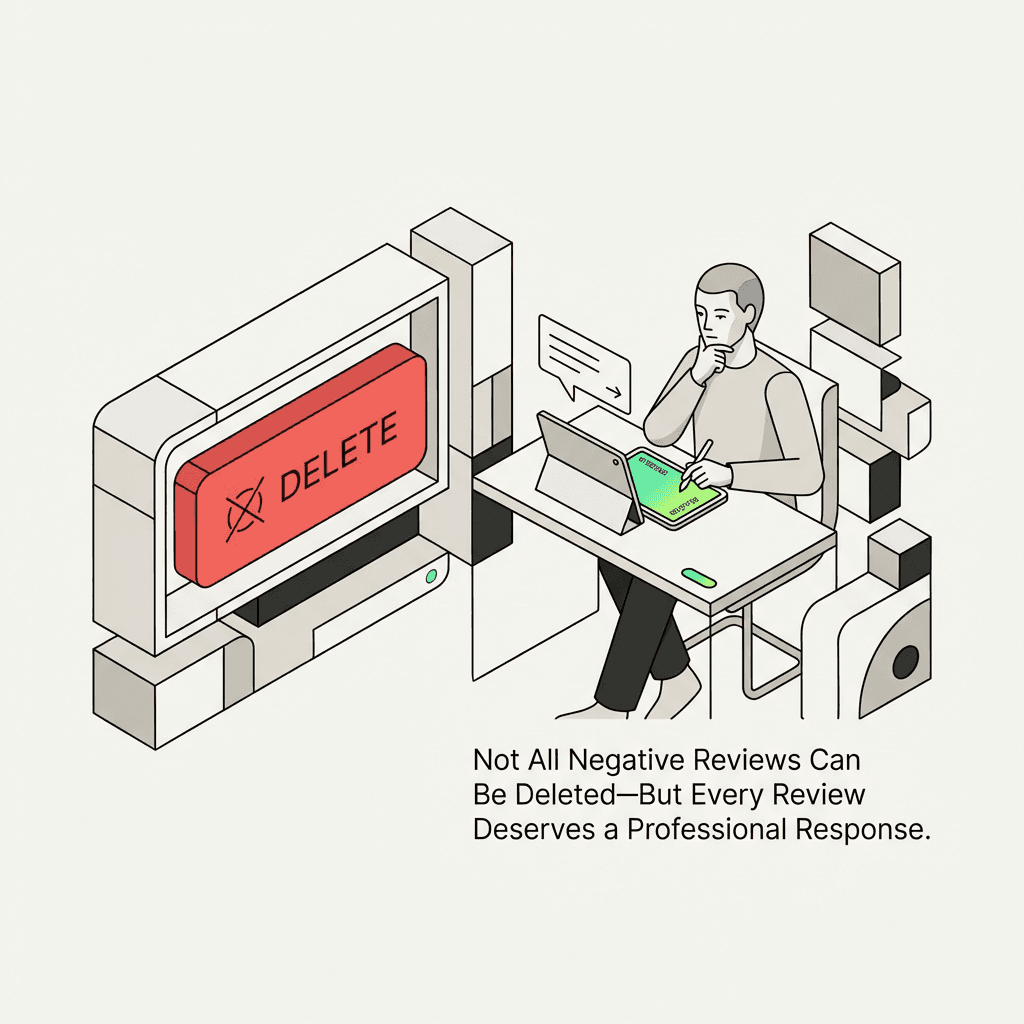
Legitimate negative feedback that doesn't violate policies can't be removed—focus on professional responses, generating fresh positive reviews, and fixing underlying operational issues
Review management software and AI marketing agents now enable enterprise-grade reputation governance at scale: sentiment analysis across thousands of pieces of customer feedback, automated NAP inconsistency detection, draft responses for human approval, and consolidated "reputation pulse" reporting—all without massive teams
In the hyper-competitive landscape of local search, your star rating isn't just a vanity metric—it's a ranking signal, a trust indicator, and often the deciding factor between a click and a scroll-past. Online reputation management has evolved from "nice to have" to mission-critical infrastructure for any business serious about local visibility. Whether you're managing a single storefront or orchestrating reputation across 200 franchise locations, the operational playbooks you build today will determine your prominence tomorrow.
Here's the reality: Google's local algorithm weighs customer reviews heavily in its prominence calculations. But beyond the algorithm, your online reviews are now being read, analyzed, and cited by AI assistants answering queries like "best Italian restaurant near me with fast service." The stakes have multiplied, and so has the complexity. This guide will walk you through building scalable systems for managing Google reviews, maintaining NAP consistency across citation sources, and governing access across multi-location operations—with a clear-eyed look at how ai marketing agents are transforming this entire discipline.
Why Google Reviews Management Matters More Than Ever
Google Business Profile (GBP) customer reviews don't just influence consumer behavior—they directly impact where you appear in the Local Pack, Maps results, and even organic search. Studies consistently show that businesses with higher star ratings and review volume outrank competitors with identical category and location signals.
But the influence extends beyond traditional SEO. AI-powered search assistants and recommendation engines now parse review content to understand what your business actually delivers. When a customer writes "the delivery was incredibly fast," that becomes a machine-readable signal. AI systems extract sentiment, identify themes (service speed, product quality, staff friendliness), and use that intelligence to answer natural language queries. Your customer feedback is no longer just social proof—it's structured data for the AI era, powering modern ai marketing workspace solutions.
The Three Pillars of Local Reputation Infrastructure
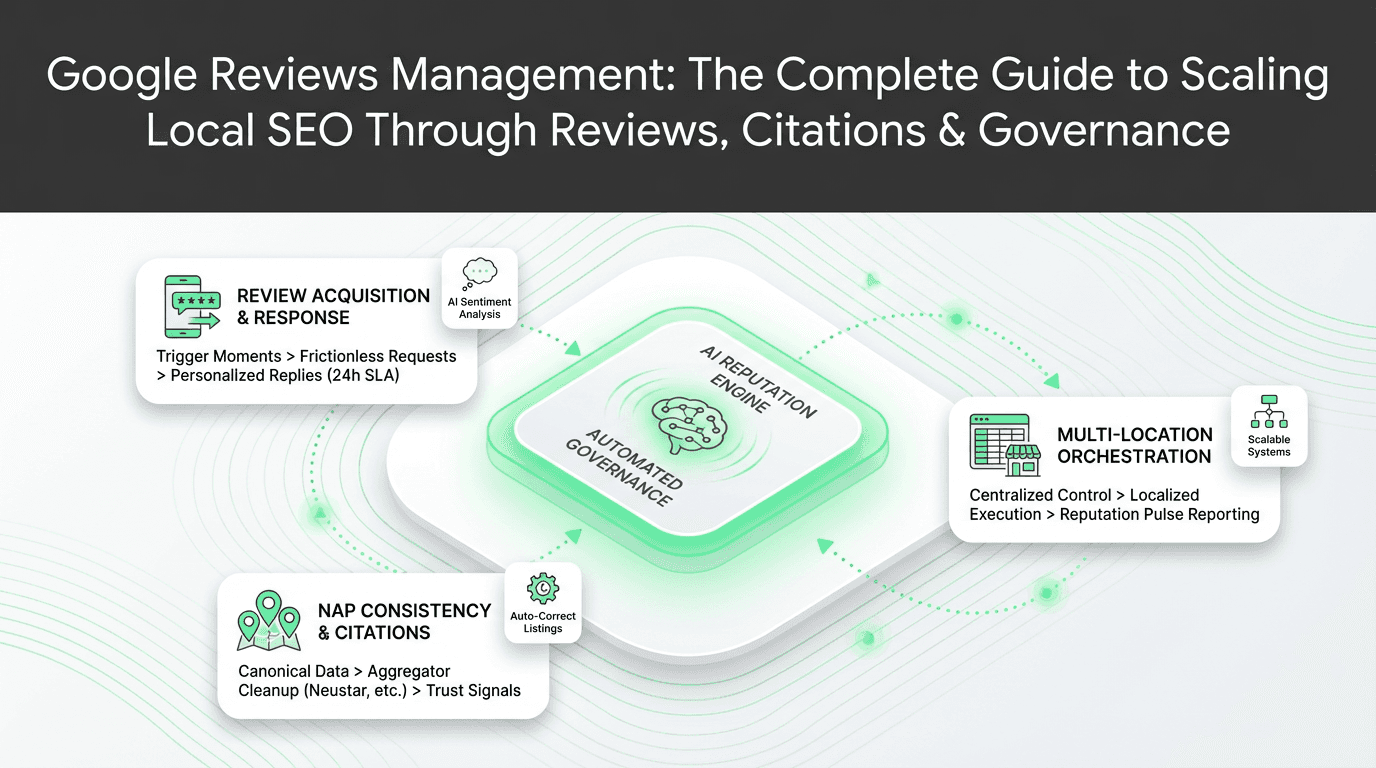
Effective reputation management strategy rests on three operational pillars:
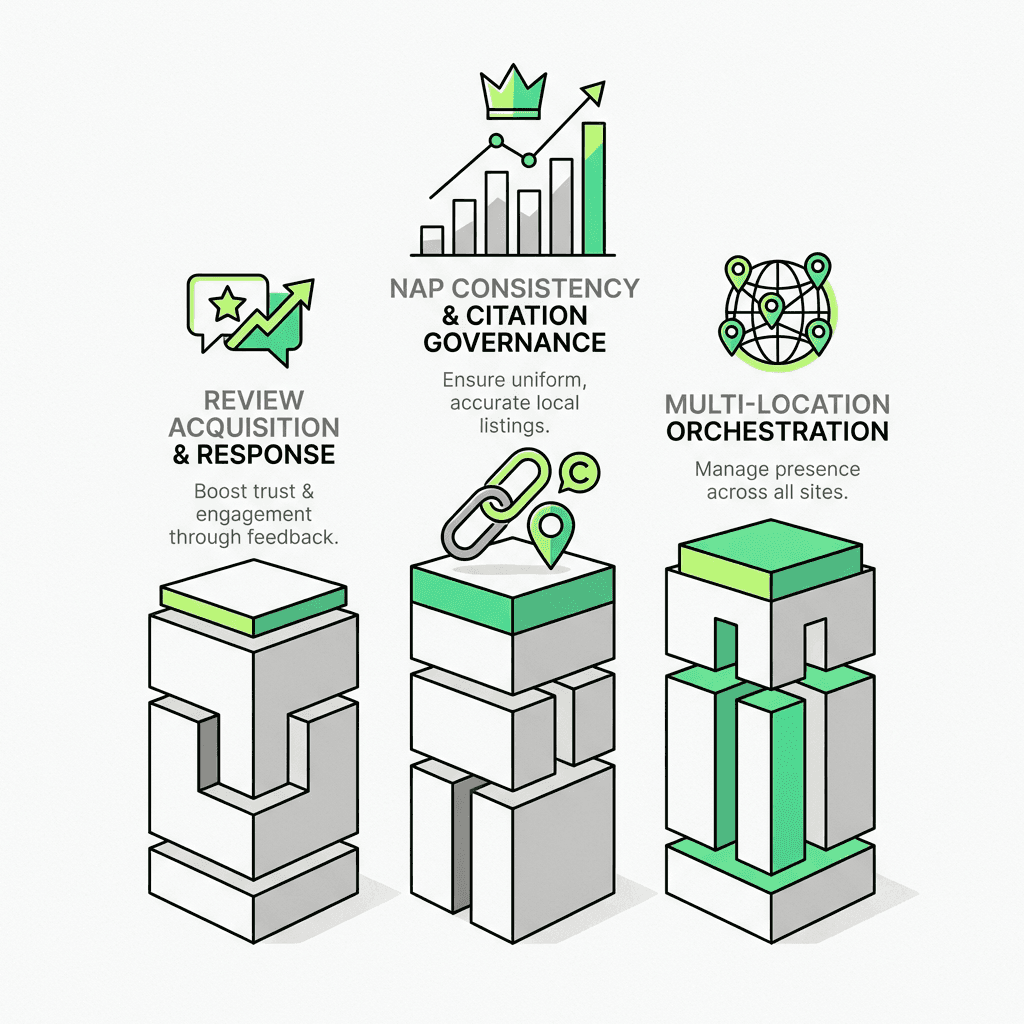
Review Acquisition & Response: Systematic processes for generating authentic customer reviews and engaging with every piece of feedback
NAP Consistency & Citation Governance: Ensuring your business name, address, and phone number are identical across every directory, listing, and platform
Multi-Location Orchestration: Centralized oversight with localized execution, especially critical for franchises, healthcare networks, and retail chains
Master these three, and you've built a reputation engine that compounds over time. Neglect any one, and you're leaving rankings—and revenue—on the table.
Building Your Review Acquisition SOP: From Ad-Hoc to Systematic
Most small businesses approach review generation reactively: a happy customer leaves a glowing testimonial, and everyone celebrates. A one-star bomb drops, and panic ensues. This ad-hoc approach doesn't scale, and it doesn't build the consistent review velocity that search algorithms reward.
The Review Acquisition Playbook
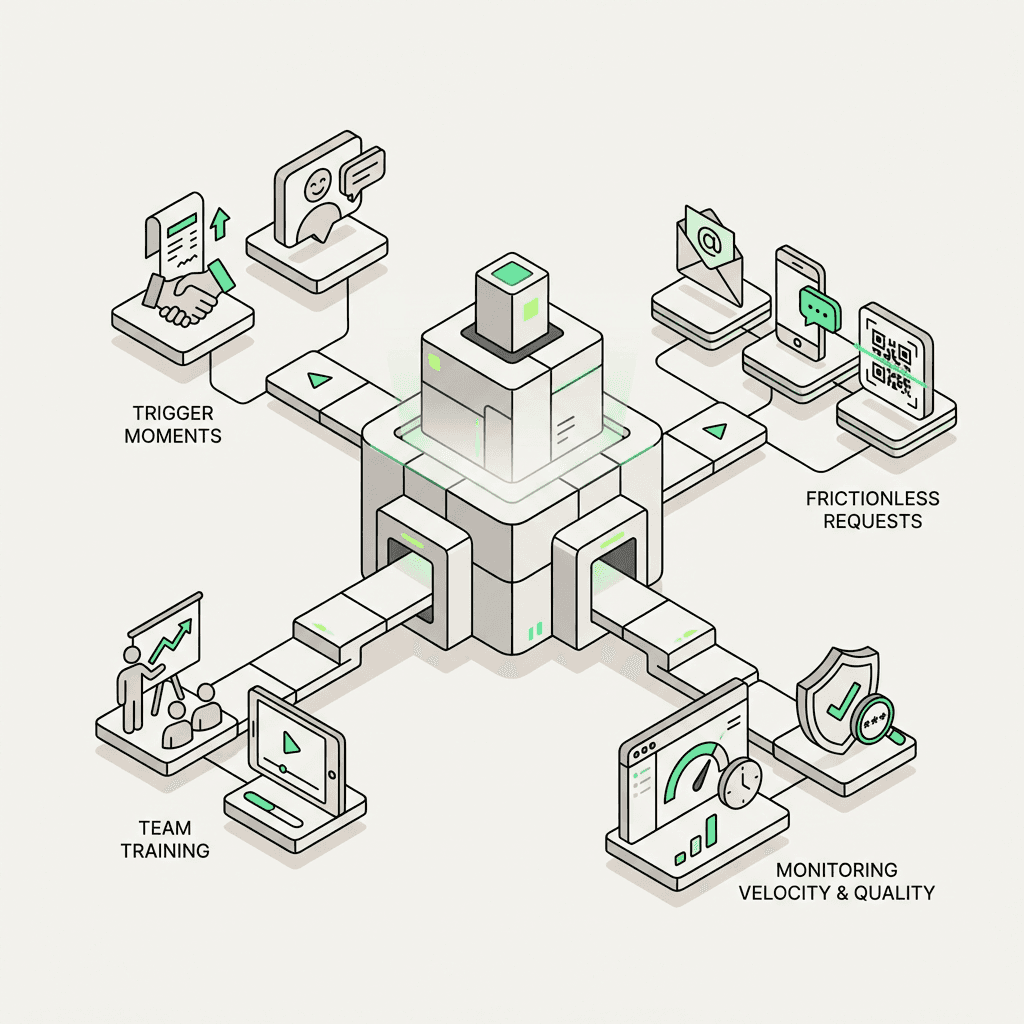
Step 1: Identify Your Review Trigger Moments
Map the customer journey and pinpoint the moments of peak customer satisfaction. For a restaurant, it's right after a great meal. For a home services company, it's immediately after project completion. For SaaS, it might be after a customer achieves their first major win with your product.
Step 2: Build Frictionless Review Requests
The easier you make it, the higher your conversion rate. Create a direct link (find it in your GBP dashboard under "Get more reviews") and embed it in:
Post-purchase email sequences
SMS follow-ups (with proper opt-in compliance)
Printed cards or QR codes at point of sale
Digital receipts and invoices
Step 3: Train Your Team on Ethical Review Generation
Google's policies are clear: you can ask for customer reviews, but you cannot incentivize, gate (only asking happy customers), or write fake content. Train your staff to make authentic review requests: "We'd love to hear about your experience—would you mind sharing your feedback on our profile?"
Step 4: Monitor Review Velocity and Quality
Track weekly volume, average star rating, and response rate. Sudden drops in volume may indicate process breakdowns. Sudden rating shifts warrant immediate investigation. Utilizing ai tools for marketing can help automate the monitoring and analysis of your review data for actionable insights.
Review Response Playbook: Every Review Deserves a Reply
Responding to reviews isn't just good manners—it's an algorithmic signal and a public demonstration of your commitment to customer experience. Here's your operational framework:
For Positive Reviews (4-5 Stars):
Template Structure:
Example:
For Negative Reviews (1-3 Stars):
Template Structure:
Example:
Critical Rules:
Respond to reviews within 24-48 hours maximum
Never argue or get defensive
Take heated conversations offline
Personalize every response (no copy-paste generic replies)
Thank positive reviewers and acknowledge specific details they mentioned
How to Remove Bad Reviews: When (and How) to Fight Back
Not all negative feedback is legitimate. Fake content, competitor sabotage, and posts that violate platform policies can and should be challenged. Here's your tactical guide for managing negative reviews that don't belong.
Google's Review Policy Violations
The platform will remove content that:
Contains spam or fake content
Is off-topic (reviewing the wrong business)
Includes illegal content, hate speech, or harassment
Contains personal information or impersonation
Represents conflicts of interest (competitors, disgruntled employees)
The Removal Process
Flag the content directly in your Google Business Profile dashboard or through Maps
Select the violation category that best matches the issue
Provide context if the option is available (screenshots, evidence of fake patterns)
Wait for platform review (typically 3-7 days, sometimes longer)
If your request is denied and you have strong evidence the content violates policy, you can escalate by contacting Google reviews support through the Google Business Profile Help Community or via Twitter @GoogleBusiness.
When You Can't Remove It: The Reputation Recovery Strategy
For legitimate negative feedback that doesn't violate policy, removal isn't an option. Instead:
Respond professionally and offer to resolve the issue offline
Generate fresh positive reviews to dilute the negative's impact
Improve the underlying issue the feedback highlighted (operational quality affects performance)
Monitor for patterns: Multiple mentions of the same problem demand operational changes
Consider leveraging an ai productivity tool to help streamline review monitoring and response efforts across locations.
NAP Consistency: The Foundation of Local SEO Trust
Your business Name, Address, and Phone number (NAP) must be identical everywhere they appear online. Inconsistencies—"123 Main St." vs. "123 Main Street," different phone numbers, abbreviated vs. full names—confuse search engines and erode trust signals.
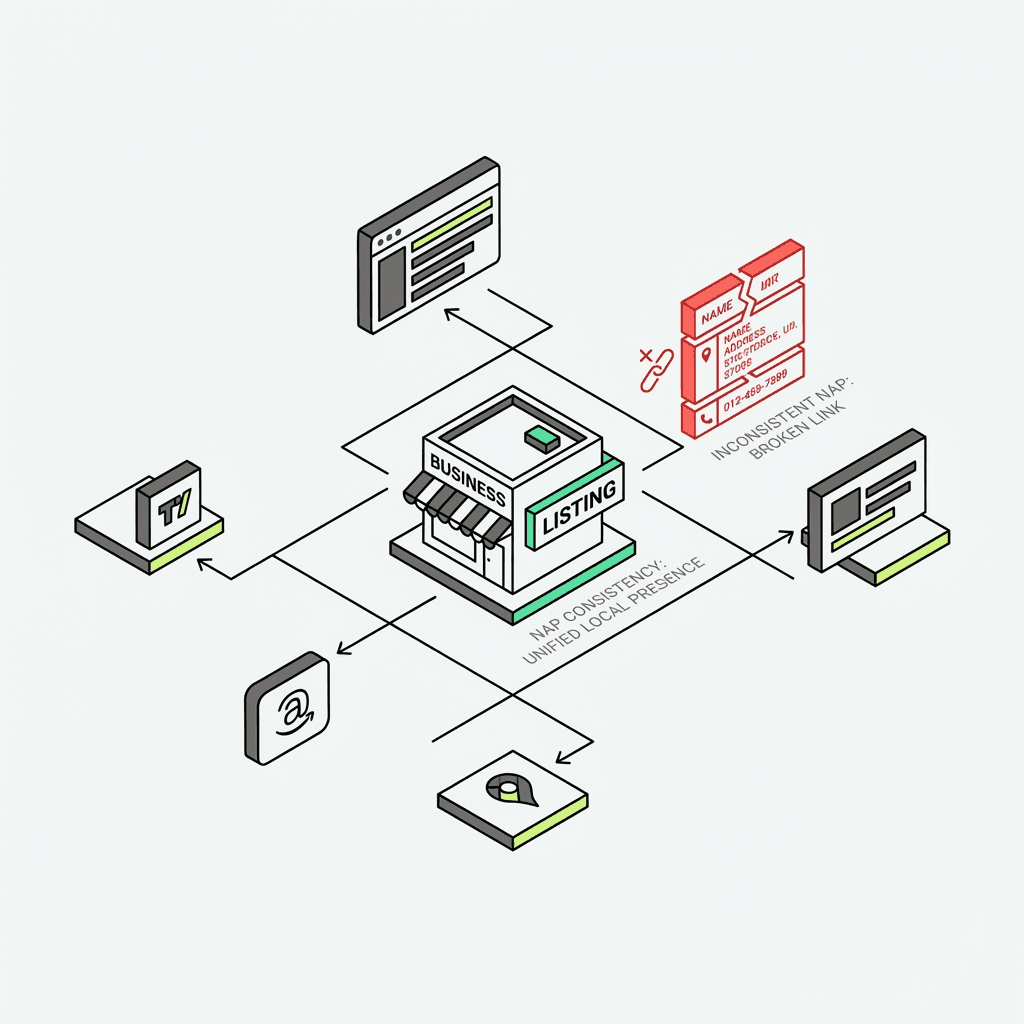
Why NAP Consistency Matters
Search engines build confidence in your data through corroboration. When 50 citation sources all list identical NAP information, algorithms trust that data. When those sources conflict, search engines must choose which version is correct—or worse, may suppress your business listing entirely due to ambiguity.
Local citations—mentions of your NAP on directories, review sites, blogs, and industry-specific platforms—act as validation. The more consistent citations you have from authoritative sources, the stronger your foundation for local search visibility. Modern ai workflow automation platforms can help monitor and update NAP data efficiently across numerous sources.
The NAP Audit Process
Step 1: Establish Your Canonical NAP
Document the exact format you'll use everywhere:
Business Name: Antonio's Italian Kitchen (not Antonio's, not Antonio's Italian Kitchen & Bar)
Address: 123 Main Street, Suite 4B (not 123 Main St. #4B)
Phone: (555) 123-4567 (not 555.123.4567 or 5551234567)
Step 2: Audit Existing Citations
Use reputation management software like Moz Local, BrightLocal, or Whitespark to discover where your business is listed. Manually check:
Google Business Profile
Yelp, Facebook, Apple Maps
Industry-specific directories (Avvo for lawyers, Healthgrades for doctors, etc.)
Data aggregators (Neustar/Localeze, Acxiom, Factual, Foursquare)
Step 3: Citation Cleanup Checklist
Step 4: Claim and Optimize Unclaimed Listings
If you find listings you didn't create, claim them and update the information. These "found citations" are valuable—don't delete them unless they're duplicates.
Multi-Location SEO: Governance at Scale
Managing online reputation and citations for one location is straightforward. Managing 50, 100, or 500 locations requires enterprise-grade governance, centralized oversight, and localized execution.
The Multi-Location Challenge
Each location needs:
Its own optimized profile
Unique, localized content (not duplicate descriptions)
Individual review management
Consistent NAP across all citations
Proper access controls (franchise owners shouldn't have admin access to corporate-level settings)
Centralized Location Data Management
Build a Master Location Database
Create a single source of truth—a spreadsheet or database containing:
Location ID
Canonical NAP
GBP listing URL
Primary contact/manager
Access permissions
Performance metrics (review count, average star rating, monthly velocity)
Implement Access Governance
Use Google Business Profile's user roles carefully:
Owner: Reserved for corporate/headquarters
Manager: For regional directors who oversee multiple locations
Site Manager: For individual location managers (can respond to customer reviews, update hours, post updates—but can't delete the listing or remove other users)
Scaling Review Response Across Locations
Responding to hundreds or thousands of pieces of customer feedback monthly is impossible without systems. Options include:
Regional response teams: Assign clusters of locations to team members who understand context
Templated frameworks with required personalization: Provide response templates but mandate that teams customize with specific customer details
AI-assisted draft generation: More on this in the next section, where an ai workflow builder can help automate and personalize large-scale responses.
How AI Marketing Automation Is Transforming Review & Citation Governance
The manual processes outlined above work—but they don't scale efficiently beyond a certain threshold. This is where AI marketing automation and AI marketing agents are fundamentally changing the game.
AI Sentiment Analysis: Understanding Review Themes at Scale
Instead of manually reading 10,000 pieces of customer feedback across 100 locations to identify patterns, AI sentiment analysis can:
Categorize content by theme (service speed, product quality, cleanliness, staff friendliness)
Track customer sentiment trends over time ("Location #47's service speed sentiment dropped 15% this month")
Surface actionable insights ("23% of negative feedback mentions parking issues")
Identify outlier locations that need immediate attention
This intelligence allows you to shift from reactive firefighting to proactive operational improvement and is a hallmark of advanced ai powered marketing tools.
AI as a Citation Factor: Why Review Content Matters More Than Ever
AI assistants don't just look at your star rating—they read and interpret customer feedback content. When a user asks, "Which pizza place has the fastest delivery?", AI systems scan online reviews for mentions of delivery speed, extract sentiment, and use that data to formulate recommendations.
Your review content is now machine-readable intelligence. Encouraging customers to mention specific attributes (speed, quality, friendliness) in their feedback amplifies your visibility in AI-mediated search.
The Metaflow Agent Opportunity: Governance Without the 20-Person Team
This is where platforms like Metaflow AI demonstrate the power of natural language agent orchestration for marketing designed for growth teams. Instead of stitching together fragmented automation tools, disconnected APIs, and rigid if-then workflows, you can design and deploy AI agents for marketing that handle complex, multi-step reputation governance:
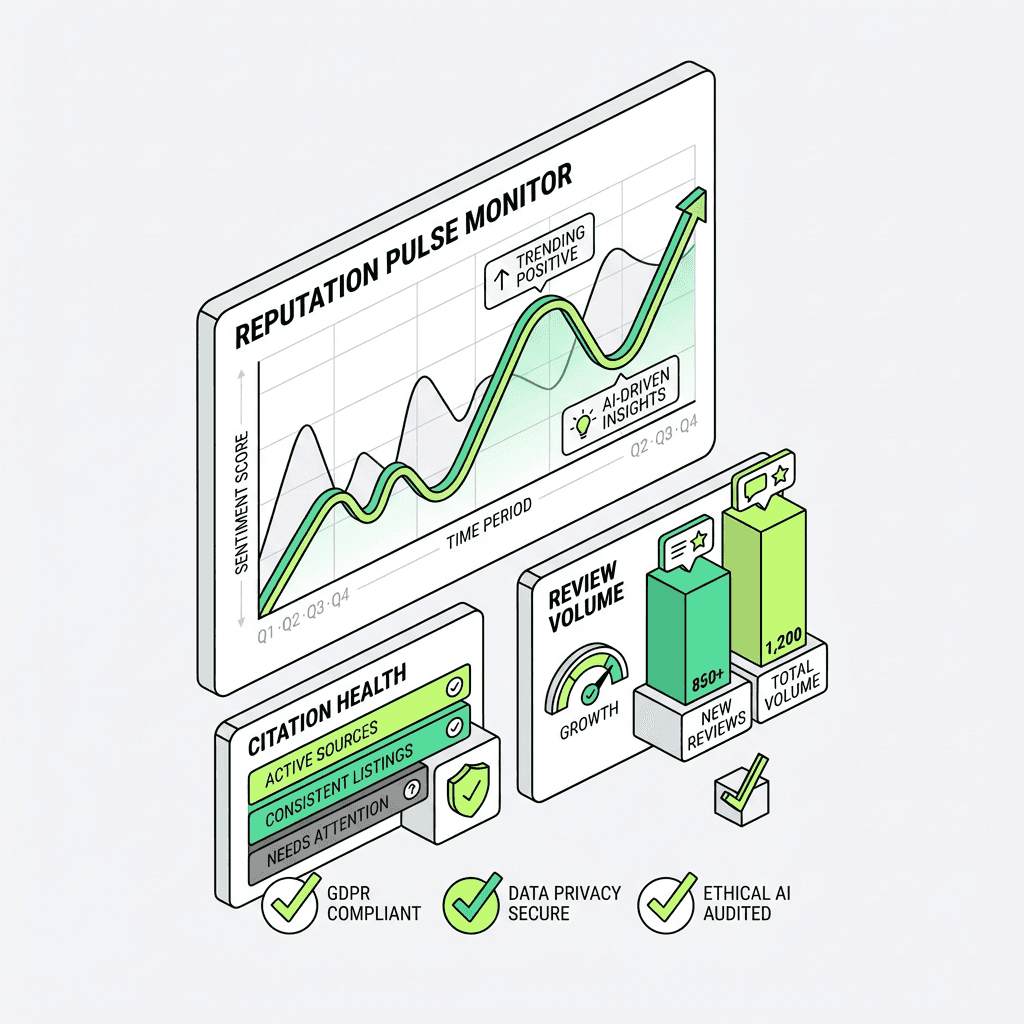
Example Agent Workflow: "Reputation Pulse Monitor"
Daily review ingestion: Agent monitors all GBP locations for new customer feedback
Sentiment analysis: Categorizes each piece by sentiment and theme
Draft personalized responses: Generates contextual reply drafts using specific details, ready for human approval
NAP inconsistency flagging: Crawls citation sources, compares against canonical database, flags discrepancies
Weekly reporting: Compiles a "reputation pulse" dashboard showing:
This isn't a rigid, pre-built workflow. It's an agent you can design in natural language, iterate on based on your team's needs, and deploy without writing code. The result: enterprise-grade governance without enterprise-grade headcount.
For growth teams managing multi-location SEO at scale, this represents a fundamental shift. You're no longer choosing between "hire more people" or "accept inconsistent execution." You're building intelligent systems that augment your team's capabilities, freeing cognitive bandwidth for high-impact strategic work while the agent handles operational consistency.
Putting It All Together: Your 90-Day Reputation Growth Plan
Ready to operationalize everything we've covered? Here's your tactical roadmap:
Days 1-30: Foundation & Audit
Establish canonical NAP for all locations
Complete citation audit using the cleanup checklist
Claim all unclaimed listings
Set up GBP access governance (proper user roles)
Baseline current metrics (volume, average star rating, response rate)
Days 31-60: Process Implementation
Launch acquisition SOP (trigger moments, request templates, team training)
Implement response playbook (templates, 24-48 hour SLA, personalization requirements)
Begin citation cleanup (prioritize data aggregators first for maximum impact)
Set up weekly monitoring dashboard
Days 61-90: Optimization & Scale
Analyze first 60 days of data for themes and patterns
Refine request timing and messaging based on conversion data
Address operational issues surfaced in negative feedback themes
Explore AI sentiment analysis tools or agent-based automation for scaling
Schedule quarterly NAP audit and citation refresh
Ongoing: Continuous Improvement
Monthly assessment of response quality and personalization
Quarterly citation audits
Semi-annual assessment of GBP access permissions
Ongoing operational improvements based on customer feedback themes
Advanced Tactics: Featured Snippet Optimization & Review Schema
Want to maximize visibility beyond the Local Pack? Two advanced tactics:
Optimize for Review-Related Featured Snippets
Create FAQ content targeting questions like:
"How do I respond to a negative review?"
"What is NAP consistency in local SEO?"
"How many customer reviews do I need to rank?"
Structure answers concisely (40-60 words), use question-format headings, and provide direct, actionable answers. To further boost content, consider using ai tools for content marketing to identify key topics and optimize your FAQ sections.
Implement Review Schema Markup
If you display customer reviews on your website, use schema.org markup to help search engines understand and potentially display your star ratings in organic search results. This creates additional SERP real estate and trust signals beyond your GBP listing.
The Competitive Advantage of Operational Excellence
Here's the truth that most businesses miss: your competitors are likely managing their online reputation haphazardly, ignoring citation inconsistencies, and treating reputation as an afterthought. Online reputation management executed with operational discipline isn't just about avoiding penalties—it's about building a compounding advantage.
Every consistent citation reinforces trust. Every thoughtful review response demonstrates commitment to customer service. Every week of sustained velocity strengthens prominence signals. This isn't a quick-win tactic; it's infrastructure that pays dividends for years.
And in an era where AI systems increasingly mediate discovery—reading customer reviews, extracting signals, and making recommendations—the businesses that treat reputation as a strategic discipline will dominate local search and AI-powered recommendations alike.
The question isn't whether to invest in systematic review and citation governance. The question is whether you'll build these systems before or after your competitors do.
FAQs
What is online reputation management for local businesses?
Online reputation management is the systematic process of monitoring, influencing, and managing customer reviews, citations, and business listings across digital platforms. It encompasses review acquisition and response, NAP consistency maintenance, and multi-location governance to strengthen local SEO rankings and build consumer trust. Modern reputation management also serves as structured data for AI-powered search assistants that analyze review content to answer natural language queries.
How do Google reviews affect local SEO rankings?
Google Business Profile reviews directly impact local search rankings through Google's prominence calculations in the Local Pack and Maps results. Higher star ratings and review volume signal business quality to search algorithms, while review content provides semantic signals that AI systems parse to understand service attributes like speed, quality, and customer satisfaction. Businesses with consistent positive reviews and high response rates typically outrank competitors with identical location and category signals.
What is NAP consistency and why does it matter?
NAP consistency means maintaining identical Name, Address, and Phone number formatting across all online directories, citations, and platforms. Inconsistent NAP data—such as "123 Main St." versus "123 Main Street"—confuses search engines and erodes trust signals, potentially causing algorithms to suppress business listings entirely. Consistent citations from authoritative sources validate your business information and strengthen local SEO foundation.
How quickly should you respond to Google reviews?
Businesses should respond to all Google reviews within 24-48 hours maximum. Rapid response rates signal active customer engagement to both algorithms and potential customers, while delayed responses suggest poor customer service commitment. Every review response should be personalized with specific details the customer mentioned rather than generic copy-paste replies, and negative reviews require especially prompt attention to demonstrate accountability.
Can you remove negative Google reviews that are legitimate?
Legitimate negative reviews that don't violate Google's policies cannot be removed, even if they're unfavorable. Google only removes reviews containing spam, fake content, off-topic information, illegal content, hate speech, harassment, personal information, or conflicts of interest like competitor sabotage. For legitimate criticism, focus on professional public responses, generating fresh positive reviews to dilute negative impact, and fixing underlying operational issues mentioned in feedback patterns.
What are data aggregators and why should you prioritize them for citation cleanup?
Data aggregators like Neustar/Localeze, Acxiom, Factual, and Foursquare are authoritative databases that syndicate business information to hundreds of downstream directories and platforms. Correcting NAP inconsistencies at the aggregator level automatically propagates accurate data across their entire distribution network, making them the highest-leverage citation cleanup targets. Fixing four aggregators can correct hundreds of citations simultaneously compared to manual updates.
How do you manage Google reviews across multiple business locations?
Multi-location review management requires centralized governance with localized execution: maintain a master location database with canonical NAP data, implement proper Google Business Profile access controls using Owner, Manager, and Site Manager roles, and establish scalable review response systems. Regional response teams, templated frameworks requiring personalization, or AI-assisted draft generation enable consistent engagement across dozens or hundreds of locations without massive teams.
How is AI transforming online reputation management?
AI marketing automation enables enterprise-grade reputation governance through sentiment analysis that categorizes thousands of reviews by theme and tracks trends, automated NAP inconsistency detection across citation sources, draft response generation for human approval, and consolidated reporting dashboards. AI assistants now read and interpret review content as machine-readable intelligence to answer natural language queries, making review content quality as important as star ratings for visibility in AI-powered search and recommendations.
What should a review acquisition process include?
An effective review acquisition SOP identifies customer journey trigger moments of peak satisfaction, creates frictionless review request mechanisms like direct GBP links in post-purchase emails and SMS, trains teams on ethical generation without incentives or gating, and monitors weekly volume and quality metrics. The process must comply with Google's policies prohibiting fake reviews, incentivization, or selective requests only to satisfied customers.
What are the three pillars of local reputation infrastructure?
The three operational pillars are: Review Acquisition & Response (systematic processes for generating authentic reviews and engaging every piece of feedback within 24-48 hours), NAP Consistency & Citation Governance (ensuring identical business name, address, and phone formatting across all directories and platforms), and Multi-Location Orchestration (centralized oversight with localized execution for franchise operations, healthcare networks, and retail chains). Mastering all three creates a compounding reputation advantage over time.