







TL;DR:
Programmatic SEO (pSEO) creates hundreds/thousands of pages automatically, but Google's 2024 update now penalizes "scaled content abuse" — thin, template-swapped pages designed to manipulate rankings
The new standard: Each page must have ≥60% different content, pull from 3+ sources, and provide value beyond a results page
AI changes everything: Modern pSEO uses AI to generate genuinely distinct insights per page (local stats, product comparisons, review synthesis) rather than just {{city}} swaps
Quality automation is essential: Implement checks for uniqueness ratio, word count, source diversity, readability, and schema validity before publishing
Successful examples: Zillow (MLS information per property), Zapier (integration workflows), NerdWallet (personalized card comparisons) all pass the bar
Metaflow advantage: Build pSEO as parameterized agent workflows with checks and compliance trails — every generation decision is auditable and adjustable
Implementation checklist: Define page spec → require N distinct fields per page → automate QA scoring → monitor index coverage → iterate on underperformers
Future-proof approach: Focus on entity relationships, structured information, and generative engine optimization (GEO) as search evolves beyond traditional rankings
This guide provides a step-by-step strategy for building programmatic SEO that drives website traffic and reaches potential customers while maintaining search engine compliance
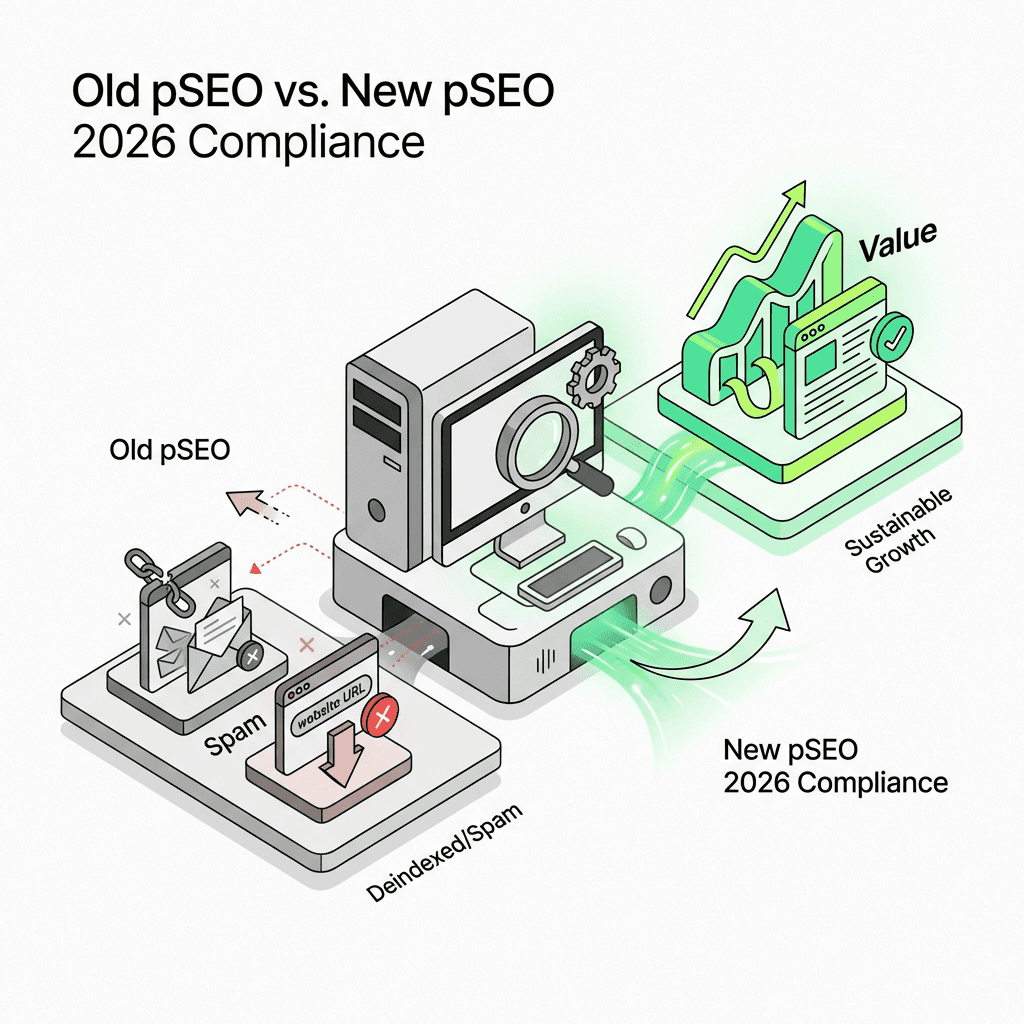
The promise of programmatic SEO has always been tantalizing: generate thousands of pages automatically, rank for long-tail keywords, and capture search traffic at scale. But in 2026, the landscape has fundamentally shifted. Google's March 2024 Helpful Content Update explicitly targeted "scaled content abuse" — and suddenly, the old playbook of template-based landing pages filled with {{city}} swaps became a fast track to deindexing.
Yet programmatic SEO isn't dead. It's evolving. The question is no longer whether you can build website pages at scale, but how you build them with real differentiation, automated quality checks, and genuine value for users. In this guide, we'll explore what is programmatic SEO in the modern era, examine programmatic seo examples that work (and those that don't), and show you how AI marketing agents are transforming pSEO from a risky tactic into a defensible, scalable growth strategy.
What Is Programmatic SEO? A 2026 Definition
Programmatic SEO (pSEO) is the practice of creating hundreds or thousands of web pages automatically using templates, a database, and code — with the goal of ranking for a large number of related queries. Think Zillow's millions of property listings, Yelp's location-based business profiles, or Zapier's integration documentation.
At its core, programmatic seo tools and techniques allow you to:
Scale content creation beyond what a human team could manually produce
Target long-tail keywords systematically (e.g., "best CRM for real estate agents in Austin")
Leverage structured data from your database or Excel spreadsheet to populate templates with information
Automate publishing workflows so new website pages go live as your data updates
But here's the critical distinction in 2026: not all programmatic content is created equal. Search engines now draw a bright line between legitimate programmatic pages (like Zillow's property listings with real MLS data) and what they call doorway pages or scaled content abuse — thin, low-value landing pages designed solely to manipulate rankings.
The Scaled Content Abuse Problem: Why Old pSEO Tactics Fail
Google's March 2024 update introduced a new category of spam: scaled content abuse. According to the search engine's spam policies, this includes:

> "Generating many pages where the content is only slightly different, with the primary purpose of manipulating search rankings rather than helping users."
The tell-tale signs of scaled content abuse include:
Template swaps with no insight: Individual pages that only change a city name, product name, or keyword while keeping everything else identical
Doorway pages: Low-value landing pages created to funnel users to a single destination
Thin content at scale: Hundreds of web pages with minimal differentiation, often auto-generated without human review
Keyword stuffing patterns: Repeating target keywords unnaturally across templated sections
The penalty is severe: sites engaging in scaled content abuse see mass deindexing, with thousands of pages vanishing from results overnight. Recovery can take months or be impossible.
Real-World Casualties: pSEO Gone Wrong
Several high-profile cases illustrate the risk:
Local service directories that generated category pages with identical content except for location names lost 70-90% of organic traffic
SaaS comparison sites creating "Tool A vs Tool B" pages for every combination without analysis saw manual actions
Affiliate content farms using AI to create thousands of blog posts with minimal differentiation were hit hardest
The lesson? Volume without value is now a liability, not an asset.
How AI Is Changing Programmatic SEO (For the Better)
Here's the paradox: the same AI technology that makes it easier to generate scaled content abuse also makes it possible to create genuinely valuable programmatic pages at scale.
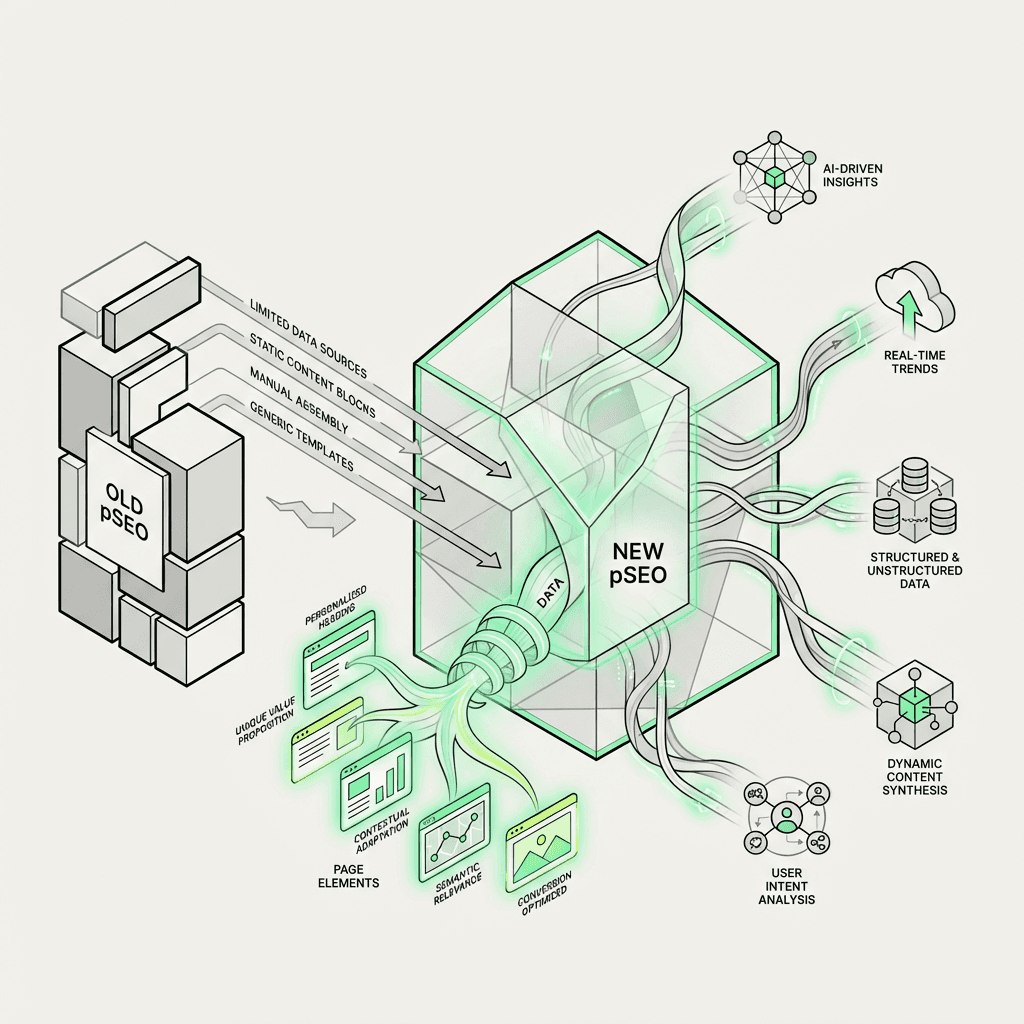
The difference lies in how you use AI and leveraging the right ai tools for digital marketing.
Old pSEO: Template Swaps
Every page is 95% identical. No insights. Pure manipulation.
New pSEO: AI-Generated Insights
Each page pulls from:
Local market statistics (median prices, growth rates, inventory levels)
Product-specific information (features, pricing, integrations)
User-generated content (reviews, ratings, testimonials filtered by location)
Comparative analysis (specific to that product/location combination)
This is where seo tools and generative engine optimization techniques shine: they can synthesize multiple sources into coherent narratives per page — something impossible at scale without AI.
Building pSEO With Real Differentiation: A Framework
To build programmatic page systems that pass the quality bar in 2026, follow this framework:
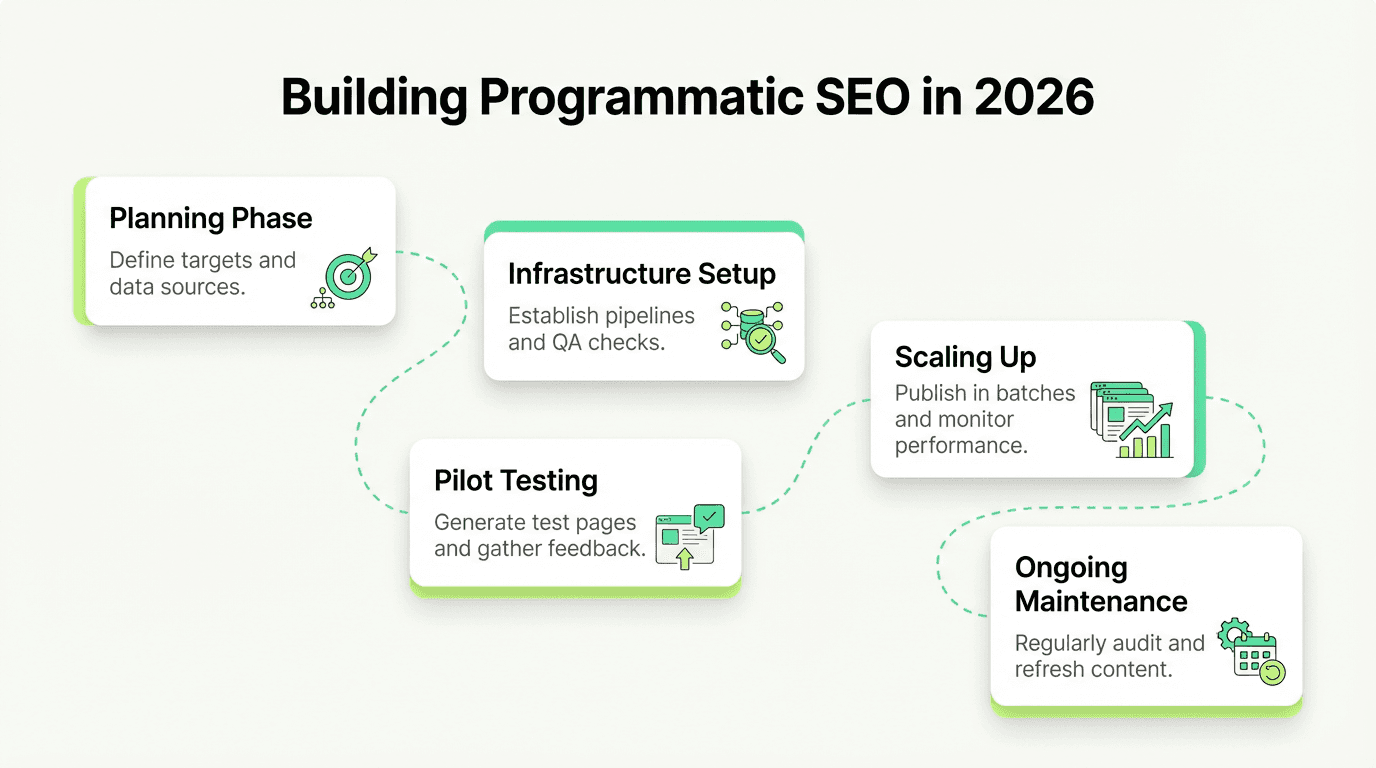
1. Define Your Page-Generation Spec
Start with a clear specification:
What query intent does each page serve? (informational, commercial, transactional)
What data sources will populate each page? (APIs, databases, user content)
What is the minimum threshold? (percentage of different content, number of distinct data points)
What value does each page add beyond a results page? (synthesis, comparison, local context)
Example spec for a real estate CRM comparison page:
2. Require Distinct Data Per Page Template
The key to avoiding doorway pages and thin content is ensuring every page has substantive distinct information.
Uniqueness check formula:
Set N (minimum distinct fields) based on your template complexity. For a comparison page, N might be 8-10 distinct data points (pricing, features, reviews, local stats, etc.).
3. Implement Automated Quality Checks
Manual review of thousands of pages is impossible. Instead, instrument your pSEO pipeline with automated QA checks using an ai workflow automation for growth approach:
Quality signals to measure:
Word count: Minimum 800-1000 words for informational content
Unique content ratio: At least 60% different from other pages in the set
Data source diversity: Pull from 3+ sources per page
Readability score: Flesch-Kincaid grade level appropriate for audience
Keyword stuffing detection: Flag pages with keyword density >3%
Internal link diversity: Each page links to varied related content
Schema markup validity: Structured data passes validation
Quality score threshold:
Only pages passing your threshold should be published and indexed.
4. Monitor Index Coverage and User Signals
Post-launch, track:
Index coverage rate: What percentage of submitted pages are indexed?
Average position: Are pages ranking competitively or stuck on page 5+?
Click-through rate: Are users clicking when pages do rank?
Bounce rate and time on site: Are users finding value or immediately leaving?
Manual action notifications: Any spam penalties in Search Console?
A healthy pSEO system shows:
70%+ index coverage rate
Improving average positions over 3-6 months
CTR above category baseline
Time on site >90 seconds
Declining index coverage or high bounce rates signal issues requiring intervention.
Programmatic SEO Examples That Work in 2026
✅ Zillow's Property Pages
Why it works: Every page pulls distinct information from MLS feeds — price, photos, property details, neighborhood stats, school ratings, market trends. No two pages are alike.
Key insight: The data is the differentiation. Zillow doesn't need to editorialize much because the structured information itself provides value.
✅ Zapier's Integration Pages
Why it works: Each "App A + App B Integration" page includes use cases, workflow templates, user reviews, and setup instructions specific to that combination.
Key insight: User-generated content (templates, reviews) adds differentiation at scale without manual writing.
✅ NerdWallet's Credit Card Comparison Pages
Why it works: Pages compare cards based on user profile (credit score, spending habits, location) with real-time APR information, reward calculations, and personalized recommendations.
Key insight: Personalization and calculation tools provide value beyond static content.
Programmatic SEO Tools for 2026
To execute modern pSEO, you'll need the best marketing ai tools that support both data and workflow automation.
Data Infrastructure
APIs and databases: Structured data sources (product catalogs, location information, user reviews)
Web scraping tools: For competitive intelligence and market research (used ethically and legally)
Data warehouses: BigQuery, Snowflake for storing and querying large datasets
Spreadsheet integration: Excel, Airtable for managing your database of source material
Content Generation
AI writing tools: GPT-4, Claude, or custom LLMs for generating narratives from your database
Template engines: Jinja2, Handlebars for rendering website pages
CMS with API: Headless CMS like Contentful, Sanity for managing programmatic content
Quality Assurance
Text similarity detection: Compare pages to flag excessive duplication
SEO analysis tools: Screaming Frog, Sitebulb for crawling and auditing at scale
A/B testing platforms: Optimize templates based on user engagement
Publishing and Monitoring
Static site generators: Next.js, Gatsby for fast, search engine-friendly page rendering
Search Console API: Monitor index coverage and performance
Analytics instrumentation: Track user behavior per template type
The Metaflow Advantage: pSEO With a Compliance Trail
Here's where traditional pSEO approaches break down: you lack visibility and control once you've generated thousands of pages. Which pages are underperforming? Which passed QA but are now thin? How do you audit decisions made by systems?
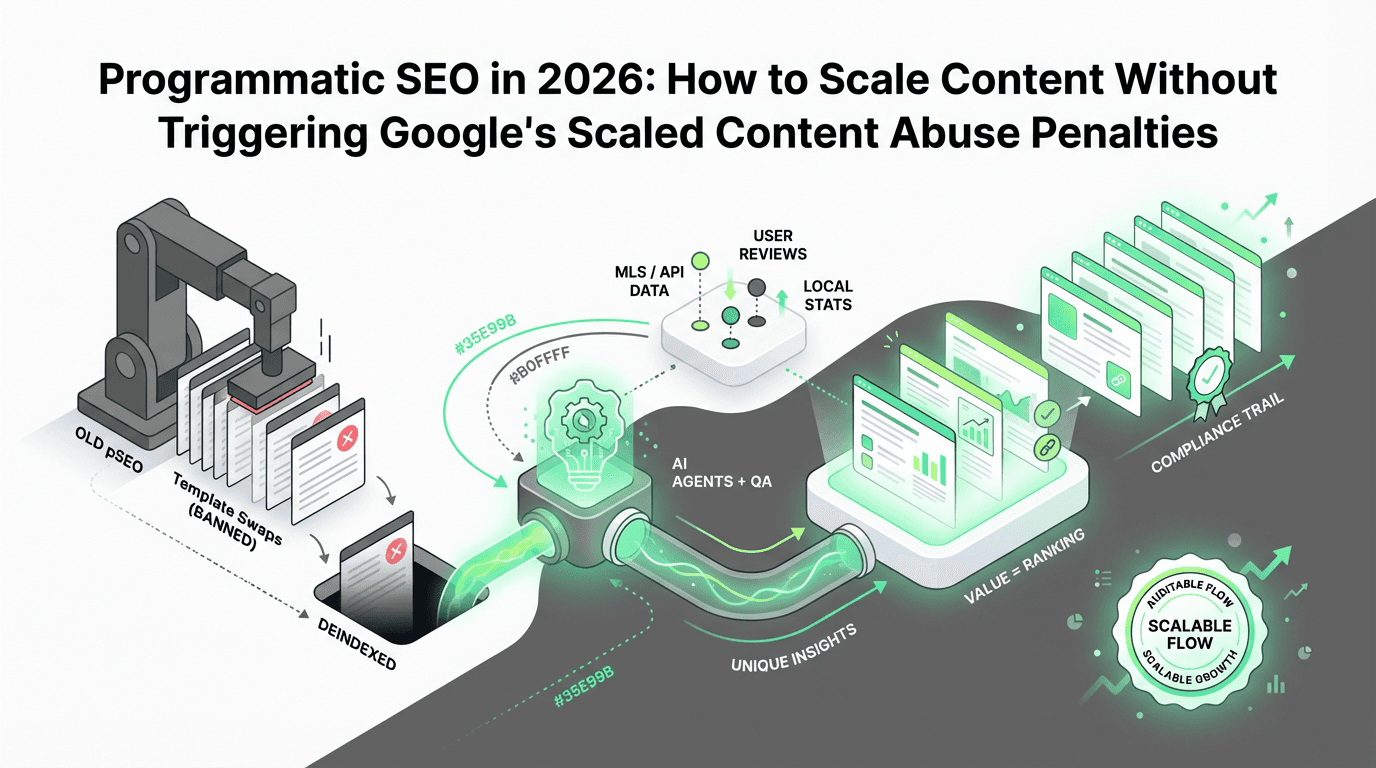
This is where AI marketing agents built on platforms like Metaflow change the game.
How Metaflow Makes Safe pSEO Tractable
Imagine each page as a parameterized flow run:
Data ingestion agent: Fetches sources for a given page (location stats, product details, user reviews)
Content generation agent: Uses AI to synthesize information into a coherent narrative, following your brand voice and SEO strategy
Quality assurance agent: Scores the generated page against your thresholds
Publishing decision agent: Only pages passing QA thresholds are published; others are flagged for review or discarded
Every step is logged, auditable, and adjustable.
Unlike traditional automation stacks where you write a script and hope for the best, Metaflow's no-code ai agent builder lets you:
Define rules in plain language: "Only publish if uniqueness score >60% and word count >800"
Iterate on templates quickly: Adjust prompts and see results without rewriting code
Audit any page's generation history: See exactly what information was used, what scores it received, and why it was published
Scale with confidence: As you add new page types or sources, the same QA framework applies
This is pSEO with a compliance trail — essential in an era where scaled content abuse can destroy your site's reputation overnight.
Real-World Metaflow pSEO Workflow
Use case: SaaS business wants to create pages 500 "Tool Category for Industry" comparison pages.
Metaflow agent workflow:
Result: 500 pages generated, 420 published automatically, 80 flagged for review. Every decision documented. No scaled content abuse risk.
Avoiding Doorway Pages: The Canonical Test
A simple test to determine if your website pages are doorway pages:

Ask yourself: 1. If a user lands on this page from a search engine, will they find what they're looking for on this page? 2. Or is the page just a thin gateway forcing them to click elsewhere?
Doorway page example (bad):
Valuable page (good):
The good page is the destination. The bad page is just a manipulative funnel.
Tactical Steps: Your pSEO Implementation Checklist
Ready to build programmatic SEO the right way? Follow these steps:
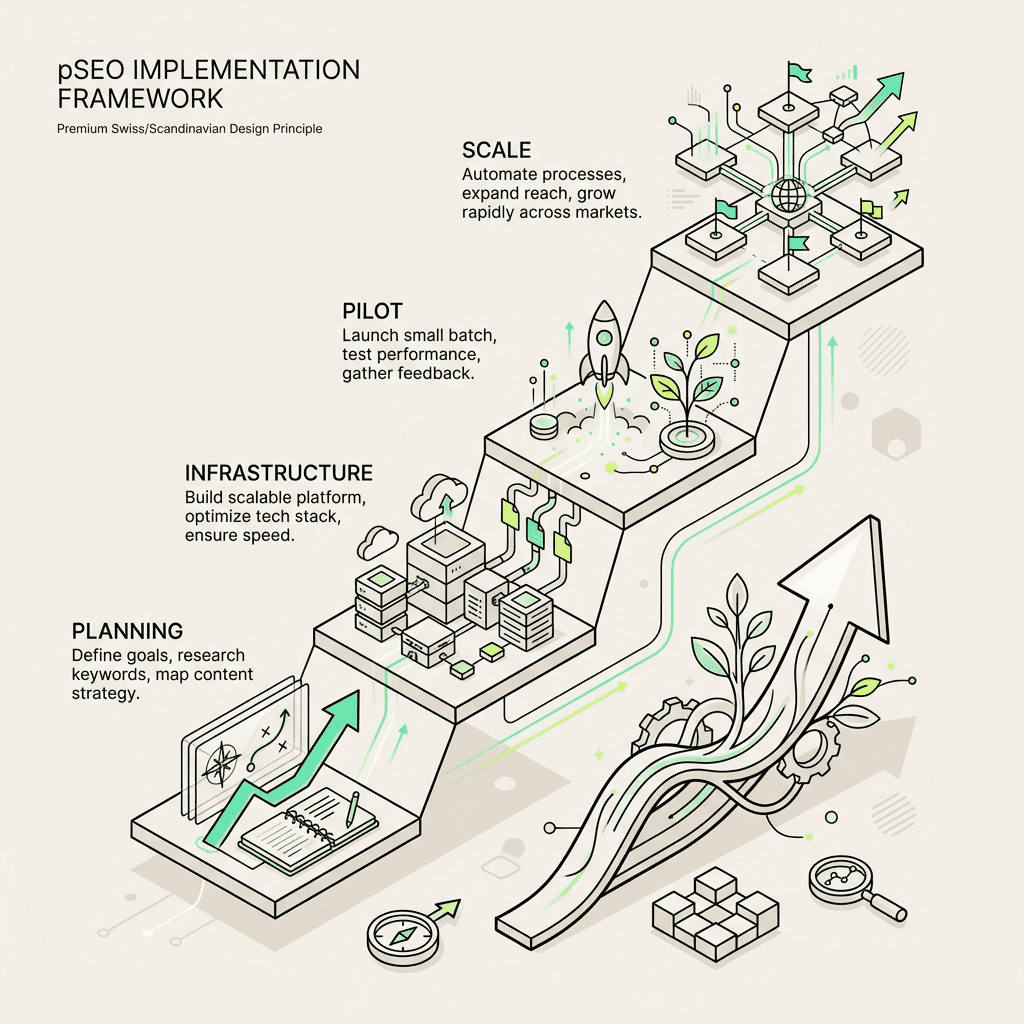
Phase 1: Planning (Week 1-2)
Define target keyword clusters and query intent using a keyword research tool
Identify data sources for each page type
Set minimum thresholds (percentage and field count)
Create page-generation spec document
Audit competitor pSEO approaches for inspiration
Conduct keyword research to identify relevant keywords and head terms
Map out URL structure for your website
Phase 2: Infrastructure (Week 3-4)
Set up pipelines and APIs to your database
Build or configure generation system (AI + templates)
Implement checks for quality assurance
Create staging environment for testing
Set up monitoring in Search Console and analytics
Configure your CMS or spreadsheet integration
Phase 3: Pilot (Week 5-6)
Generate 50-100 test pages to create pages for evaluation
Manual review of sample pages
Submit to Google Search Console
Monitor index coverage and initial rankings
Gather user feedback and engagement metrics
Check organic traffic and website traffic patterns
Phase 4: Scale (Week 7+)
Generate full page set (hundreds or thousands)
Publish in batches to monitor impact
Continuously monitor signals
Iterate on templates based on performance
Document learnings and refine process
Target potential customers through strategic optimization
Ongoing Maintenance
Weekly: Monitor index coverage and manual action notifications
Monthly: Audit sample of pages for degradation
Quarterly: Refresh sources and update template
Annually: Full pSEO system audit and strategy review
The Future of Programmatic SEO: Generative Engine Optimization
As online search evolves beyond traditional blue links — with Google's AI Overviews, ChatGPT search, and other generative engine optimization (GEO) interfaces — programmatic SEO must adapt.
Key shifts:
From keyword targeting to entity relationships: Pages must establish clear entity connections (Product X → solves Problem Y → for Industry Z)
From page views to answer sourcing: Success means being cited in AI-generated answers, not just ranking #1
From link building to data authority: Structured information, citations, and freshness matter more than backlinks
From static pages to dynamic personalization: Systems that adapt content to user context will win
AI agents for marketing are positioned for this future: they can generate content that's not just optimized for search engines but also structured for AI consumption, with clear entity relationships and citation-worthy information.
Conclusion: Scale With Integrity
Programmatic SEO in 2026 is not about gaming the system — it's about scaling genuine value. The old tactics of template swaps and doorway pages are dead. The new playbook requires:
Real differentiation through distinct information per page
Automated checks to maintain standards at scale
Transparency and auditability in your generation process
User-first design that serves intent, not just rankings
When done right, pSEO remains one of the most powerful growth channels available. It allows you to systematically capture long-tail traffic, serve niche audiences, and leverage information assets that competitors can't replicate.
The tools have evolved. The bar has risen. But the opportunity is bigger than ever — especially for teams that embrace AI workflows and platforms like Metaflow to build systems with built-in compliance and controls.
The question isn't whether to do programmatic SEO. It's whether you'll do it with integrity.
FAQs
What is programmatic SEO (pSEO)?
Programmatic SEO is the automated creation of hundreds or thousands of pages from templates plus structured data (databases, APIs, spreadsheets) to target many related long-tail queries. In 2026, “good” pSEO looks like unique, data-backed destination pages (e.g., listings, integrations, comparisons), not keyword-swapped clones. The key is that each page satisfies a specific search intent on-page.
Does programmatic SEO still work in 2026?
Yes—programmatic SEO still works when each page provides distinct information and clear user value beyond what a SERP already shows. Sites win by combining real data, synthesis, and strong UX, then publishing only pages that meet quality thresholds. The failure mode is scaling thin pages that exist mainly to manipulate rankings.
What is Google’s “scaled content abuse” and why does it matter for pSEO?
Scaled content abuse is Google’s spam classification for producing many near-duplicate pages primarily to influence rankings rather than help users. It commonly includes doorway pages, “{{city}} swap” templates, and thin AI pages with minimal differentiation. If your pSEO system triggers this, you risk broad deindexing and long recovery cycles.
How is modern AI changing programmatic SEO?
AI enables pSEO pages to include genuinely different insights per URL—like local market stats, product feature deltas, review synthesis, and scenario-based recommendations—rather than repeating the same boilerplate. The practical shift is from “render a template” to “generate a page-specific narrative from multiple sources.” Used well, AI supports both uniqueness and usefulness at scale.
What makes a programmatic page “high quality” (and not a doorway page)?
A high-quality programmatic page is the destination: it answers the query fully without forcing users to click elsewhere to get the real information. It contains unique, query-specific data (tables, calculations, comparisons, local context), transparent sourcing, and helpful internal links. A doorway page mostly repeats generic text and funnels to a single CTA or another page.
What are good programmatic SEO examples in 2026?
Zillow-style property pages work because each URL is differentiated by MLS-backed attributes (price, photos, history, neighborhood and school context). Zapier-style integration pages work because the combination of two apps produces specific workflows, setup guidance, and use cases. NerdWallet-style comparison pages work because personalization and calculators turn structured inputs into distinct, decision-support content.
What automated QA checks should a pSEO pipeline run before publishing?
At minimum, score pages for similarity/uniqueness against the set, minimum word count appropriate to intent, and “source diversity” (e.g., 3+ independent inputs like product data + reviews + local stats). Add readability, keyword-stuffing flags, internal link rules, and schema validation (e.g., making sure structured data passes common validators). Only publish/index pages that pass, and route failures to rewrite or human review.
How do you measure if your pSEO launch is healthy after publishing?
Track index coverage (what % of generated URLs Google indexes), search performance (impressions, CTR, average position), and engagement (time on page, bounce/return-to-SERP behavior). Sudden indexing drops, many URLs in “Crawled—currently not indexed,” or weak engagement across a template type are common signs of thin/duplicative pages. Use those signals to refine your page spec and regenerate underperforming cohorts.
How can Metaflow help build safer programmatic SEO at scale?
Metaflow can implement pSEO as parameterized agent workflows where each page run logs inputs, generation steps, and QA decisions, creating an auditable compliance trail. That makes it easier to enforce rules like uniqueness thresholds, minimum distinct fields, and schema validity before anything is published. It also helps you iterate systematically by tracing exactly why a page passed or failed and updating the workflow rather than hand-fixing thousands of URLs.