







TL;DR: Key Takeaways
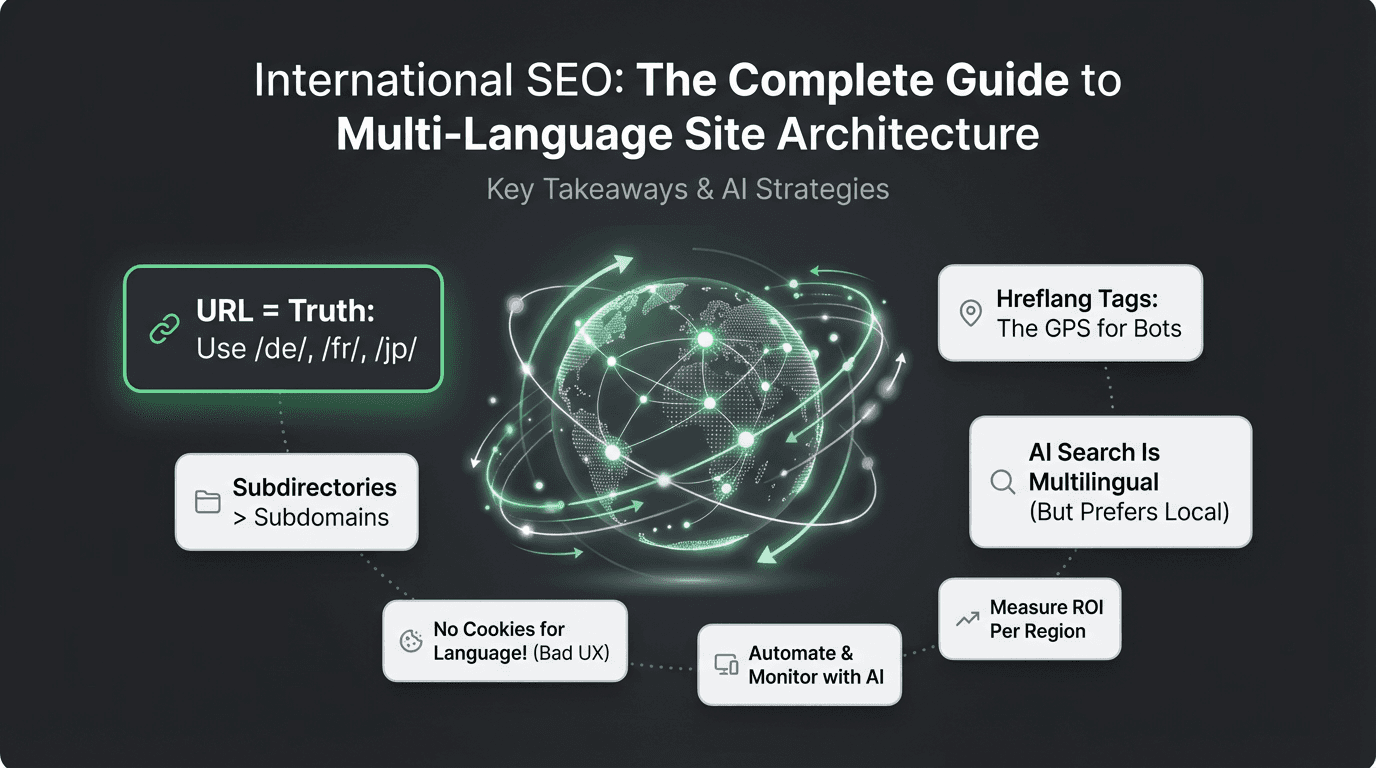
Use URL-based language differentiation (ccTLD, subdomain, or subdirectory)—never rely on cookies or browser detection
Subdirectories (example.com/de/) offer the best balance of SEO effectiveness, cost efficiency, and operational simplicity for most businesses
Implement hreflang tags correctly on all pages with language variants to prevent duplicate content issues and ensure proper indexing
Build clear governance models defining ownership, translation workflows, and quality tiers for each region
AI search is multilingual by default—ChatGPT and other LLMs can cite your English pages for non-English queries, but localized material wins when available
Leverage AI automation to monitor citation patterns across languages, detect localization gaps, and prioritize translation efforts by revenue opportunity
Avoid common mistakes like automatic IP-based redirects, poor translation quality, inconsistent hreflang, and duplicate content problems
Measure success per region tracking organic traffic, rankings, conversions, AI citations, and ROI to optimize your global strategy and maximize results
Expanding your business across borders is one of the most powerful growth levers available today. But without a solid international SEO strategy, even the best products and services can remain invisible to global audiences. Whether you're targeting customers in Tokyo, Berlin, or São Paulo, the technical foundation of your multi-language website will determine whether search engines—and increasingly, AI systems—can properly understand, index, and serve your content to the right people.
In this comprehensive guide, we'll walk you through everything you need to know about optimizing for global search visibility, from choosing the right URL structure to building a governance model that scales. You'll learn the critical differences between ccTLD, subdomain, and subdirectory approaches, discover how to avoid common pitfalls like cookie-based language switching, and understand how AI is fundamentally reshaping multilingual search, especially with the rise of ai workflows for growth.
Why Multi-Language Site Architecture Matters More Than Ever
When Google crawls your website, it needs clear signals about which pages serve which language and region. Get this wrong, and you'll face duplicate content issues, confused search rankings, and wasted crawl budget. Get it right, and you unlock organic traffic from dozens of global markets simultaneously.
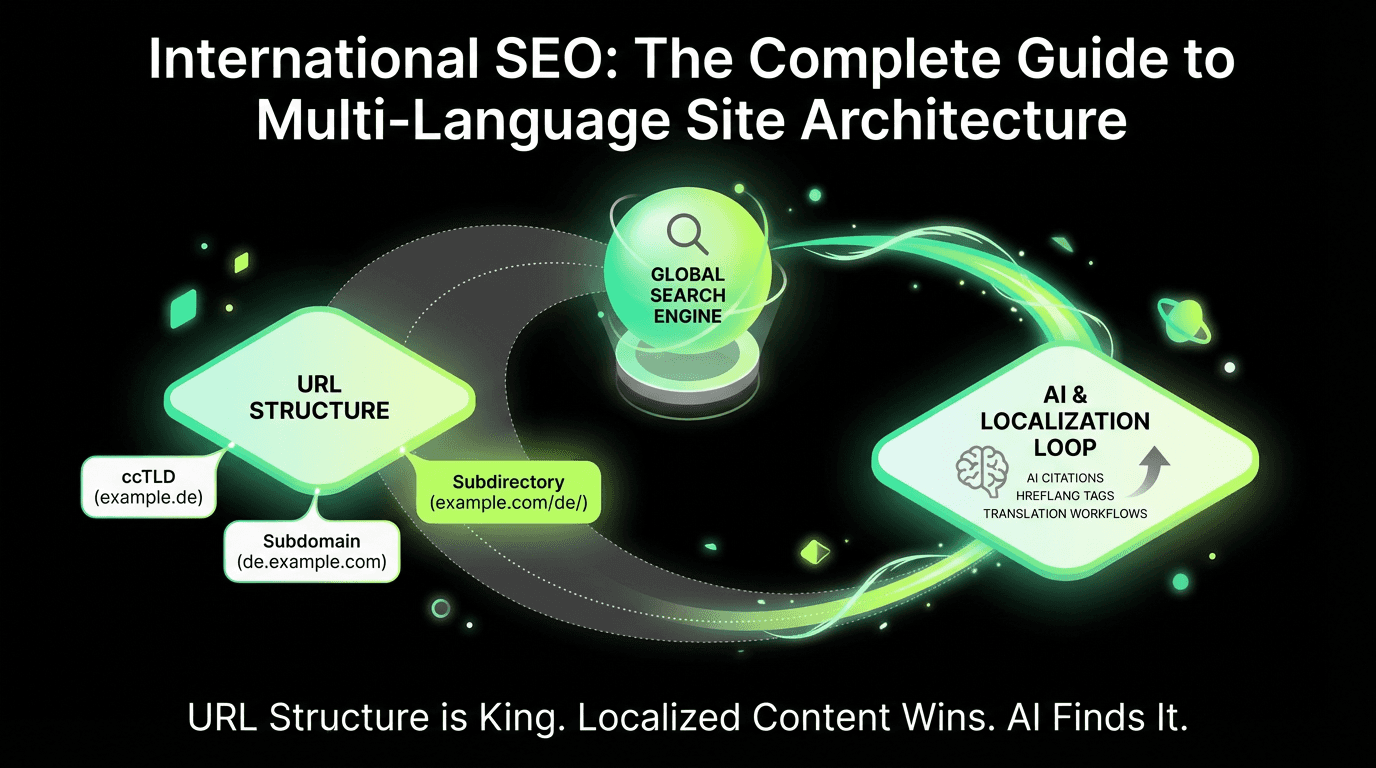
The stakes are even higher in 2026. AI for SEO has transformed how web content gets discovered and cited. ChatGPT, Perplexity, and other AI search engines answer queries in the user's language regardless of your source material's original language. English-only pages can now get cited for Spanish, Japanese, or Arabic queries. But here's the catch: when high-quality localized material exists, large language models strongly prefer it. This means your optimization checklist must now account for both traditional search engines and AI retrieval systems, often requiring the use of advanced ai tools for marketing.
Understanding the Three Core URL Structures for International Sites
Google's official guidance is unambiguous: use different URLs for different languages. Cookie-based or JavaScript-only language switching is invisible to search engines and creates a poor user experience. Let's break down your three primary options for multilingual site structure.
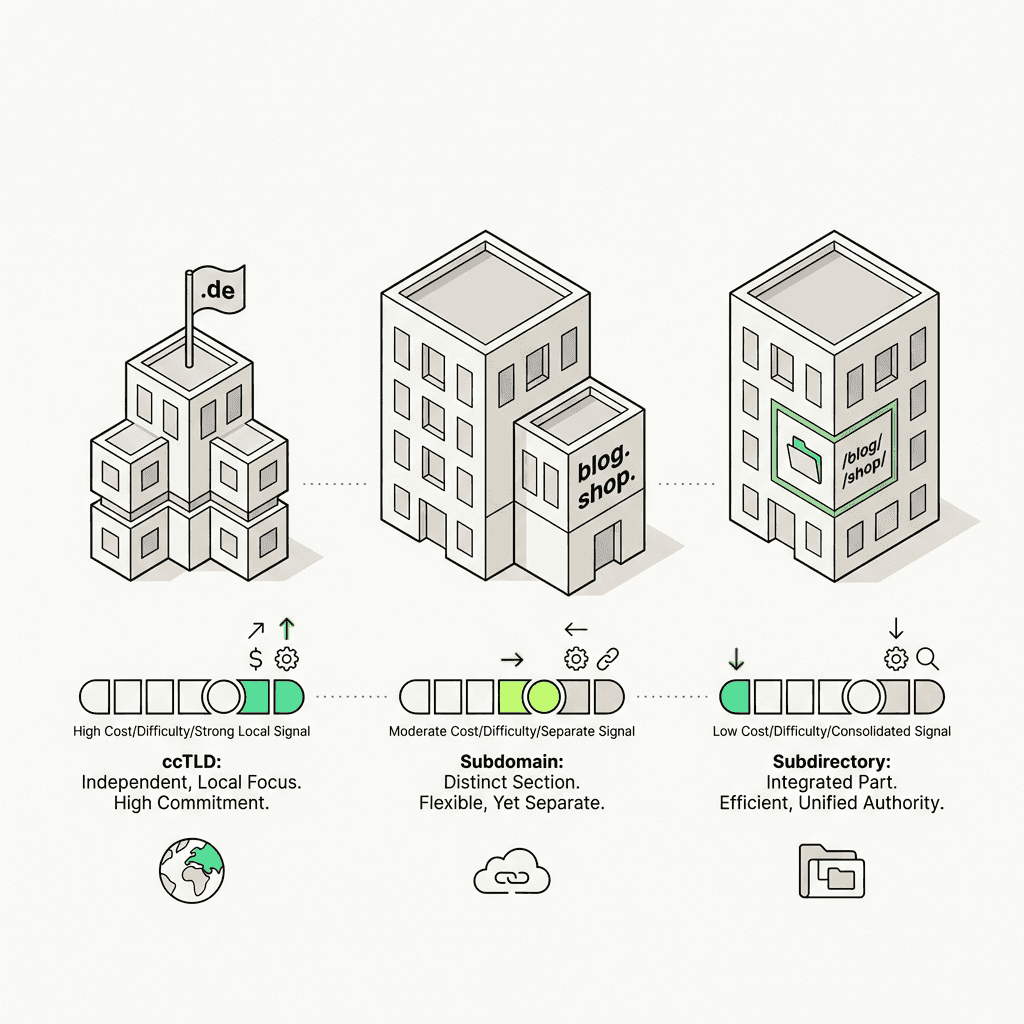
ccTLD (Country Code Top-Level Domain)
A ccTLD approach means registering separate domains for each target country: example.de for Germany, example.fr for France, example.jp for Japan. This is the strongest geographic signal you can send to search engines and provides excellent technical SEO benefits.
Advantages:
Maximum geo-targeting clarity for both users and search engines
Builds local trust (users prefer local domains
Allows hosting in-country for faster page speed and better performance
Complete independence for local SEO strategies and link building campaigns
Strong signal for ranking in specific regions
Disadvantages:
Expensive to acquire and maintain multiple domains
Each domain starts with zero domain authority and requires separate backlink profiles
Requires separate link-building efforts for each property
Higher technical overhead and infrastructure costs
More complex analytics and report generation
This approach works best for large enterprises with dedicated teams, significant budgets, and long-term commitment to specific global markets. Think Amazon (amazon.de, amazon.co.uk, amazon.fr) or major brands with country-specific operations.
Subdomain Structure
The subdomain approach places each language or regional variant on a separate subdomain: de.example.com, fr.example.com, jp.example.com. This sits between ccTLDs and subdirectories in terms of both signal strength and complexity.
Advantages:
Easier to set up than multiple ccTLDs
Can host subdomains on different servers/locations for better speed
Some separation between markets for testing different strategies
Moderate geo-targeting signal when combined with Google Search Console settings
Disadvantages:
Search engines treat subdomains as separate sites
Domain authority doesn't fully transfer between subdomains
More complex than subdirectories
Requires careful Google Search Console configuration
Subdomains make sense when you need technical separation—perhaps different markets use different CMS platforms, or you want to isolate risk while testing new markets. Using an ai workflow builder can help manage and streamline these technical differences across regions.
Subdirectory (Subfolder) Structure
The subdirectory approach keeps everything under one domain: example.com/de/, example.com/fr/, example.com/jp/. This is increasingly the recommended method for most organizations pursuing global expansion.
Advantages:
All pages benefit from the main domain's authority
Simpler to implement and maintain with less technical SEO overhead
Centralized hosting and infrastructure
Easier analytics and report tracking
Lower cost and technical overhead
Better for building consolidated backlink profiles
Disadvantages:
Weaker geo-targeting signal than ccTLDs
Must rely on hreflang tags and Google Search Console for location targeting
All markets share the same domain reputation (good or bad)
Hosting location affects all markets equally
For most businesses—especially those in the growth phase—subdirectories offer the best balance of SEO effectiveness, cost efficiency, and operational simplicity. Companies like Airbnb, Shopify, and HubSpot use this approach successfully, often supported by ai powered marketing automation for efficiency.
The Architecture Decision Matrix: Choosing Your Path
Selecting the right structure isn't about which is "best" in absolute terms—it's about which aligns with your resources, goals, and constraints. Here's a practical guide to help with your decision:
Choose ccTLD if:
You have substantial budget and technical resources
You're committed to major markets for the long term
You have or plan to build local teams in each region
Local trust and brand perception are critical
You need in-country hosting for compliance or performance requirements
Choose subdirectories if:
You're testing new markets or in growth phase
You want to leverage existing domain authority
You prefer operational simplicity and lower costs
You have centralized teams managing SEO
You're targeting multiple markets without massive differentiation
Choose subdomains if:
Different markets require different technical infrastructure
You're using different CMS or platforms per region
You need clear separation for organizational or testing reasons
You want some independence but can't justify full ccTLDs
Geo-Targeting SEO: Beyond URL Structure
Your URL structure is just the foundation. Effective geo targeting SEO requires multiple reinforcing signals that tell search engines exactly who your pages serve. Leveraging ai agents for marketing can help automate and optimize these geo-targeting efforts.
Hreflang Implementation
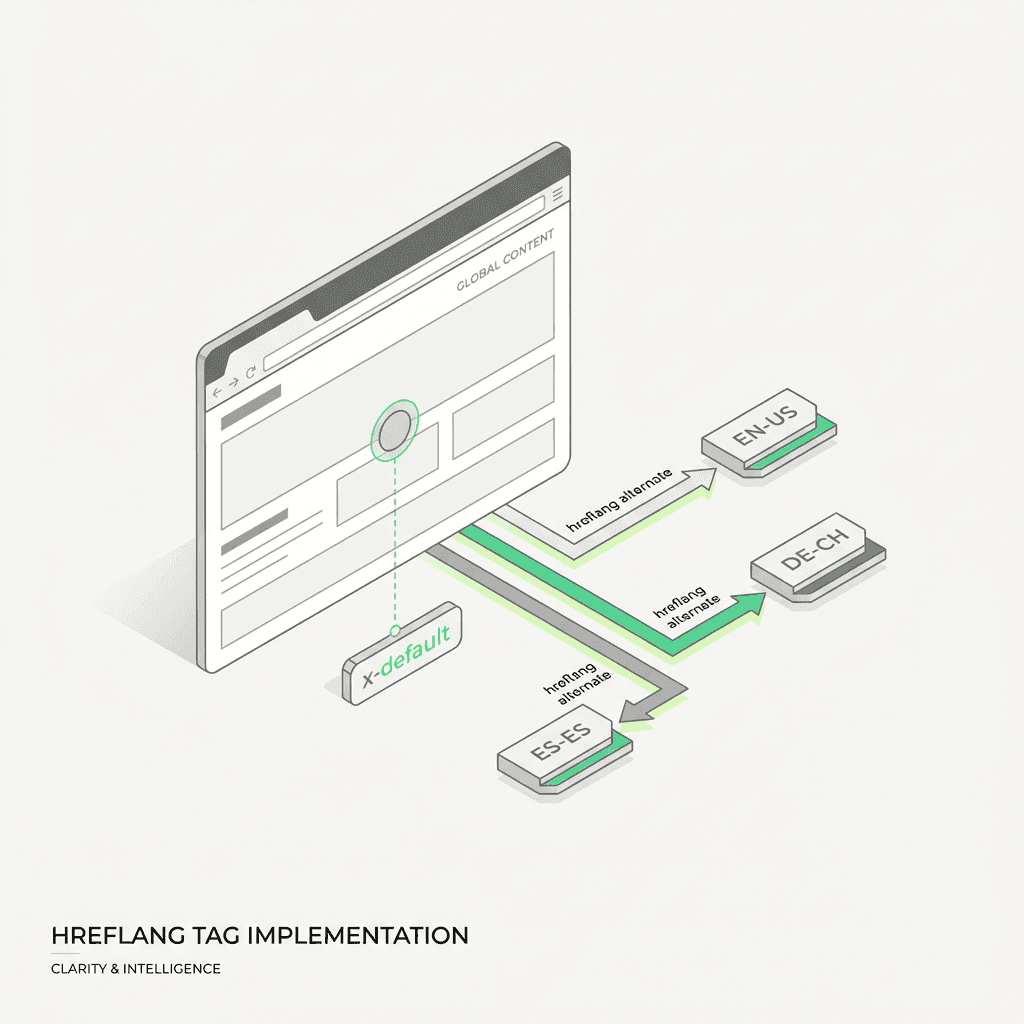
Hreflang tags are HTML annotations that specify the language and optional region for each page, plus all its alternates. They prevent duplicate content problems and ensure users see the right version in search results.
The `x-default` tag specifies which version to show users who don't match any specific language combination. Every page should include hreflang tags pointing to all its language variants, and those tags must be reciprocal—if page A points to page B, page B must point back to page A.
Google Search Console Geographic Targeting
For subdirectories and subdomains (not ccTLDs, which are inherently geographic), set your target country in Google Search Console. This reinforces your URL signals and helps Google understand your intent for better ranking performance.
On-Page Localization Signals
True localization goes far beyond translation. Search engines look for best practices including:
Language declaration in HTML: ``
Local currency and units: Euros and kilometers for Europe, dollars and miles for the US
Contact information for the region: Local phone numbers and addresses
Regional references: Culturally relevant examples, case studies, and imagery
Proper date and time formats: DD/MM/YYYY vs MM/DD/YYYY
These signals collectively tell search engines—and users—that your material was genuinely created for their region, not just machine-translated. Incorporating ai productivity tools for marketing can streamline and enhance these localization efforts.
Governance and Content Ownership: The Operational Foundation
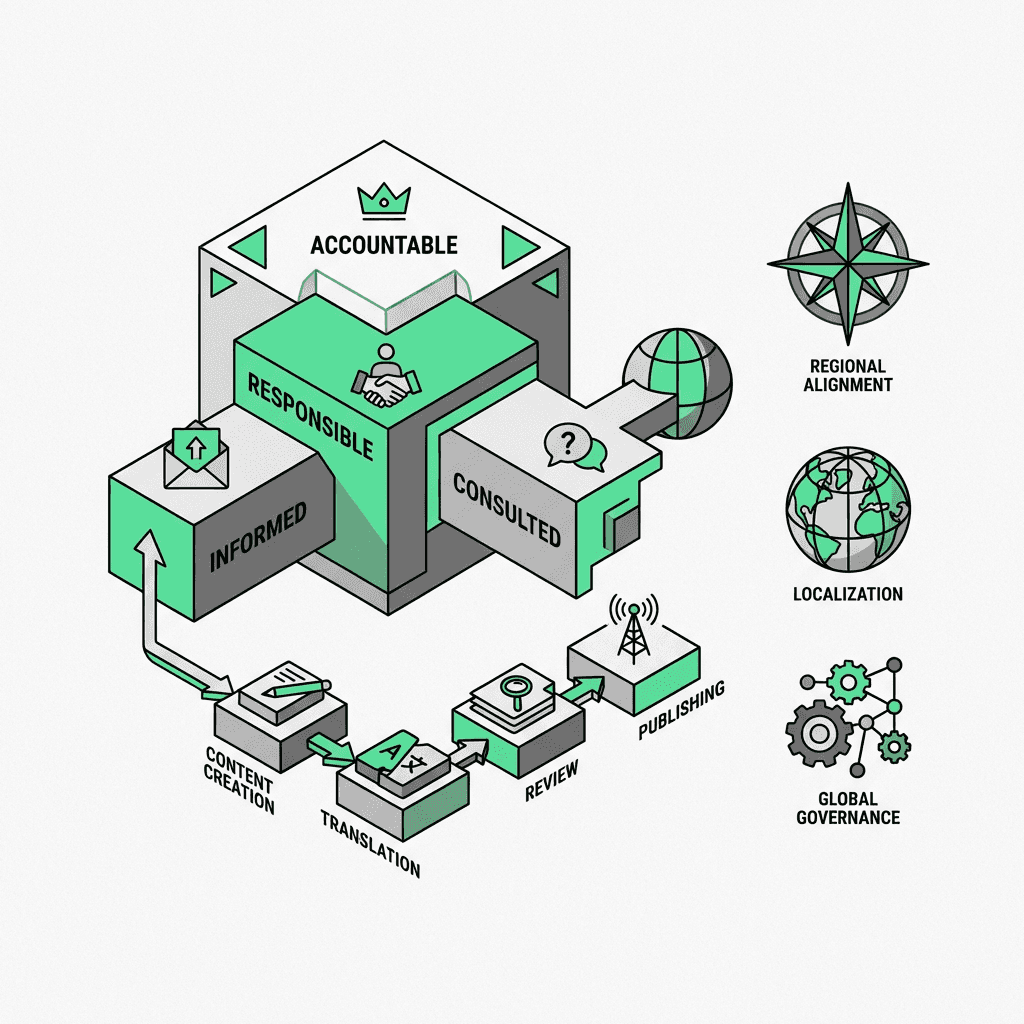
Even the most technically perfect setup will fail without clear governance. Who owns creation for each region? Who approves translations? How do you maintain consistency across regions while allowing local relevance?
Centralized vs. Distributed Models
Centralized governance means a core team creates master material, manages translation, and enforces brand standards. This ensures consistency and quality but can feel slow and disconnected from local markets.
Distributed governance empowers teams in each region to create and manage their own material within brand guidelines. This enables local relevance and speed but risks inconsistency and duplicated effort.
Most successful programs use a hybrid approach: centralized strategy and core material with distributed execution and local adaptation.
Translation Workflow Planning
Your translation method profoundly impacts both quality and velocity:
Human translation: Highest quality, best for marketing and sales material, but expensive and slow
Professional localization: Includes cultural adaptation beyond literal translation, ideal for key pages
Machine translation with human review: Faster and cheaper, good for support documentation and large volumes
Pure machine translation: Fastest and cheapest, acceptable only for user-generated material or very low-stakes pages
Build your workflow around tiered priorities. Your homepage, key product pages, and conversion paths deserve professional localization. Blog archives and help documentation might work fine with machine translation plus light review.
Content Ownership Mapping
Create a clear RACI matrix (Responsible, Accountable, Consulted, Informed) for each region:
Who creates new material?
Who translates or localizes it?
Who reviews for quality and brand alignment?
Who publishes and maintains it?
Who owns optimization for each region?
This organizational clarity prevents bottlenecks, duplicated work, and material that falls through the cracks. Tools such as a no-code ai workflow builder can support these processes by automating task assignments and tracking progress through your workflow.
Avoiding the Cookie Trap: Why Dynamic Language Switching Fails
Google's guidance is crystal clear: don't use cookies, browser settings, or IP-based detection as your primary language mechanism. Here's why this technique fails:

Search engines can't see it. Googlebot sees whatever your server delivers by default. If you show English to all users and only switch language via JavaScript after detecting browser settings, Google only indexes English pages.
It breaks sharing and linking. When a German user shares a link, a French user who clicks it might see German material based on the URL, then get a 301 redirect to French, creating confusion.
It prevents proper indexing. Without unique URLs per language, Google can't index your French, Spanish, or Japanese material separately. You lose the ability to rank in those markets and generate organic traffic.
It creates poor user experience. Users can't bookmark or share specific language versions. Back button behavior breaks. The experience feels unpredictable and frustrating.
Always use URL-based language selection with clear navigation that allows users to switch between versions. The URL should be the source of truth, not cookies or detection.
How AI Is Transforming Multilingual Search
The rise of AI search engines and large language models has fundamentally changed the landscape. ChatGPT, Claude, Perplexity, and Gemini are multilingual by default. They can read English material and answer in Japanese, or consume Spanish sources and respond in German.

This creates both opportunity and challenge. On one hand, your English pages can now get discovered and cited for queries in dozens of languages. You're no longer completely invisible in markets where you haven't localized.
On the other hand, when high-quality localized material exists, LLMs strongly prefer it. A well-written, culturally relevant German page will almost always be cited over a machine-translated or English-only alternative when answering German queries.
The implication: ai marketing automation platform adoption must now monitor not just traditional ranking data, but AI citation patterns across languages. Which markets are discovering your site in AI systems? Where are you getting cited, and where are competitors winning? Where would localized material unlock significant new visibility?
The Metaflow Opportunity: AI Agents for Global SEO Intelligence
This is where AI marketing automation platforms like Metaflow become invaluable. Traditional monitoring requires manual tracking of rankings across dozens of keyword combinations, periodic translation audits, and gut-feel decisions about which markets deserve investment.
A Metaflow AI agent can automate this entire intelligence layer:
Monitor AI citation patterns across languages to see where your material appears in ChatGPT, Perplexity, and other LLM responses
Detect localization gaps by identifying markets where you're getting discovered but lack proper localized pages
Prioritize translation efforts by revenue opportunity, combining search volume data, AI citation frequency, and conversion potential
Track competitor localization to see which markets they're investing in and where you have whitespace opportunities
Generate dashboards showing performance metrics, gap analysis, and recommended next actions for each region
Instead of quarterly manual reviews, you get continuous intelligence that surfaces high-impact opportunities as they emerge. The agent orchestrates data collection from search APIs, AI systems, and your analytics tool, then synthesizes it into actionable recommendations.
This is the future of global SEO strategy: human strategists focused on high-level decisions and creative localization, while AI agents handle monitoring, analysis, and opportunity detection. Metaflow's natural language ai agent builder makes this accessible without engineering resources—growth teams can design and deploy these workflows themselves.
Practical Steps: Implementing Your Multi-Language Site Architecture
Ready to build or improve your presence across multiple markets? Follow this tactical roadmap and checklist:
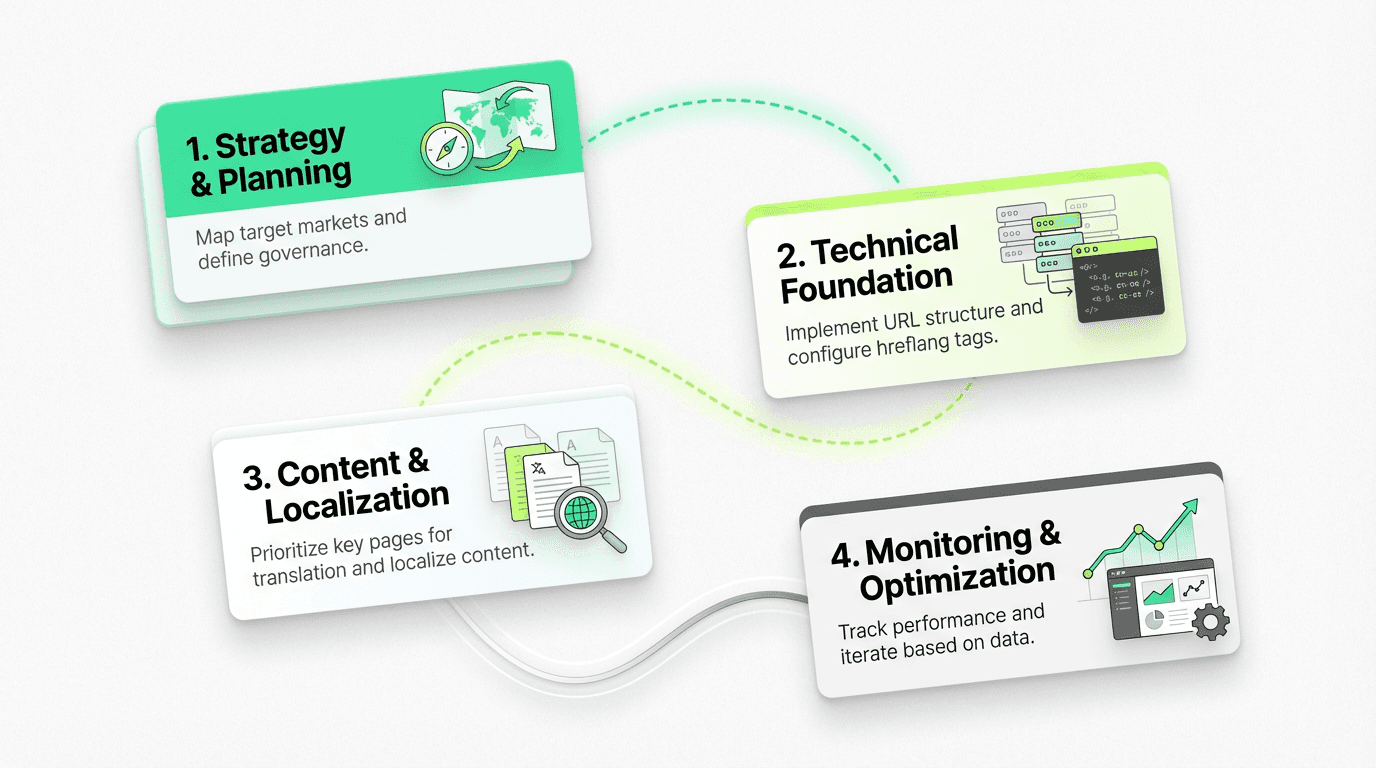
Phase 1: Strategy and Planning (Week 1-2)
Audit current state: Document existing pages, URL structures, and performance metrics
Define target markets: Prioritize based on business opportunity, not just population size
Choose URL structure: Use the decision matrix above based on your resources and goals
Map ownership: Create RACI matrix for each region
Design translation workflow: Define quality tiers and processes
Phase 2: Technical Foundation (Week 3-4)
Implement URL structure: Set up subdirectories, subdomains, or ccTLDs
Configure hreflang tags: Implement on all pages with language variants to prevent duplicate content issues
Set Google Search Console targeting: Configure geographic targeting for each property
Add language declarations: Update HTML lang attributes on every page
Create language switcher: Build clear, accessible navigation between versions
Phase 3: Content and Localization (Week 5-8)
Prioritize pages for translation: Start with highest-traffic and highest-conversion pages
Execute translation: Use appropriate quality tier for each type
Localize on-page elements: Update currency, units, contact info, examples with regional details
Optimize metadata: Translate and localize title tags, meta descriptions, and header tags
Build local backlinks: Begin outreach and link building campaigns in target markets
Phase 4: Monitoring and Optimization (Ongoing)
Track rankings per region: Monitor keyword performance in each language using your SEO tool
Analyze traffic patterns: Identify which markets are growing and which need attention
Monitor AI citations: Track where your site appears in LLM responses
Identify gaps: Find high-opportunity markets lacking localized material
Iterate and improve: Continuously refine based on performance data and KPIs, leveraging ai powered workflows for ongoing optimization.
Common Mistakes to Avoid
Even experienced teams make these errors that hurt visibility and performance:
Automatic redirects based on IP: Let users choose their language; don't force it based on location. A Japanese person traveling in the US might still want Japanese material.
Duplicate content across markets: Don't just copy English material to all subdirectories. Google will see this as duplicate and may not index it properly, hurting your crawl budget.
Inconsistent hreflang implementation: Hreflang must be reciprocal and complete. Missing or incorrect tags cause indexing problems and error messages in Google Search Console.
Ignoring local search engines: Google dominates most markets, but Yandex in Russia, Baidu in China, and Naver in South Korea require specific optimization techniques.
Poor translation quality: Machine translation without review creates terrible user experience and damages brand perception, reducing conversion rates.
Neglecting mobile in emerging markets: Many users globally are mobile-first or mobile-only. Ensure excellent mobile experience and responsive design.
Forgetting about local hosting: Page speed matters everywhere. Consider CDNs or hosting in each region for better performance and core web vitals, and use a marketing automation platform to monitor and optimize technical KPIs.
Measuring Success: KPIs for Global SEO
Track these metrics to understand whether your strategy is working and delivering ROI:
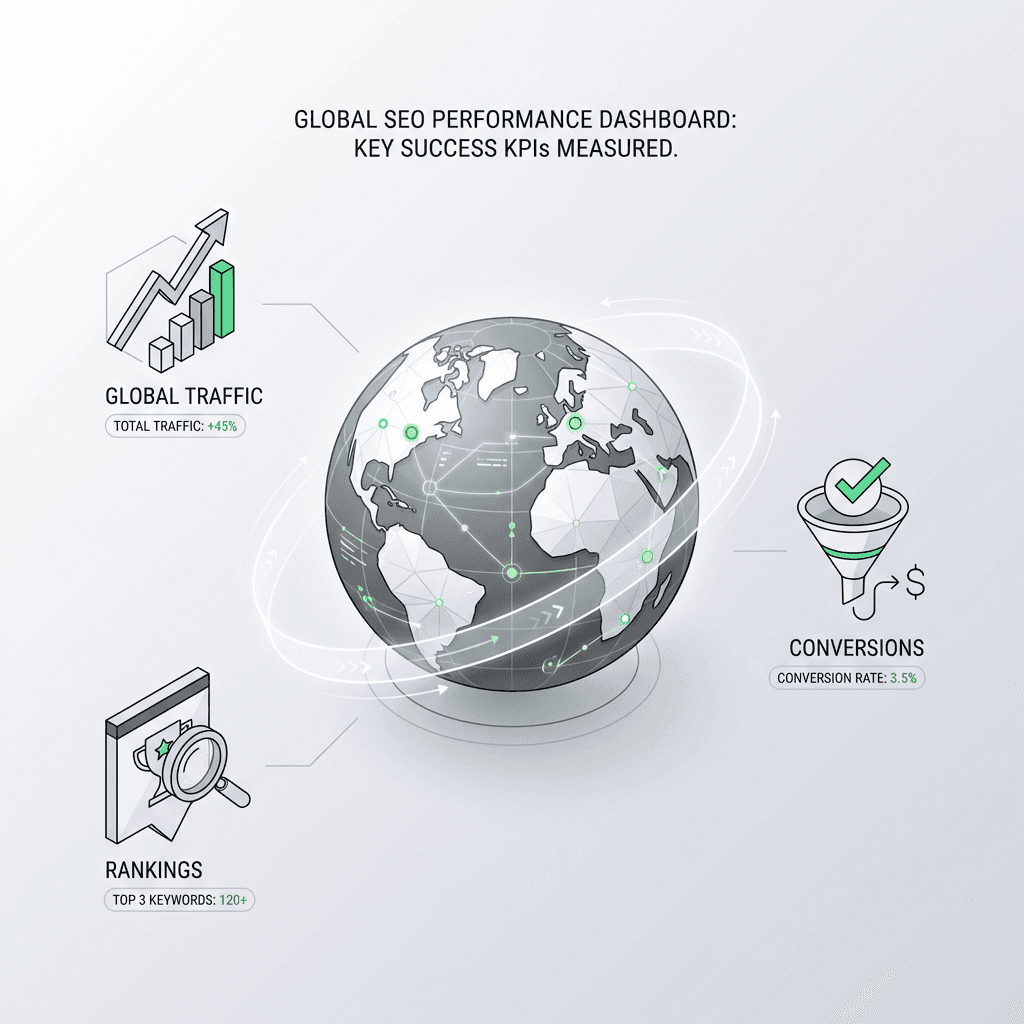
Organic traffic per region: Overall growth and market-specific trends showing visibility gains
Rankings for target keywords: Per language and region to measure competitive performance
Conversion rate by region: Some markets may drive traffic but not convert, indicating localization issues
Crawl efficiency: Ensure search engines are discovering and indexing all language versions in your XML sitemap
Hreflang errors: Monitor Google Search Console for implementation problems
AI citation frequency: How often your site appears in LLM responses, per language
Localization ROI: Revenue per region vs. localization investment to guide budget decisions
Page speed per region: Technical performance and core web vitals for users in each location
Set up dashboards that show both global overview and per-market deep dives. This allows strategic portfolio management while enabling tactical optimization for specific regions. Advanced ai tools for content marketing can help automate and enhance these measurement processes, providing better data for decision-making.
The Future: AI-Native Global Content Strategy
Looking ahead, the distinction between traditional SEO and AI-aware strategy will blur. As AI systems become the primary discovery layer for information, your material needs optimization for both traditional search engines and LLM retrieval.
This means:
Structured, semantic writing that AI can easily parse and understand
Entity-rich material that clearly identifies people, places, products, and concepts
Authoritative citations that build trust signals AI systems recognize
Multilingual entity alignment ensuring your brand and products are properly identified across languages
Continuous monitoring of how AI systems cite and represent your site
The organizations that win globally will be those that combine technical SEO best practices with AI-aware strategy, supported by automation that makes this complexity manageable at scale. Success will require a comprehensive framework that addresses both traditional ranking factors and emerging AI discovery patterns.
FAQs
What is international SEO and why is it important?
International SEO refers to the process of optimizing your website to attract organic traffic from search engines in different countries and languages. It's crucial for businesses looking to expand globally, as it ensures your content is discoverable and relevant to diverse audiences, ultimately driving better engagement and conversions.
What is the best URL structure for a multilingual website?
The best URL structure for a multilingual website often depends on your specific needs, but generally, subdirectories (e.g., example.com/de/) offer a good balance of SEO effectiveness and operational simplicity. They allow all pages to benefit from the main domain's authority while maintaining clear signals for search engines.
How do hreflang tags work in multilingual SEO?
Hreflang tags are HTML annotations that help search engines understand the language and regional targeting of your web pages. By implementing hreflang correctly, you can prevent duplicate content issues and ensure that users are directed to the appropriate language version of your content.
What are common mistakes to avoid in international SEO?
Common mistakes include relying on cookie-based language switching, implementing inconsistent hreflang tags, neglecting mobile optimization, and using poor translation quality. These errors can lead to indexing issues, poor user experiences, and decreased visibility in search results.
How does AI impact multilingual search visibility?
AI systems, like ChatGPT, can process and respond to queries in multiple languages. This means that while your English content can be cited for non-English queries, having high-quality localized material significantly improves your chances of being favored by AI systems in search results.
What are the main advantages of using a ccTLD for international sites?
Using a ccTLD (country code top-level domain) provides maximum geo-targeting clarity, builds local trust, and allows for regional hosting, which can enhance page speed. However, it can be more expensive to maintain and requires separate SEO strategies for each domain.
How can I measure the success of my international SEO efforts?
Success can be measured through various KPIs, including organic traffic per region, keyword rankings, conversion rates by region, crawl efficiency, and AI citation frequency. Tracking these metrics helps identify opportunities for optimization and guides your global marketing strategy.