







TL;DR:
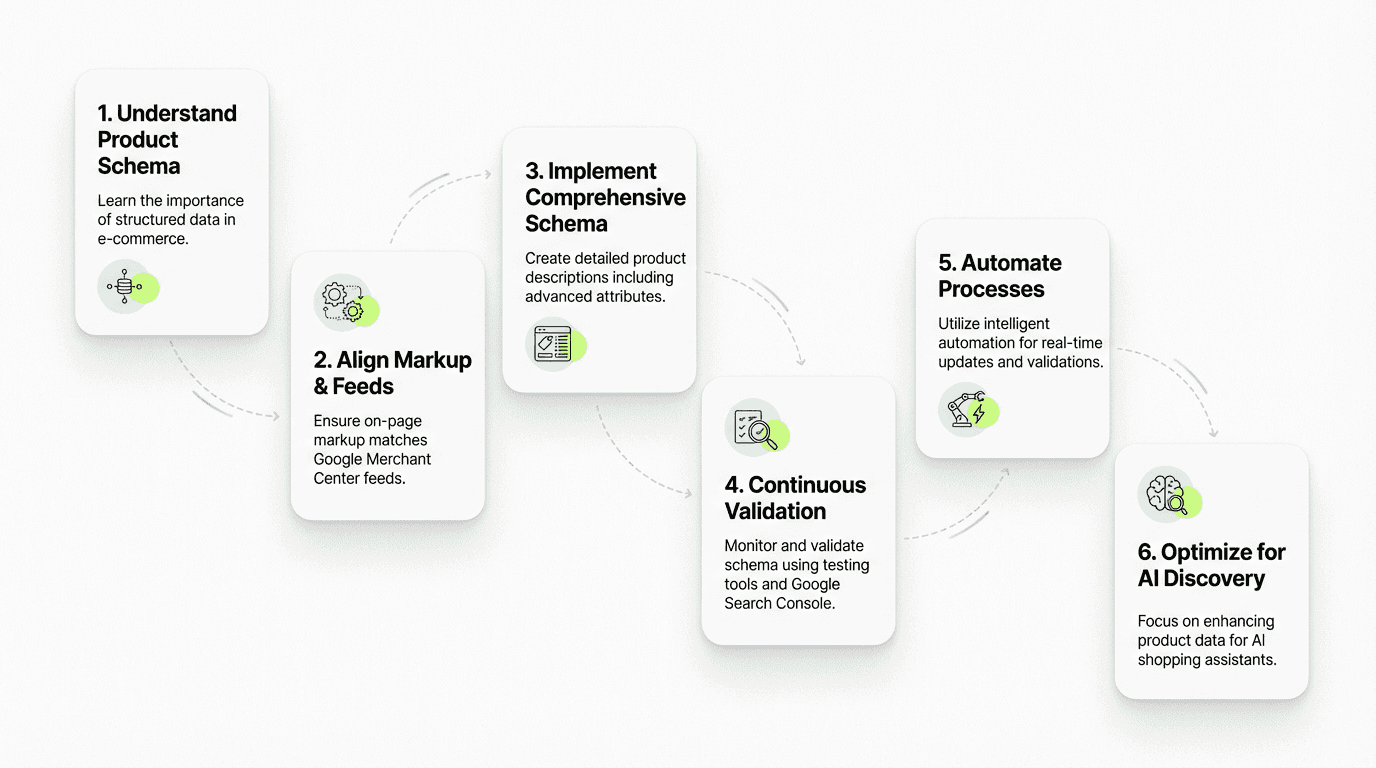
Product schema is essential infrastructure: Structured data markup using Schema.org Product type enables rich snippets, AI shopping assistant answers, and Merchant Center integration—pages without it get skipped in modern discovery.
On-page markup and Merchant feeds must align: Google cross-validates your implementation against Merchant Center feeds; mismatches in price, availability, or descriptions trigger disapprovals and reduce visibility across both organic and Shopping surfaces.
Rich attributes win in AI shopping: AI assistants like Google Shopping AI pull from detailed properties (materials, dimensions, compatibility, ratings) to answer specific buyer queries—comprehensive markup creates competitive advantage.
Validation is continuous, not one-time: Use Rich Results Test for initial validation, then monitor Google Search Console's Product report for errors, warnings, and performance trends; set up alerts for feed-markup drift.
Scale requires intelligent automation: Manual management breaks down beyond a few hundred SKUs; AI-powered pipelines (like Metaflow agents) can validate markup, detect mismatches, enrich attributes, and synchronize feeds in real time.
Prioritize high-value products for deep enrichment: Implement baseline implementation (name, price, availability) universally via templates, then invest in detailed `additionalProperty` fields for high-margin, competitive, or technically complex items where rich information drives conversions.
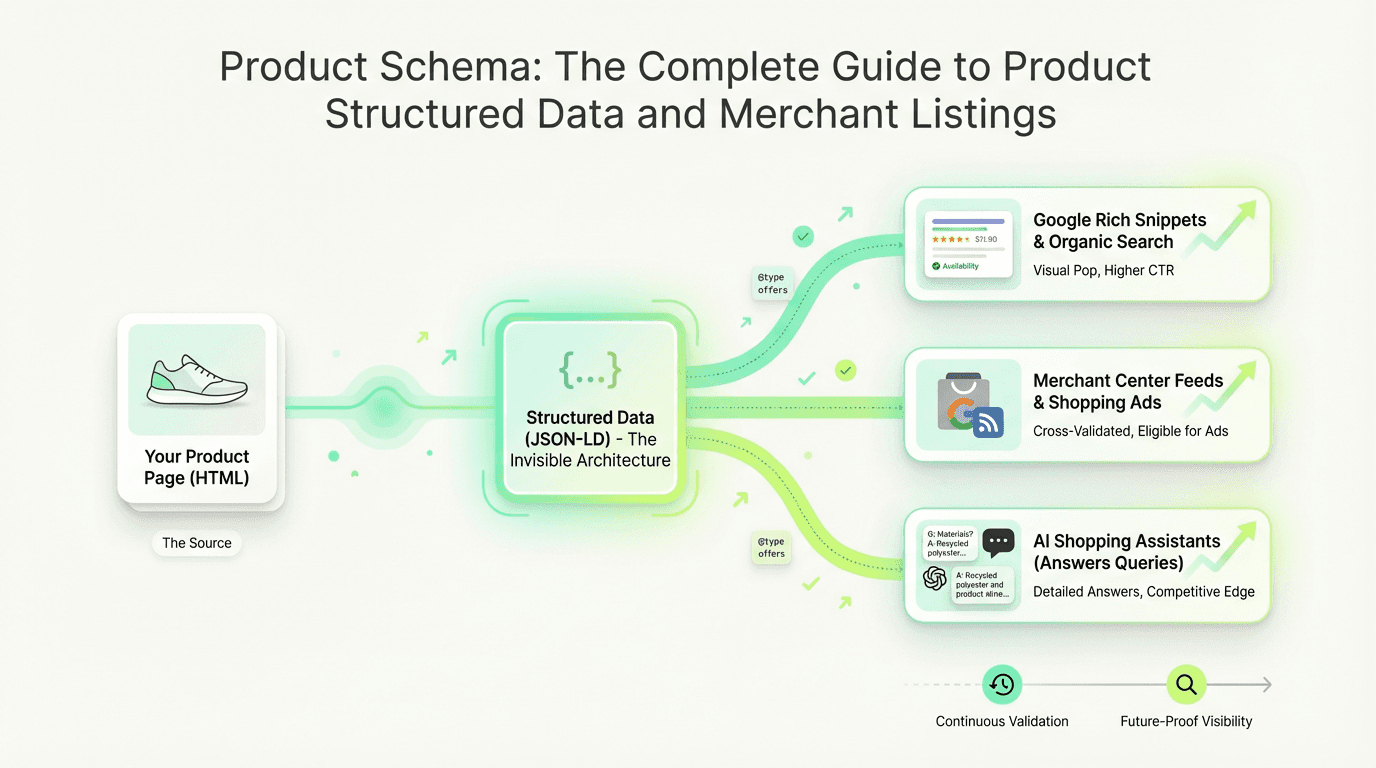
In the evolving landscape of ecommerce SEO, schema markup has become the invisible architecture that determines whether your products appear in Google's rich shopping experiences—or get lost in the noise. With 390 monthly searches and low competition, "product schema" represents a strategic opportunity that many ecommerce teams still overlook. Yet the stakes have never higher: AI shopping assistants like Google Shopping AI and Amazon Rufus now pull directly from structured product data to answer buyer queries, and pages with thin markup simply get skipped.
This guide will walk you through everything you need to know about product schema markup, from basic implementation to advanced validation techniques, and show you how to align your on-page structured data with Merchant Center feeds to maximize your eligibility for product rich results across both traditional search and emerging AI shopping surfaces.
What Is Product Schema and Why It Matters for Ecommerce
Product schema is a specific type of structured data markup that helps search engines understand the key attributes of products on your website. Using the Schema.org vocabulary—specifically the `Product` type—you're essentially creating a machine-readable label that tells Google, Bing, and AI systems exactly what you're selling, at what price, and whether it's in stock.
Think of structured data as the difference between handing someone a crumpled receipt versus a neatly organized spreadsheet. Both contain information, but only one is immediately actionable at scale.

When properly implemented, product schema markup helps Google systems use this information to generate rich snippets in search results—those eye-catching listings that display star ratings, prices, and availability directly in the SERP. But the benefits extend far beyond visual appeal. Schema markup creates eligibility for:
Product rich results with pricing, reviews, and availability badges
Google Merchant Center integration and Shopping tab placement
AI shopping assistant responses that pull specific product attributes
Voice search optimization for discovery queries
Image search enhancements with metadata overlay
The technical foundation is surprisingly straightforward. At its core, a basic product schema generator output looks like this:
This JSON-LD snippet tells search engines three critical facts: what the item is, how much it costs, and whether customers can buy it right now. But as we'll explore, modern ecommerce demands far richer product information to compete in AI-driven shopping experiences.
Product Schema Markup vs Merchant Center Feeds: Understanding the Difference
One of the most common points of confusion in ecommerce SEO is the relationship between on-page schema and Google Merchant Center feeds. They're complementary systems that serve different purposes, and understanding this distinction is crucial for maximizing your visibility.
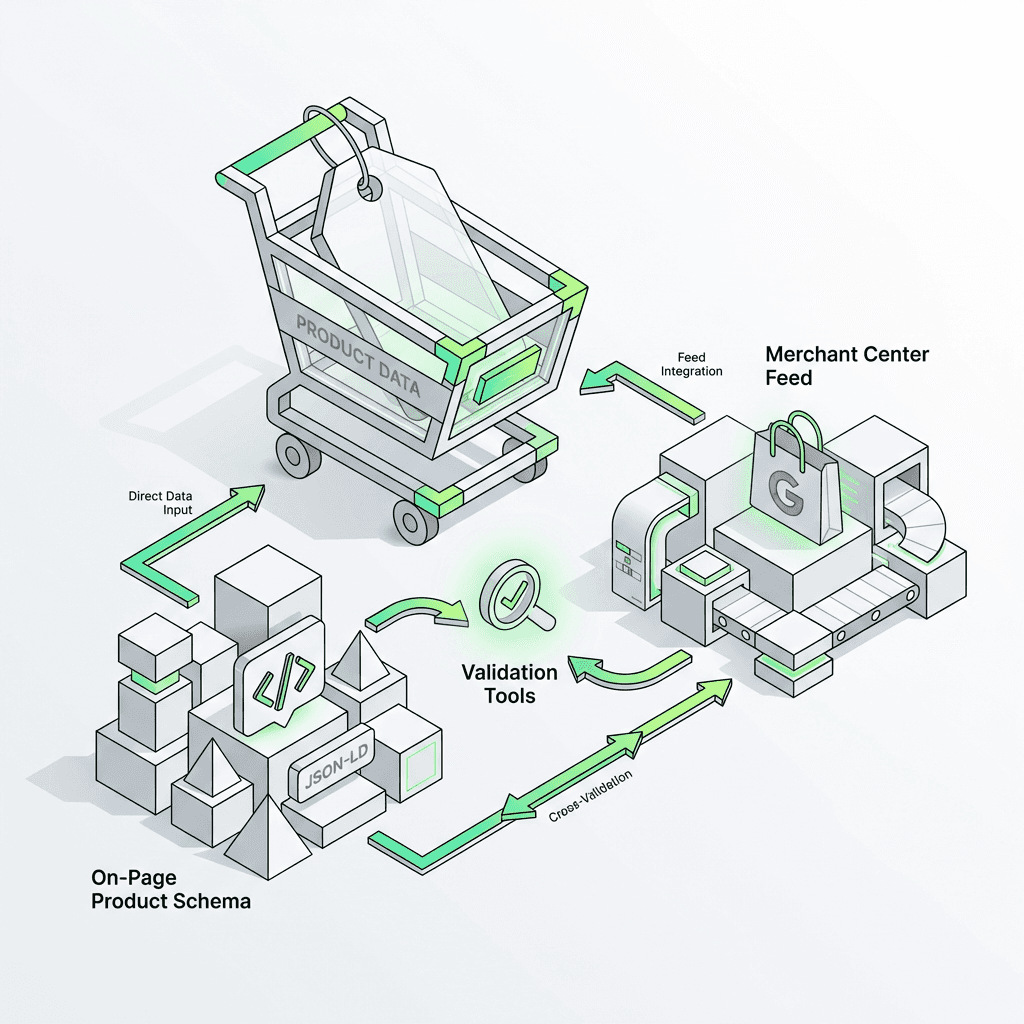
On-Page Product Structured Data
Schema markup lives directly in your HTML, typically implemented as JSON-LD in the `` or `` of each product page. This structured data:
Enables rich results in organic listings
Gets validated through Google's Rich Results Test
Appears in Google Search Console's "Enhancements" reports
Works independently of any merchant feed submission
Can include detailed attributes like materials, dimensions, and compatibility
Merchant Center Feed
A Merchant Center feed is a separate catalog file (XML, CSV, or API-based) that you submit directly to Google Merchant Center. This feed:
Powers Google Shopping ads and free listings
Appears in the Shopping tab and comparison features
Requires specific attributes like GTIN, brand, and product category
Updates on a scheduled basis (daily, hourly, or real-time via API)
Must match your on-page pricing and availability to avoid disapprovals
The magic happens when these two systems align. Google cross-references your merchant listings against your on-page markup to verify consistency. Mismatches—like a $79 price in your schema but $89 in your feed—trigger warnings and can reduce your eligibility for premium placements.
Implementing Product JSON-LD: From Basic to Advanced
Let's move from theory to practice. Implementing structured data correctly requires attention to both required and recommended properties, with an eye toward the rich attributes that AI shopping systems now prioritize.
Essential Product Schema Properties
Start with the foundational elements that Google requires for product rich results:
This covers the basics, but modern product pages should go further.
Advanced Attributes for AI Shopping Surfaces
AI shopping assistants answer specific buyer questions: "What materials is this made from?" "Will this fit my 15-inch laptop?" "Is this compatible with my device?" These queries require rich product attributes:
These detailed attributes transform your product page from a simple listing into a comprehensive resource that AI systems can confidently cite when answering shopper questions. Leveraging advanced ai workflows for growth allows ecommerce businesses to efficiently generate and maintain such rich, up-to-date information at scale.
Validating Product Schema with Testing Tools
Implementation is only half the battle. Validation ensures your schema markup actually works and qualifies for rich snippets. Google provides several testing tools, each serving a specific purpose in your validation workflow.
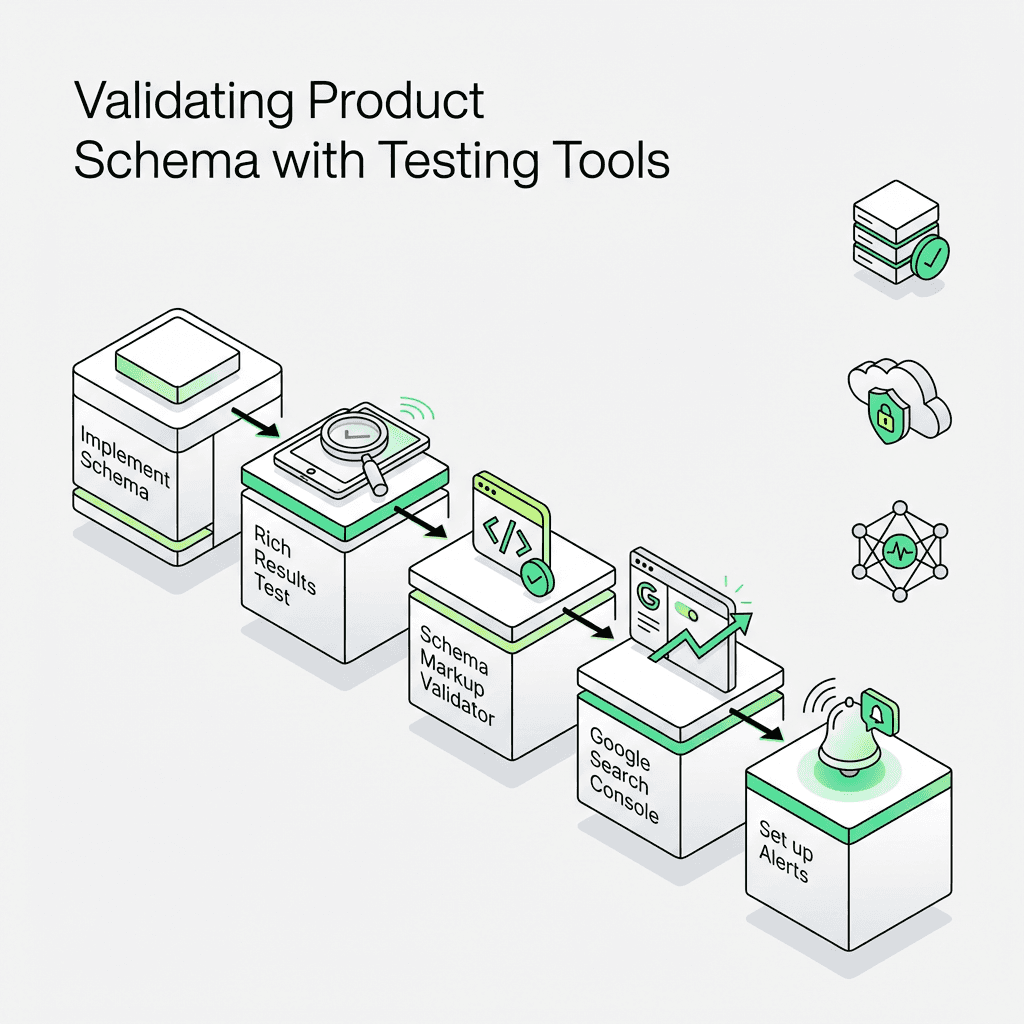
Rich Results Test
The Rich Results Test is your first line of defense. Paste your product page URL or raw HTML, and Google will show you:
Whether your markup is eligible for rich results
Specific errors or warnings in your implementation
A preview of how your item might appear in search results
Mobile vs desktop rendering differences
Pay close attention to warnings, not just errors. While warnings won't disqualify you from rich snippets, they often indicate missing recommended properties that could enhance your visibility.
Schema Markup Validator
For more technical debugging, use the Schema Markup Validator. This tool provides:
Line-by-line validation against Schema.org specifications
Detection of syntax errors in your JSON-LD code
Warnings about deprecated properties
Suggestions for additional relevant properties
Search Console Monitoring
Once your structured data is live, monitor it continuously through Google Search Console under "Enhancements > Product." This report shows:
Total product pages with valid markup
Error and warning trends over time
Specific URLs with issues
Impression and click information for rich results
Set up email alerts for new errors so you can catch feed-to-markup mismatches or implementation bugs before they impact visibility.
Connecting Your Merchant Center Feed to Product Markup
The true power of schema markup emerges when you align it with a properly configured Merchant Center feed. This integration maximizes your eligibility across Google's entire ecosystem—from organic rich snippets to Shopping ads to AI-powered comparisons.
Setting Up Your Merchant Center Feed
If you haven't already, create a Google Merchant Center account and set up your primary feed. Your feed must include these core attributes:
id: Unique identifier matching your SKU
title: Product name (should match your schema `name`)
description: Detailed product details
link: Canonical URL of the product page
image_link: Primary image URL
price: Current price with currency (must match schema `price`)
availability: in stock, out of stock, or preorder
brand: Manufacturer or brand name
gtin: Global Trade Item Number (UPC, EAN, or ISBN)
condition: new, refurbished, or used
Ensuring Feed-to-Markup Consistency
Google cross-validates your merchant listings against your on-page implementation. Discrepancies trigger warnings and can result in disapprovals. Create a validation checklist:
Price Alignment Your Merchant Center `price` field must match your schema `offers.price` within a reasonable margin (Google allows minor currency conversion differences but flags significant discrepancies).
Availability Synchronization If your markup shows `InStock` but your feed shows `out of stock`, Google may suppress both your Shopping listing and your organic rich result. Implement real-time inventory sync or schedule frequent feed updates.
Image Consistency While not strictly required to match, using the same primary image in both your feed `image_link` and schema `image` property creates a cohesive brand experience across touchpoints.
Description Harmony Your feed description doesn't need to be identical to your schema description, but they should tell the same story. Major contradictions confuse both algorithms and shoppers.
Automating Feed-Markup Validation
Manual cross-checking becomes unsustainable at scale. For stores with hundreds or thousands of SKUs, automated validation is essential. This is where an ai marketing automation platform is invaluable.
A Metaflow pipeline can continuously validate JSON-LD against Merchant Center feeds, detecting mismatches in price, availability, and descriptions in real time. The agent can flag discrepancies for review, automatically update feeds when on-page information changes, or even enrich product pages with AI-generated attribute descriptions pulled from your database—ensuring both Google and AI shopping surfaces always see accurate, comprehensive product information.
How AI Is Changing Product Discovery and Shopping
The rise of AI shopping assistants has fundamentally altered how consumers discover and evaluate items. Google Shopping AI, Amazon Rufus, and similar systems don't just match keywords—they understand buyer intent and answer specific questions by pulling directly from structured product data.
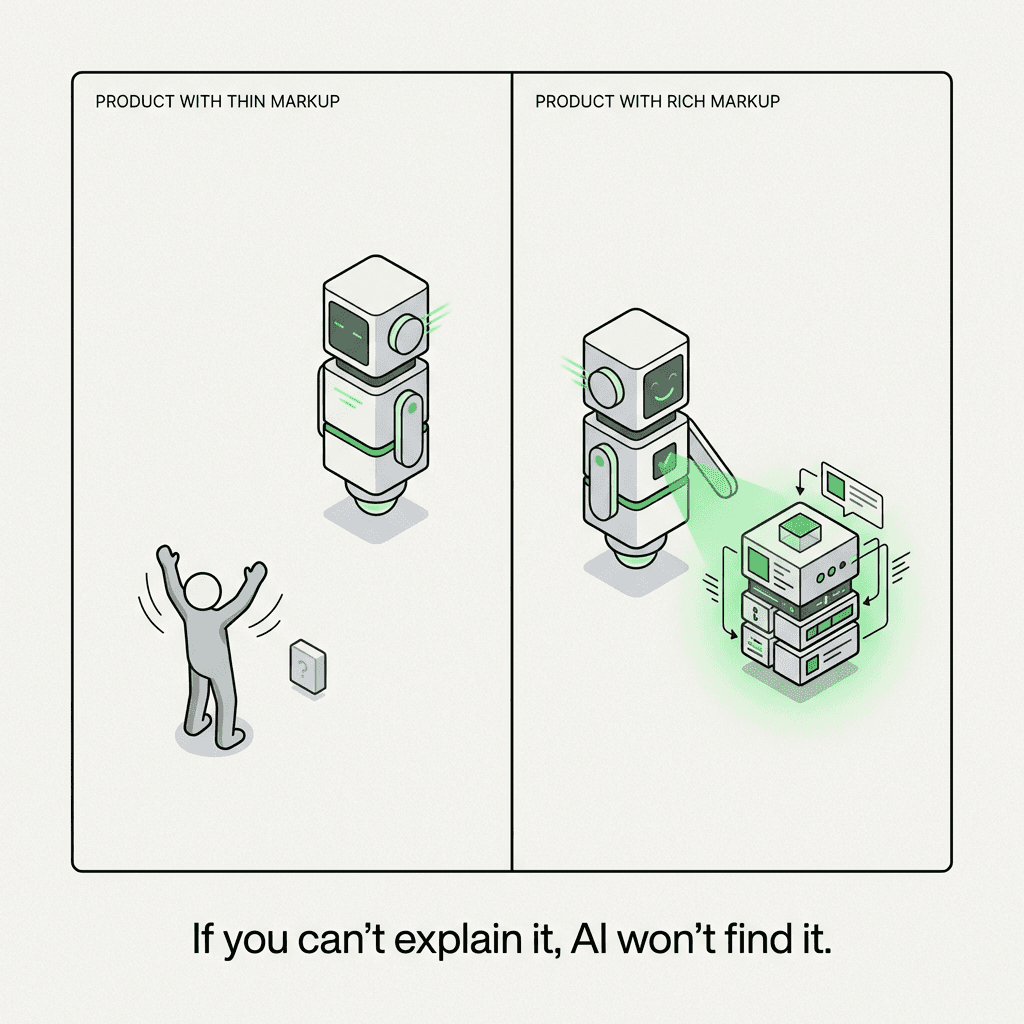
AI Shopping Assistants Pull from Structured Data
When a shopper asks Google Shopping AI, "What's the best running shoe for flat feet under $100?" the system doesn't scrape paragraphs of marketing copy. It queries structured fields:
`additionalProperty` for arch support product type
`offers.price` for price filtering
`aggregateRating` for quality signals
`material` and `weight` for comfort indicators
Items with thin or missing markup simply don't surface in these AI-mediated shopping experiences. The richer your implementation, the more queries you're eligible to answer.
Rich Attributes Drive AI Recommendations
Modern buyers ask nuanced questions: "Is this laptop bag compatible with a 16-inch MacBook Pro?" "What's the thread count of this sheet set?" "Does this coffee maker have a programmable timer?"
AI systems answer these questions by matching query intent to specific attributes. Pages that include detailed `additionalProperty` values, material specifications, dimensions, and compatibility information become the authoritative sources AI cites.
This shift rewards depth over keyword density. A product page with comprehensive structured markup but modest organic traffic can suddenly become a high-conversion entry point when AI shopping assistants start recommending it.
The Competitive Moat of Complete Product Data
Here's the strategic insight most ecommerce teams miss: complete schema markup creates a sustainable competitive advantage. While competitors chase link-building and content marketing, you can claim AI shopping real estate by simply being more thorough with your implementation.

Consider two competing items:
Product A: Basic markup with name, price, and availability Product B: Rich markup with materials, dimensions, weight, care instructions, compatibility, sustainability certifications, and 15+ additional properties
When an AI shopping assistant evaluates which item best answers a specific buyer question, Product B wins every time—not because it's a better product, but because it's better documented.
AI SEO Tools and Product Data Optimization
The complexity of managing schema markup at scale—especially across dynamic inventories with frequent price changes, stock fluctuations, and seasonal variations—has created demand for ai productivity tools for marketing that can automate validation, enrichment, and synchronization.
Automated Schema Generation and Validation
Traditional generators produce static markup that quickly becomes outdated. Modern AI for SEO approaches treat product information as a living pipeline:
Extraction: AI pulls attributes from databases, PDFs, supplier feeds, and existing content
Enrichment: Natural language generation creates detailed descriptions for `additionalProperty` fields
Validation: Automated testing checks implementation against Rich Results Test and Merchant Center requirements
Synchronization: Real-time updates keep on-page markup aligned with inventory systems
Monitoring: Continuous Google Search Console tracking flags new errors or eligibility drops
This pipeline approach transforms schema markup from a one-time implementation project into an ongoing optimization system.
Detecting and Resolving Feed-Markup Mismatches
Price discrepancies between your implementation and merchant listings are among the most common causes of Shopping ad disapprovals and lost rich result eligibility. Manual audits are time-consuming and error-prone, especially for catalogs with daily price changes or dynamic promotional pricing.
AI-powered validation agents can:
Compare schema `offers.price` against Merchant Center feed `price` fields in real time
Flag discrepancies that exceed acceptable thresholds
Automatically update feeds when authoritative on-page prices change
Generate alerts for out-of-stock items still showing `InStock` in markup
Identify products with rich on-page information but missing from Merchant Center feeds
Enriching Product Pages with AI-Generated Attributes
One of the most labor-intensive aspects of comprehensive schema markup is populating detailed attribute fields—materials, dimensions, compatibility, care instructions, sustainability certifications. For large catalogs, manually writing these descriptions is impractical.
AI content generation can extract attributes from databases, supplier specifications, and manufacturer documentation, then format them into proper Schema.org properties. A Metaflow agent, for instance, can pull raw specs from your PIM system, identify which attributes map to valuable properties, generate natural-language descriptions, and inject the enriched markup into your pages—all without manual intervention.
This automated enrichment doesn't just save time; it creates the comprehensive product information that AI shopping assistants require to confidently recommend your items.
Monitoring Product Schema Performance in Search Console
Implementation and validation are just the beginning. Ongoing monitoring through Google Search Console ensures your structured data continues to perform and helps you identify optimization opportunities.
Tracking Product Rich Result Impressions
Navigate to Google Search Console > Enhancements > Product to see your markup performance. Key metrics to monitor:
Valid items: Total product pages with error-free implementation
Items with warnings: Pages that qualify for rich snippets but could be improved
Invalid items: Pages with errors that disqualify them from rich results
Impressions: How often your rich results appear in search
Clicks: How many users click through from rich results
Compare impression and click trends against your implementation timeline. You should see growth in both metrics as you roll out richer markup and resolve validation issues.
Identifying High-Value Optimization Opportunities
Use the Google Search Console Product report to prioritize your optimization efforts:
Pages with warnings: These already qualify for rich snippets but could perform better with additional properties
High-impression, low-click items: May need better images, more compelling descriptions, or competitive pricing
Products with errors: Quick wins if the fixes are simple (missing required fields, formatting issues)
Products missing from the report: May lack implementation entirely or have bugs
Correlating Schema Changes with Traffic and Conversions
Schema markup optimization should ultimately drive business results. Set up custom Google Analytics 4 events to track:
Traffic from rich result clicks (filter by referrer or UTM parameters)
Conversion rates for users who enter via rich snippets vs standard organic listings
Revenue attributed to enhanced pages
These metrics help you quantify ROI and justify continued investment in optimization.
Best Practices for Product Schema at Scale
As your catalog grows, maintaining accurate, comprehensive markup requires systematic processes and, increasingly, intelligent automation.
1. Implement Schema at the Template Level
Rather than adding markup page by page, implement it in your CMS or ecommerce platform templates. Most modern platforms (Shopify, WooCommerce, Magento) support dynamic generation using database fields:
This ensures every product page automatically includes baseline markup that updates when information changes. Utilizing a no-code ai workflow builder can simplify the process of dynamically generating and managing implementation, even for non-technical teams.
2. Prioritize High-Value Products for Rich Attributes
While baseline implementation should be universal, investing in detailed `additionalProperty` enrichment for every SKU may not be practical. Prioritize:
High-margin items: Where improved visibility directly impacts revenue
Competitive categories: Where rich attributes differentiate you from competitors
Products with specific buyer questions: Technical items, compatibility-dependent products, specialty goods
3. Regularly Audit for Feed-Markup Drift
Even with automated synchronization, periodic manual audits catch edge cases and platform bugs. Monthly or quarterly, sample 20-30 items across different categories and verify:
On-page price matches current selling price
Availability status reflects actual inventory
Images are current and high-quality
Merchant Center feed shows same information
4. Leverage AI Agents for Continuous Optimization
The most sophisticated ecommerce operations are moving beyond static implementations to dynamic, AI-managed pipelines. A Metaflow agent can:
Monitor Google Search Console for new errors and automatically diagnose root causes
Detect when competitor items gain rich result features you're missing and suggest enhancements
Generate and deploy attribute-rich descriptions for new launches
Validate that seasonal pricing promotions update correctly in both markup and feeds
Alert merchandising teams when high-value items lose rich result eligibility
This shift from manual maintenance to intelligent automation frees growth teams to focus on strategic initiatives while ensuring product information remains accurate and comprehensive across all surfaces. For organizations seeking to streamline these processes, adopting the best ai tool for growth marketing can yield significant productivity gains.
Common Product Schema Mistakes to Avoid
Even experienced SEO teams make preventable errors that reduce effectiveness. Watch out for these common pitfalls:
Mistake #1: Hardcoding Prices in Static Schema
If you implement markup as static HTML rather than dynamically pulling from your database, promotional prices and inventory changes won't update. This creates feed-markup mismatches that trigger Merchant Center disapprovals.
Mistake #2: Using Generic Product Names
A name like "Running Shoe" is technically valid but misses SEO and user experience opportunities. Use descriptive, specific names: "Ultra Boost Running Shoe - Men's Size 10 - Midnight Black."
Mistake #3: Omitting Review and Rating Markup
`aggregateRating` and `review` properties are optional but highly valuable. Items with star ratings in search results see significantly higher click-through rates. If you have customer reviews, include them in your implementation.
Mistake #4: Mixing Product and Offer Types Incorrectly
The `offers` property should use `@type: Offer` for single items or `@type: AggregateOffer` for products with multiple variants (sizes, colors). Using the wrong type can cause validation errors or display issues.
Mistake #5: Ignoring Mobile Rendering
Always test your implementation on mobile devices using the Rich Results Test mobile preview. Some implementations render correctly on desktop but break on mobile due to JavaScript loading issues or responsive design conflicts.
The Future of Product Schema and AI Shopping
As AI shopping assistants become more sophisticated, schema markup will evolve from a nice-to-have SEO tactic to a fundamental requirement for ecommerce visibility. Several trends are accelerating this shift:
Multimodal Product Understanding
Future AI systems will combine structured information with computer vision analysis of images, video demonstrations, and user-generated content. Items with comprehensive markup that aligns with visual content will have an advantage in these multimodal environments.
Conversational Commerce Integration
Voice assistants and chat-based shopping interfaces rely entirely on structured information to answer questions. As conversational commerce grows, schema markup becomes the primary interface between your catalog and AI shopping agents.
Sustainability and Ethics Attributes
Emerging properties for sustainability certifications, ethical sourcing, and environmental impact will become ranking factors as AI systems incorporate ESG considerations into recommendations.
Real-Time Inventory and Dynamic Pricing
The line between markup and merchant feeds will blur as real-time inventory APIs and dynamic pricing systems demand instant synchronization across all surfaces. AI agents for marketing will play a pivotal role in maintaining this real-time accuracy and helping teams respond quickly to changes.
Ecommerce teams that treat structured product information as a strategic asset—investing in comprehensive attributes, automated validation, and continuous enrichment—will capture disproportionate share in AI-mediated shopping experiences.